
Stanford HAI shares a key insight about effective AI deployment: the strongest systems are those that optimize human-AI collaboration rather than defaulting to full automation. The post emphasizes that AI systems should be designed with the ability to determine when to act autonomously, when to defer to human judgment, and how to communicate uncertainty effectively. This principle positions human oversight not as a limitation but as a core design feature for reliable AI deployment.
The Institute of Biomedical Engineering (IBME) at Oxford highlights its research into Human-AI Collaboration (HAIC), an emerging field focused on how humans and AI systems can work together to achieve outcomes that surpass what either could accomplish alone. In HAIC systems, the AI can serve as an assistant, peer, or tutor to the human, requiring capabilities such as explainability, safe and responsible functioning, and an understanding of how to interact effectively with human users.
The research also emphasizes the importance of studying how human behavior changes in response to HAIC systems. The team, led by Alison Noble and Konstantinos Kamnitsas, is developing imaging-focused HAIC methods and systems to support healthcare applications. This work sits within the broader Biomedical Image Analysis group at IBME, connecting technical AI themes with clinical and translational goals.
Bernard Marr argues that AI will not replace humans but rather serve as a powerful tool for augmentation. He points to several fundamental limitations of AI: it cannot truly understand or experience emotional intelligence, it lacks the ability to conceive genuinely novel ideas, and it cannot make ethical or value-based judgments. While AI excels at processing data and identifying patterns, the human brain's ability to read context, make intuitive leaps, and understand nuanced societal needs remains unmatched.
Rather than framing the AI revolution as a zero-sum competition, Marr advocates for a human-AI partnership model. As AI automates routine and repetitive tasks, humans are freed to focus on higher-value work — strategic thinking, relationship building, and creative problem-solving. He contends that success in this new era belongs to those who develop distinctly human skills that complement AI, and that our humanity — our ability to connect, create, and care — becomes more valuable, not less, as technology advances.

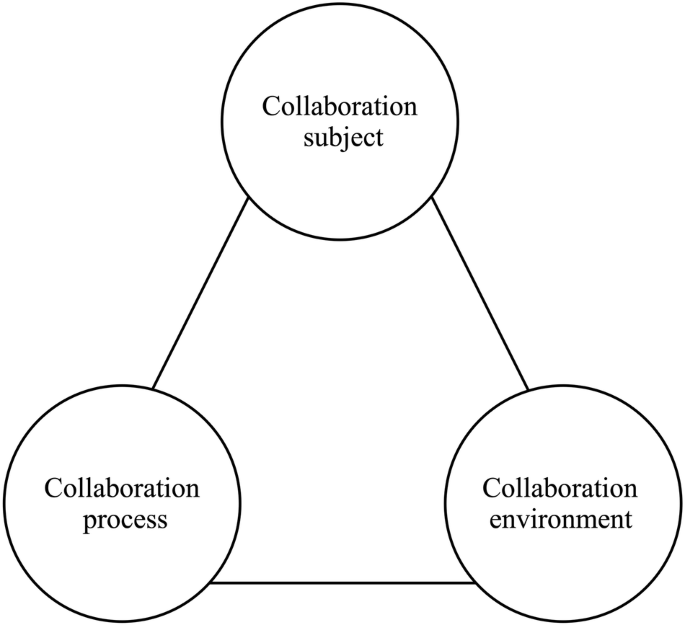
This study introduces the Human–AI Synergy Degree Model (HAI-SDM) to evaluate and understand collaboration between human teachers and AI systems (specifically educational robots) in hybrid intelligence learning environments. The researchers propose that effective human–AI classroom collaboration can be analyzed through three subsystems: collaboration subject (teachers, students, and AI machines), collaboration process (goals, methods, and teaching processes), and collaboration environment (space–time structure, infrastructure, and key technologies). The model draws on Haken's synergetics theory to measure both the order degree within each subsystem and the synergy degree across the entire system.
A case study was conducted in an eighth-grade English class in Beijing, China, involving 40 students, one teacher, and an educational robot across 12 teaching activities over a 40-minute lesson. The findings reveal that the order degree between human teacher and AI machines remains at a moderate level with dynamic fluctuations, while the synergy degree fluctuates between low and moderate levels. This suggests that while the three subsystems develop in a relatively orderly fashion individually, one subsystem may exhibit disordered behavior relative to the others, undermining overall collaboration effectiveness. The research highlights the need for more deliberate design strategies to optimize human–AI collaboration in classrooms and provides a quantitative framework that moves beyond purely technological assessments of AI in education toward evaluating the systemic dynamics of human–AI interaction.
Assistant Professor Mina Lee at the University of Chicago and collaborators from Cambridge, Princeton, NYU, The Alan Turing Institute, and MIT have published a perspective study reimagining AI not as a passive tool but as a "thought partner" for humans. The research proposes three core desiderata for effective AI collaboration: the model should understand the user, the user should understand the model, and both should share an understanding of the world. Central to this vision is a Bayesian framework that models human reasoning by accounting for uncertainty and adapting iteratively to individual users' needs, preferences, and cognitive limitations — a marked departure from current one-size-fits-all AI systems.
The study outlines practical applications across multiple domains. In programming, a Bayesian AI could model a coder's flawed mental model and help patch conceptual bugs. In storytelling, it could infer whether a writer is brainstorming, drafting, or polishing and tailor suggestions accordingly. In medicine, it could account for clinicians' time constraints and diagnostic habits to provide targeted, non-redundant recommendations. The researchers draw on collaborative thinking modes like sensemaking, deliberation, and ideation to define how AI should engage with users dynamically rather than statically.
Lee also highlights ethical concerns, particularly the risk of overreliance on AI in educational settings, where such systems could undermine the development of creativity and critical thinking skills. The team advocates for designing AI that fosters synergistic collaboration — augmenting human cognition without replacing it. Future projects from Lee's lab will investigate how AI transforms writing education and how users' creative and analytical capacities are affected by AI interaction.

This paper introduces Human-Centered Human-AI Collaboration (HCHAC), a framework that redefines the relationship between humans and AI systems in the intelligent era. The authors argue that as AI agents evolve from passive tools to active teammates, the collaboration paradigm must shift accordingly, with humans maintaining critical leadership roles throughout. The chapter, part of an upcoming Handbook of Human-Centered Artificial Intelligence, reviews current research methodologies and agendas within the HAC field through the lens of Human-Centered AI (HCAI).
The proposed HCHAC framework integrates existing research to address the unique challenges of human-AI collaboration, including effectiveness, reliability, and ethical integration. A case study on autonomous vehicles demonstrates practical applications of the framework, illustrating how synergistic interactions between humans and AI agents can function in real-world contexts. The paper concludes by identifying future research directions aimed at improving human-centered HAC systems across diverse domains, emphasizing that the design of collaborative AI must prioritize human agency and oversight rather than full automation.

Diyi Yang announces an ACL 2025 tutorial focused on human-AI collaboration, highlighting the premise that humans and AI work better together. The tutorial promises an interdisciplinary overview covering the goals, evaluation methods, and societal impacts of human-AI collaboration, making it a resource for researchers and practitioners interested in the intersection of AI systems and human interaction.
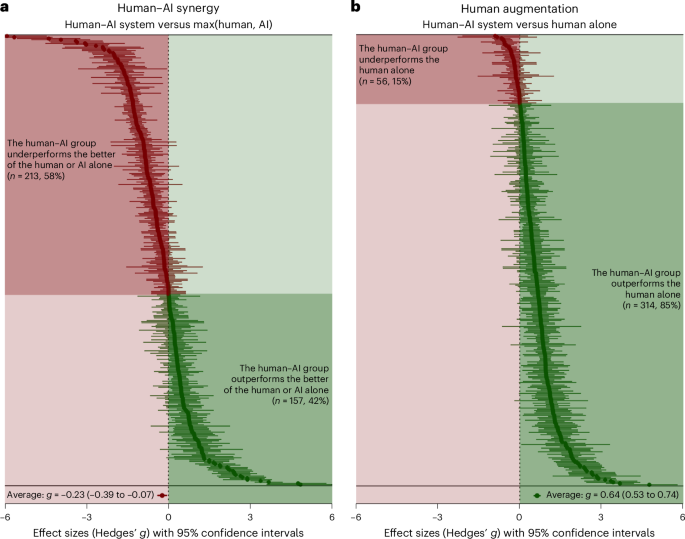
A systematic review and meta-analysis published in Nature Human Behaviour examines whether combining humans and AI yields better performance than either alone. Researchers analyzed 106 experimental studies with 370 effect sizes published between January 2020 and June 2023, finding that on average, human–AI systems performed significantly worse than the best of humans or AI alone (Hedges' g = −0.23). However, these combinations did outperform humans working alone, demonstrating what the authors call human augmentation (g = 0.64). The findings challenge the widespread assumption that pairing humans with AI automatically produces superior results.
The study identifies critical moderating factors. Task type matters significantly: decision tasks (choosing among finite options) showed performance losses, while creation tasks (generating open-response content) showed performance gains from human–AI collaboration. The relative performance gap between human and AI also proved crucial — when humans outperformed AI alone, the combination achieved genuine synergy (g = 0.46), but when AI outperformed humans, the combination suffered losses (g = −0.54). The authors hypothesize that when humans are more skilled at a task, they are also better at judging when to trust their own judgment versus the AI's suggestions.
Notably, factors that have received significant research attention — such as providing AI explanations or confidence scores — did not significantly affect human–AI system performance. The authors suggest researchers should shift focus toward less-studied but more impactful factors like task type, baseline performance differences, and division of labor between humans and AI. They also note that only 3 of 100+ experiments explored predetermined delegation of subtasks to humans and AI, pointing to a largely unexplored but promising design approach for achieving genuine human–AI complementarity.
Researchers at Carnegie Mellon University's Tepper School of Business are investigating how AI can strengthen human teamwork rather than replace team members. Professor Anita Williams Woolley and her colleagues developed COHUMAIN (Collective HUman-MAchine INtelligence), a framework for understanding where AI fits within organizational social psychology. The researchers argue AI should serve as a partner under human direction — facilitating connections and nudging collaboration — rather than acting as a manager or autonomous teammate. They note that while AI excels at tasks like summarizing meetings, it still can't replicate human abilities like reading the mood of a room.
Ph.D. student Allen Brown is exploring the tension between AI's collaborative potential and concerns around psychological safety and privacy. His research found that people feel more vulnerable when they believe an AI system is evaluating them, compared to being evaluated by another human, due to the loss of "mutual assumption of risk." Meanwhile, researcher Zhaohui (Zoey) Jiang is studying how AI transparency affects trust, finding that transparent AI benefits less-skilled users by helping them learn from the system's decision-making rules, while black box AI can actually be more effective for high-ability users, who tend to penalize AI mistakes more harshly when they understand the system's inner workings. Opacity, paradoxically, inflates perceptions of sophistication. The researchers suggest future AI systems may self-adapt their level of transparency to complement individual users' decision-making weaknesses.

A Wharton Human-AI Research (WHAIR) webinar explored the dual-edged impact of AI on creativity, featuring researchers from UCL, University of Exeter, and University of Washington. The panel found that while AI boosts individual productivity and raises baseline creative quality — particularly helping less-creative individuals produce more novel and useful work — it simultaneously narrows the overall diversity of ideas. When people start with AI-generated suggestions, they tend to anchor to them, leading to convergent rather than divergent thinking across teams.
The researchers emphasize that collaboration design is critical: having humans drive early ideation while AI assists with refinement and evaluation preserves idea diversity, whereas using AI at the start of the creative process leads to homogenized outputs. Panelists warned against over-reliance on AI as a "copilot," drawing an analogy to pilots losing manual skills through autopilot overuse. To maintain a competitive innovation edge, organizations should use multiple AI models with varied prompting strategies, encourage independent ideation before AI input, deploy AI as a critic rather than a generator, and establish clear norms about when AI should complement versus substitute for human creativity. The bottom line: companies that carefully structure human-AI collaboration will outperform those that treat AI as a default creative shortcut.

This Harvard Business Review article by Tojin T. Eapen, Daniel J. Finkenstadt, Josh Folk, and Lokesh Venkataswamy explores how generative AI — technologies capable of creating new content such as text, images, audio, and video — can be used to augment human creativity rather than simply replace human workers. The authors argue that while there is significant apprehension about AI displacing jobs, one of the largest opportunities lies in using these tools to promote divergent thinking and democratize innovation across businesses and governments.
The article, published in the July–August 2023 issue, positions generative AI not as a threat to creative professionals but as a powerful collaborator that can expand the range of ideas people generate and help overcome traditional barriers to innovation. The piece is notable for practicing what it preaches — all images in the article were themselves created using Midjourney, a generative AI tool, demonstrating the practical creative applications of the technology.

Researchers at Swansea University have conducted one of the largest studies to date on human-AI creative collaboration, involving over 800 participants designing virtual cars. The study found that when participants were shown AI-generated design galleries — created using a method called MAP-Elites — they spent more time on tasks, produced better designs, and felt more creatively engaged. Crucially, the galleries included a wide spectrum of ideas, from highly effective to intentionally flawed, which helped participants break free from initial assumptions and explore broader possibilities.
The research, published in ACM Transactions on Interactive Intelligent Systems, also challenges how AI design tools are typically evaluated. Standard metrics tend to focus on surface-level behaviors like click rates and copying frequency, but the Swansea team argues these miss the deeper cognitive and emotional effects AI has on users. Lead author Dr. Sean Walton emphasized that diversity in AI output — including imperfect ideas — was key to preventing early fixation and encouraging creative risk-taking. As AI becomes embedded in fields from architecture to game design, the study suggests the real question isn't what AI can do alone, but how it can enhance human thinking and collaboration.
Microsoft Research's New Future of Work Report 2025 examines how generative AI is reshaping workplaces at a pace exceeding previous technological shifts. Rather than simply automating tasks, AI is now actively participating in workflows — changing how people create, decide, collaborate, and learn. The report draws on large-scale data analyses, field studies, and theoretical frameworks to assess adoption patterns, productivity impacts, and labor market effects across industries and geographies.
A key finding is that AI's benefits are unevenly distributed. Adoption varies significantly by gender, income level, region, and organizational culture. High-income countries lead usage, but growth is fastest in low- and middle-income regions, where gaps in multilingual model support risk reinforcing existing inequalities. Entry-level workers face particular vulnerability, with empirical evidence showing a 16% employment decline for workers aged 22–25 in highly AI-exposed roles relative to less-exposed ones, raising concerns about how future expertise will be built if learning-intensive jobs are automated away.
The report emphasizes that human expertise matters more, not less, in an AI-powered world. Workers are shifting from doing tasks to guiding, critiquing, and refining AI outputs — requiring new skills like prompt crafting, quality oversight, and calibrated trust. Current AI systems, designed primarily for individuals rather than teams, often underperform in group settings, though emerging research into team-oriented AI and collective intelligence shows significant promise. The authors stress that the future of work is not predetermined but will be shaped by intentional choices in system design, organizational adoption, and workforce development.


This AWS Insights article outlines the evolution of autonomous AI agents from simple rule-based automation to fully autonomous systems capable of reasoning, planning, and executing tasks with minimal human oversight. It introduces a four-level framework analogous to autonomous driving — from Level 1 (chain-based RPA) to Level 4 (fully autonomous agents) — noting that most enterprise implementations as of Q1 2025 remain at Levels 1 and 2. The article cites projections that agentic AI will drive 15% of work decisions by 2028 and that the AI agents market will reach $52.6 billion by 2030, supported by real-world examples from Genentech (drug discovery), Amazon (Java application modernization via Amazon Q Developer), and Rocket Mortgage (personalized financial guidance via Amazon Bedrock Agents).
Beyond economics, the piece explores the deeper question of whether autonomous agents are tools or teammates, arguing that while they lack consciousness and moral agency, their functional behavior increasingly resembles that of colleagues. This reframing demands new approaches to accountability, privacy, and governance — including shared responsibility frameworks, context-aware guardrails, and traceability mechanisms. The article positions the CIO as the key orchestrator of agentic innovation, urging enterprise leaders to develop strategic roadmaps that balance decentralized AI adoption with consistent governance standards, invest in "agent literacy" as a core workforce skill, and establish security controls specifically designed for the dynamic and autonomous nature of these systems.

This California Management Review article by Dritjon Gruda and Brad Aeon systematically debunks seven common myths about AI and productivity using evidence from recent meta-analyses and systematic reviews rather than individual studies or vendor claims. The authors challenge the assumption that AI is a universal productivity enhancer, showing that gains are highly context-dependent — benefiting junior workers far more than experts, and often introducing quality regressions that offset speed improvements. Perhaps most strikingly, a meta-analysis of 106 experiments found that human-AI collaboration frequently underperforms either agent working independently, except in open-ended creative tasks like brainstorming.
The article also addresses AI's impact on creativity, finding that while AI-augmented humans achieve modestly higher novelty scores, this comes at the cost of dramatic declines in idea diversity — a homogenization effect that undermines innovation. At the macroeconomic level, a meta-analysis of 371 estimates found no robust relationship between AI adoption and aggregate productivity gains once methodological factors are controlled, echoing a modern version of the Solow paradox. Additional myths around automation bias, where high-reliability AI systems actually increase certain types of human error by 12%, and the stress paradox, where AI creates new forms of technostress rather than reducing workplace burden, round out the analysis.
The authors conclude with practical guidance: organizations should conduct evidence audits with task-specific metrics, implement a "creation versus evaluation" matrix for task triage, deploy adaptive governance structures with confidence disclosures, and maintain an equity lens to track distributional impacts across skill levels. The core message is that AI's productivity dividend is real but narrow — it materializes only for specific users, specific tasks, and specific workflow designs, demanding far more analytical rigor than most organizations currently apply.

A study from the MIT Center for Collective Intelligence, published in Nature Human Behaviour, challenges a widely held assumption about AI-human collaboration. After analyzing over 100 studies, researchers found that human-AI combinations on average do not outperform the best human-only or AI-only systems — a finding that surprised even the researchers. The study reveals that combinations work best when each party handles what it does better than the other: humans excel at tasks requiring contextual understanding and emotional intelligence, while AI dominates repetitive, high-volume, or data-driven tasks. Notably, when humans already outperform AI on a given task, adding AI to the mix tends to yield the best collaborative results.
One bright spot for collaboration is generative AI and content creation tasks, where human-AI synergy showed significantly positive effects compared to decision-making tasks. The iterative, interactive nature of generative AI — where humans can draft, edit, and refine outputs in real time — makes it better suited for collaboration than earlier AI systems designed for narrow tasks. Rather than simply dividing subtasks between humans and AI, the researchers recommend redesigning entire workflows and adopting continuous improvement models. MIT Sloan professor Thomas W. Malone emphasized that the findings should not discourage collaboration efforts but instead push organizations toward more sophisticated, evidence-based approaches to deploying human-AI teams.
Valerio Capraro shares findings from a meta-analysis of 106 studies published in Nature Human Behaviour examining the effectiveness of human-AI collaboration. The key finding is striking: on average, there was no synergy between humans and AI working together. Human–AI combinations did not outperform both humans and AI working independently.
Particularly notable is the implication that when AI alone performed well on a task, adding a human to the loop did not improve outcomes. This challenges the widely held assumption that combining human judgment with AI capabilities automatically produces superior results, and raises important questions about how organizations should design their human-AI workflows.