The AI_4_Healthcare account on X pushes back against the prevailing "white-collar jobs are doomed" narrative that dominated the previous week's discourse. Citing a U.S. Bureau of Labor Statistics (BLS) report, the post highlights that nearly 82,000 new jobs were created in January 2026 across the healthcare sector alone — a sector that is simultaneously experiencing massive AI adoption.
The implication is that AI integration does not automatically equate to job destruction. Healthcare, one of the industries most actively deploying AI tools, is still adding tens of thousands of positions, suggesting a more nuanced reality than the alarmist "pink slips are coming" headlines would imply. The post encourages sober second thought about the relationship between AI adoption and employment.
A Stanford Institute for Economic Policy Research (SIEPR) policy brief from July 2026 examines the real-world impact of AI on the labor market, cutting through sensationalized predictions of an "AI jobs apocalypse." The authors — Neale Mahoney, Erika McEntarfer, and Karsen Wahal — synthesize a growing body of research into five key findings: AI's impact on aggregate employment remains small, with unemployment rising no faster in AI-exposed occupations than in others. However, recent graduates face a notably tougher job market, with entry-level hiring declining in AI-exposed roles like software development and customer service, though disentangling AI's role from rising interest rates and post-pandemic corrections remains empirically challenging.
On productivity, experimental evidence shows generative AI tools generally improve worker speed and output, with gains disproportionately benefiting less-experienced and lower-performing workers — a 30% productivity boost for novice call center agents, for example. Yet the authors caution that AI's capabilities are "jagged," sometimes harming outcomes when workers lack the judgment to evaluate AI-generated advice. Creative diversity also suffers, as AI-assisted output tends toward homogeneity. Firm adoption is accelerating but remains uneven, with conservative Census estimates placing adoption around 20% of firms, mostly concentrated in tech and information-intensive sectors, and many companies still in experimentation phases.
The brief concludes by drawing a parallel to the delayed productivity gains from the PC revolution of the 1980s, noting that transformative technologies typically take years or decades to reshape labor markets. The authors stress that while current evidence does not support imminent mass displacement, the situation is evolving rapidly, and policymakers should prepare for a range of outcomes as AI capabilities and adoption continue to advance.
Ethan Mollick shares a working paper that argues AI creates an "inflection point" for each job type, fundamentally altering freelancer economics. Before this inflection point, AI acts as a productivity booster — for example, web developers saw a +65% increase in earnings by leveraging AI tools. However, once AI capability crosses the threshold for a given job, it begins replacing freelancers rather than augmenting them, as seen with translators who experienced a -30% drop in earnings.
A key takeaway from the research is that this replacement effect appears to be irreversible — once AI starts substituting for a particular job type, the trend does not reverse. This suggests a critical strategic implication for freelancers and workers: the window to benefit from AI as a complement to human work is finite, and timing matters enormously in determining whether AI becomes an ally or a competitor.
A Morgan Stanley survey of 935 corporate executives across five sectors reveals that AI adoption is driving 11.5% average productivity gains alongside a 4% net reduction in jobs globally. The survey, published in February 2026, focused on industries deemed most exposed to near-term AI impact: consumer staples distribution & retail, real estate, transportation, healthcare equipment & services, and automobiles & components. While U.S. companies actually reported a 2% net gain in jobs, Europe experienced the most significant negative employment effects, and the automotive sector saw the highest net job loss at 10%.
The workforce impact is uneven across company sizes and experience levels. Larger firms (501–1,000 employees) cut 15% of positions, while smaller companies (under 49 employees) saw a 4% net gain. Entry-level employees face the greatest risk of job elimination, while workers with 2–10 years of experience are more likely to be retrained or redeployed. Notably, 27% of employees were retrained in the past 12 months, signaling growing demand for reskilling programs.
For investors, Morgan Stanley highlights that some sectors could achieve savings exceeding 50% of estimated 2026 pre-tax earnings at full AI adoption, with consumer staples, real estate, and transportation potentially surpassing 100% of earnings in benefits. The firm advises investors to reassess AI exposure across portfolios, noting that if AI capabilities continue improving at a non-linear rate, the magnitude of value creation could far exceed current expectations.

ADP Research challenges the prevailing narrative that knowledge work is declining in the age of artificial intelligence. Despite the professional and business services supersector slipping from a record 17.6% of U.S. private employment in January 2022 to 16.8% in January 2025, the authors argue this dip is misleading. The decline stems primarily from reductions in administrative and support roles — such as office managers, janitors, and security guards — which fell from 47.5% to 39.5% of the supersector's employment between 2020 and 2025, largely due to pandemic-driven shifts like remote work reducing demand for on-site support staff.
Within knowledge work itself, a clear divergence has emerged. Traditional professional services like legal, accounting, and architecture have lost employment share, while technology and research-oriented roles have surged. Computer programming and infrastructure jobs now constitute the largest share of the professional services supersector, and management, scientific, and technical consulting nearly doubled its share from 10.1% to 17.3% over five years. ADP Research's long-running studies also show that knowledge workers remain better paid, more engaged, more loyal, and less intimidated by AI than workers in routine jobs — suggesting that reports of knowledge work's demise are, as the authors note, greatly exaggerated.

IESE professors Enrique Ide and Eduard Talamas present a framework for understanding how AI may reshape the knowledge economy, focusing on two critical variables: AI autonomy and computing power availability. Their research distinguishes between non-autonomous AI, which always requires human collaboration and broadly enhances productivity, and autonomous AI, which can operate independently and creates more complex labor dynamics with clear winners and losers.
The framework further differentiates between basic autonomous AI (capable of routine knowledge work) and advanced autonomous AI (capable of specialized problem-solving), each producing distinct organizational effects. Basic AI displaces workers from routine roles into more knowledge-intensive positions, leading to smaller, more centralized firms. Advanced AI does the opposite — it reduces the knowledge content of human work and creates larger, more decentralized organizations. Crucially, the most knowledgeable workers always benefit from AI regardless of its sophistication, as they can leverage it to amplify their expertise.
The question of whether AI will destroy knowledge jobs ultimately hinges on computing power relative to AI's potential applications. If compute remains scarce relative to demand, no one's labor becomes redundant. But if computing power becomes sufficiently abundant, autonomous AI could render workers whose knowledge falls below AI's level unemployable — a scenario with profound implications for both individual career strategy and organizational design.

This article examines Anthropic CEO Dario Amodei's prediction that AI could eliminate roughly 50% of entry-level white-collar jobs, weighing it against empirical research from Stanford, MIT, the Federal Reserve, and other institutions. The critical distinction emerging from the data is between task displacement and job displacement — AI automates specific tasks within roles rather than eliminating entire positions outright. However, when enough tasks within entry-level roles are automated, companies reduce junior headcount by redistributing remaining work upward or relying on smaller AI-augmented teams. The research shows that white-collar workers face higher AI exposure than blue-collar workers, reversing historical automation patterns, with roles like junior software developers, entry-level financial analysts, paralegals, and content coordinators facing the most pressure.
The Federal Reserve data reveals wage compression at the entry level in high-AI-exposure occupations, while productivity gains accrue primarily to senior workers who use AI to augment complex work. Perhaps most concerning is the entry-level pipeline problem: if AI absorbs the tasks that historically served as training grounds for junior professionals, the pathway to developing senior expertise narrows significantly — a structural issue that won't appear in current unemployment statistics but could compound over the next decade. The article concludes that while Amodei's 50% figure is directionally supported, the mechanism is hiring slowdowns and task absorption rather than mass firings, and that workers who learn to build and deploy AI workflows gain a structural advantage over those who don't.

PwC announces the launch of its 2026 Global AI Jobs Barometer, a comprehensive study based on analysis of over one billion job listings worldwide. The report examines how the world of work is being reshaped by artificial intelligence, with findings suggesting that AI is not merely automating tasks but fundamentally redefining roles and skill requirements across industries.
This annual barometer serves as a key indicator of how AI adoption is influencing labor markets globally, tracking shifts in employer demand and the evolving skill sets workers need to remain competitive. The scale of the dataset — over a billion job postings — underscores the breadth of PwC's analysis and positions the report as a significant resource for understanding AI's impact on employment trends.
Gracy Chen, associated with Bitget, shares a chart she encountered at an MIT event from an NBER working paper titled Artificial Intelligence and the Labor Market. The chart examines how exposed different jobs are to AI disruption across wage levels, highlighting the varying degrees of vulnerability depending on income brackets.
The post points to ongoing academic research into AI's impact on employment, suggesting that the relationship between wage levels and AI exposure is a nuanced and important topic for understanding the future labor market. By sharing this research, Chen draws attention to the intersection of AI advancement and workforce economics.
A National Academies consensus study examines how recent advances in artificial intelligence—particularly generative AI systems like ChatGPT—are poised to reshape the labor market, productivity, and workforce dynamics. The report emphasizes that while AI's trajectory is difficult to predict precisely, the technology is at an inflection point driven by innovations in neural networks and large-scale data processing. Rather than focusing on whether AI will eliminate jobs outright, the study highlights that the more pressing concern is how AI will shift demands for certain types of expertise, potentially eroding the value of some skills while creating demand for entirely new ones.
The report identifies several key opportunity areas for policymakers, businesses, and institutions. These include expanding real-time data collection on AI's workforce impacts, creating public-private partnerships for sharing labor market data, and investing in continuing education and retraining programs to help workers adapt. It stresses that AI's productivity benefits—already demonstrated in software development, writing, and contact centers—will not be distributed equitably without deliberate institutional and policy interventions. The study also raises concerns about societal risks including privacy threats, algorithmic bias, market concentration, and national security implications.
Critically, the report advocates for intentional design of AI systems that augment rather than replace human workers, promoting human-AI collaboration that produces higher-quality outcomes than either could achieve alone. It calls for government investment in AI research, standards development, and building federal AI expertise to support effective oversight across sectors like healthcare, education, transportation, and environmental protection.
Annie Lowrey of The Atlantic examines the worst-case scenario for white-collar workers as AI rapidly transforms the labor market. She notes alarming early signals: college graduates now account for a record quarter of the unemployed, high-school graduates are finding jobs faster than degree holders, and companies like Baker McKenzie and Salesforce are cutting hundreds of positions while citing AI efficiencies. Two reporters with no engineering background managed to "vibe-code" a clone of Monday.com's platform in under an hour, tanking the company's stock.
The core argument is that an AI-driven displacement of office workers would be fundamentally different from a typical recession. Rather than a cyclical demand problem that stimulus spending and rate cuts can fix, the economy would face a structural unemployment crisis — businesses simply wouldn't need the accountants, lawyers, analysts, and middle managers they laid off. This would mirror the devastation that blue-collar workers experienced during deindustrialization and the China trade shock, but striking the educated upper-middle class instead. Existing workforce-training programs have a track record that ranges from "muted" to "dubious," offering little hope for rapid retraining.
Lowrey also scrutinizes universal basic income, a favorite proposal among Silicon Valley leaders like Sam Altman, calling it a dystopian outcome rather than a utopian one. She argues that $1,500 a month wouldn't be enough, that the taxes required would be fiercely opposed, and that Americans fundamentally derive identity and well-being from work. Long-term unemployment destroys mental and physical health, and a society where 30 percent are jobless risks producing a "hyper-wealthy techno-oligarchy and a dispossessed and teed-off underclass." While she concedes that history suggests technology creates prosperity without permanently reducing labor demand, she acknowledges she may simply be in denial.

New research from MIT Sloan School of Management challenges the prevailing narrative that AI will replace human workers, arguing instead that AI is more likely to complement human capabilities. The paper, titled "The EPOCH of AI: Human-Machine Complementarities at Work," introduces a framework built around five groups of uniquely human capabilities: Empathy and Emotional Intelligence, Presence, Networking, and Connectedness, Opinion, Judgment, and Ethics, Creativity and Imagination, and Hope, Vision, and Leadership. These capabilities, collectively called EPOCH, represent areas where machines are fundamentally limited due to statistical shortcomings like biased or small datasets, extrapolation challenges, and moral dilemmas.
The researchers — Roberto Rigobon and Isabella Loaiza — developed three key metrics to evaluate tasks across occupations: the EPOCH index, a risk-of-substitution score, and a potential-for-augmentation score. Their findings show that human-intensive tasks have actually increased between 2016 and 2024, and newly added tasks in the O*NET labor dataset in 2024 exhibit higher EPOCH capability levels than previously existing tasks. The study emphasizes that augmentation goes beyond partial automation — it enables humans to accomplish things they couldn't do before, much like advanced microscopes opened up nano-scale work.
The authors stress the importance of investing in developing workers' EPOCH capabilities, deliberately avoiding the label "soft skills." As Rigobon notes, teaching empathy, hope, and creativity is far harder than teaching technical problem-solving — yet these are precisely the skills that will keep human workers complementary to, rather than replaceable by, AI.

Quartz highlights what it calls the "AI shrinkflation" of white-collar jobs — a trend where employees are taking on more work for the same pay while seeing their benefits quietly eroded. According to the post, flexible spending accounts are vanishing, wellness programs are disappearing, and other perks are being cut, yet none of these reductions are captured in traditional wage data.
The framing draws a parallel to consumer shrinkflation, where products get smaller while prices stay the same. Here, the "product" is the total compensation package, which is effectively shrinking even as workloads increase — partly driven by AI-related productivity expectations. This matters because it suggests that official wage statistics may be painting a misleadingly stable picture of worker compensation during a period of significant structural change in the labor market.
Bharat Chandar highlights a key pattern in AI-exposed jobs: occupations with a higher share of college-educated workers are growing, while those with a lower share are shrinking. This observation suggests that AI is following the same trajectory as previous technology shifts, which have historically complemented college-educated workers rather than displaced them.
The implication is that AI adoption may be reinforcing existing labor market inequalities tied to education, rather than disrupting them in novel ways. This challenges narratives that AI will be a great equalizer or that it will primarily threaten white-collar, educated workers.
The Penn Wharton Budget Model (PWBM) estimates that generative AI will increase U.S. productivity and GDP by 1.5% by 2035, nearly 3% by 2055, and 3.7% by 2075. The analysis finds that approximately 40 percent of current GDP could be substantially affected by generative AI, with occupations around the 80th percentile of earnings being the most exposed — about half their work is susceptible to automation. The highest- and lowest-earning occupations face less exposure. AI's peak annual contribution to productivity growth is projected at 0.2 percentage points in 2032, after which the boost fades as adoption saturates, leaving a permanent but modest lift of less than 0.04 percentage points from sectoral composition shifts.
The research builds on Acemoglu's (2024) task-based framework and combines it with historical technology diffusion curves from PCs, the internet, smartphones, and cloud computing to project adoption timelines. PWBM estimates that just under 10 percent of current GDP will actually be impacted, since only about 23 percent of exposed tasks will prove feasible and profitable to automate. Real-world studies of AI adoption show labor cost savings averaging around 25 percent, projected to grow to 40 percent over coming decades. Notably, PWBM's estimate of exposed GDP share is roughly double Acemoglu's original figure due to methodological differences in how they interpret task automation categories.
The study also presents early labor market evidence: employment has stagnated or declined in occupations with the highest AI automation potential, with fully automatable jobs seeing a 0.75 percent employment decline by 2024. In preliminary analysis, PWBM estimates AI could reduce federal deficits by $400 billion over the 2026–2035 budget window. The authors emphasize significant uncertainty in these projections, noting they do not account for AI's effects on product quality, new product creation, or innovation feedback loops.

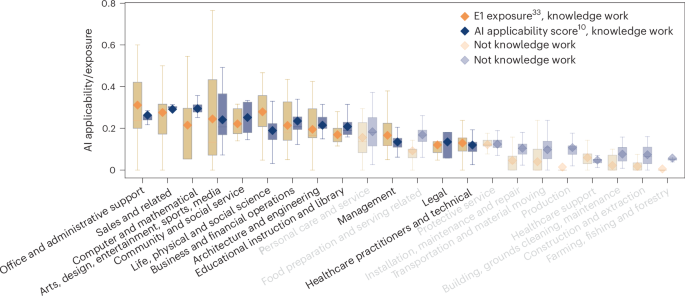
A Nature Computational Science perspective article by Microsoft Research authors explores how generative AI is reshaping knowledge work — and who actually benefits. Recent empirical research shows that people primarily use generative AI for high-complexity, knowledge-work tasks, but the distribution of these benefits is far from equal. The paper examines social and place-based divides in AI adoption, highlighting disparities across demographics, geographies, and economic contexts.
The authors reference data on AI exposure across occupational groups and global internet traffic patterns to ChatGPT, revealing significant inequities in access and usage. While AI tools like GitHub Copilot and Microsoft 365 Copilot have demonstrated measurable productivity gains — particularly for lower-skilled workers who see the largest relative improvements — concerns remain about displacement in creative fields such as translation, illustration, and media. The paper also draws on Bloom's taxonomy to frame how AI affects different cognitive task levels and warns that uncritical reliance on AI can actually harm learning outcomes.
The perspective calls for both technical and social interventions to ensure AI democratizes rather than concentrates knowledge work. Issues such as multilingual AI performance gaps, regional digital divides, and uneven organizational adoption are identified as key barriers. The authors argue that without deliberate action, generative AI risks exacerbating existing inequalities among workers and across nations, rather than bridging them.
Alex Imas presents a comprehensive, continuously updated review of research on AI's impact on productivity, organizing evidence into micro-level studies (controlled experiments and natural experiments) and macro-level studies (aggregate economic indicators). At the micro level, the evidence leans heavily positive: studies document productivity gains ranging from 14-15% for customer support agents to 55.8% faster task completion for developers using GitHub Copilot, with less experienced workers generally benefiting most. However, notable exceptions exist—the METR study found experienced open-source developers were actually 19% slower with AI, and BCG consultants performed worse when applying AI to tasks outside its capabilities.
At the macro level, AI productivity gains have only recently begun appearing in aggregate statistics. A March 2026 update notes that new BLS data revisions show US productivity growth of roughly 2.7%, and economists like Jason Furman now agree with Erik Brynjolfsson that AI may be contributing to these gains. Yet studies from Denmark show precise null effects on earnings and wages despite high adoption rates, and surveys indicate most firms report no measurable impact on employment or productivity.
Imas identifies several factors explaining the micro-macro disconnect: adoption frictions and lack of training (only 36% of workers feel properly trained), bottleneck tasks within jobs that AI doesn't speed up, endogenous selection into AI use by higher-skilled workers (contrary to micro findings showing lower-skilled workers benefit most), and a potential productivity J-curve where initial investments in reorganization suppress measured output before a harvest phase. He argues these frictions will diminish as organizations standardize AI tools and training, and predicts aggregate productivity numbers will reflect AI gains in the near term—especially as AI agents like Claude Code begin automating increasingly complex workflows.

Goldman Sachs Research finds that AI's impact on the labor market is a two-sided story: while it displaces workers in some roles, it simultaneously boosts employment in occupations where it augments human capabilities. The analysis estimates AI has reduced US monthly payroll growth by roughly 16,000 jobs over the past year and raised the unemployment rate by 0.1 percentage point, though the true aggregate impact is likely smaller when accounting for data center construction hiring and AI-driven productivity gains.
The research distinguishes between AI substitution (where AI replaces human labor) and AI augmentation (where AI complements human workers). Jobs with high augmentation potential—such as education workers, judges, and construction managers—have actually seen increased employment, adding about 9,000 jobs per month. This reflects Jevons paradox: when AI makes workers more productive, it lowers the cost per unit of output, which can increase demand enough to create net job gains. Meanwhile, roles like telephone operators, insurance claims clerks, and bill collectors face the highest substitution risk.
Notably, the negative effects of AI on job creation appear to fall disproportionately on younger, less-experienced workers. The framework combining AI displacement scores with an IMF-developed complementarity index offers a more nuanced view than earlier research, helping to clarify which professions stand to benefit from AI adoption and which are most vulnerable to disruption.