Aaron Levie, CEO of Box, identifies the context problem as the #1 challenge for AI agents in the enterprise. He draws a distinction between agentic coding — where much of the needed context already exists within the code base and users are technical enough to supply the rest — and the broader world of knowledge work agents, where the context problem becomes significantly harder.
Levie's observation highlights a critical barrier to enterprise AI adoption: while AI coding assistants benefit from structured, accessible context, general-purpose knowledge work agents must navigate fragmented, unstructured, and often siloed enterprise information. This framing underscores why companies building enterprise AI infrastructure need to solve the context delivery problem before agents can be truly effective across business functions.
Aaron Levie, CEO of Box, argues that context is king for AI agents, emphasizing that the ability to design systems providing agents with optimal context will become a critical competitive advantage. He highlights that individuals, teams, and companies who excel at structuring and delivering relevant context to AI agents will command a huge premium in the market.
Levie notes that knowledge work has always been a relatively messy space, implying that the challenge of organizing information and context for AI agents represents both a significant hurdle and a major opportunity. The post is truncated, but the core insight points to a future where the value shifts from simply having AI capabilities to effectively curating and structuring the information that powers them.
Advait Sarkar shares a research paper exploring how AI and generative models are revolutionizing knowledge work. The paper examines the broader implications of these technologies on creativity, plagiarism, credit, and copyright — key issues that arise as generative AI becomes increasingly integrated into creative and professional workflows.
Aaron Horwath argues that the widespread adoption of AI across knowledge work is driving intellectual homogenization — a phenomenon he calls "Airbrain" — where companies across entire industries funnel their thinking through the same small set of LLMs, producing eerily similar outputs and strategies. Drawing a parallel to Kyle Chayka's concept of "Airspace," where social media algorithms flattened the aesthetics of coffee shops and hotels worldwide, Horwath warns that AI is now doing the same to business strategy, marketing, and creative work. Research from Duke and Technion confirms that while individual LLMs can sometimes outperform individual humans on creativity tasks, as a population, LLMs converge on strikingly similar answers while humans don't.
Using the cautionary tale of the Kissimmee River — where the Army Corps of Engineers straightened its bends for efficiency only to cause ecological devastation requiring a $1 billion restoration — Horwath argues that the "inefficient" collaborative processes of knowledge work (meetings, idea refinement, stakeholder feedback) served critical purposes for innovation and differentiation. He predicts a "ruthless bifurcation" of knowledge work: AI handles routine, repeatable tasks at near-zero cost, while a small number of highly paid "tastemakers" deliver the uniquely human creativity, judgment, and perspective that actually drives competitive advantage. The hollowed-out middle — human-in-the-loop oversight roles — will migrate to lower-cost labor markets.
Horwath also warns of a coming wave of fractionalization, where executives attempt to convert full-time knowledge workers into gig-style arrangements, a strategy he predicts will ultimately fail because it confuses tasks with jobs and strips away institutional knowledge and relationships. He concludes that success in the next AI era will require deliberate decisions about which work remains strictly human, where "AI-free" zones should exist, and how to distinguish between friction worth eliminating and friction that produces the best work.

Researchers from Perplexity and academic collaborators conducted a field study comparing a conversational AI assistant with an autonomous AI agent, finding that AI agents don't merely accelerate knowledge work — they fundamentally change its nature. The study highlights a key distinction: a conversational assistant returns information quickly (summaries, links) that a user must then act on manually, while an autonomous agent delivers completed work products such as built spreadsheets, drawn charts, and draft memos, albeit with a longer processing time.
The research, published in Harvard Business Review, suggests that AI agents broaden the scope of knowledge work by shifting what counts as a task boundary. Rather than simply helping workers find information faster, agents take on multi-step workflows end to end. This has significant implications for competitive strategy, change management, and how organizations think about productivity and the evolving role of human judgment in an AI-augmented workplace.

Jerry Liu discusses the concept of a Document Context Layer for AI agents, arguing that while AI agents are increasingly functioning as knowledge workers, their effectiveness is fundamentally limited without proper access to unstructured documents. He emphasizes that the vast majority of knowledge work depends on unstructured data, and without the right tools to unlock that context, agents remain constrained in what they can accomplish.
The post references a comprehensive talk or presentation Liu gave on this topic, highlighting the critical infrastructure gap between AI agent capabilities and the document-rich environments they need to operate in. This framing positions document understanding and context extraction as a foundational layer for the next generation of agentic AI systems.
Aaron Levie, CEO of Box, argues that context is king for AI agents, emphasizing that the ability to design systems providing agents with optimal context will become a critical competitive advantage. He highlights that knowledge work has always been relatively messy, implying that structuring and surfacing the right information for AI agents represents both a significant challenge and a major opportunity for individuals, teams, and companies alike.
The post underscores a growing theme in enterprise AI: that the value of agents is directly tied to the quality of context they receive. This positions context engineering — the practice of curating and delivering relevant information to AI systems — as a key discipline in the next phase of AI adoption.
ADP Research challenges the prevailing narrative that knowledge work is declining in the age of artificial intelligence. Despite the professional and business services supersector slipping from a record 17.6% of U.S. private employment in January 2022 to 16.8% in January 2025, the authors argue this dip is misleading. The decline stems primarily from reductions in administrative and support roles — such as office managers, janitors, and security guards — which fell from 47.5% to 39.5% of the supersector's employment between 2020 and 2025, largely due to pandemic-driven shifts like remote work reducing demand for on-site support staff.
Within knowledge work itself, a clear divergence has emerged. Traditional professional services like legal, accounting, and architecture have lost employment share, while technology and research-oriented roles have surged. Computer programming and infrastructure jobs now constitute the largest share of the professional services supersector, and management, scientific, and technical consulting nearly doubled its share from 10.1% to 17.3% over five years. ADP Research's long-running studies also show that knowledge workers remain better paid, more engaged, more loyal, and less intimidated by AI than workers in routine jobs — suggesting that reports of knowledge work's demise are, as the authors note, greatly exaggerated.

This Harvard Business Review article by Maryam Alavi and George Westerman explores how generative AI is poised to transform knowledge work across industries. The authors note that tools like ChatGPT have achieved unprecedented adoption rates, reaching 100 million monthly users faster than any internet application in history. Companies in professional services, health care, and finance are investing billions to harness the efficiency and productivity gains these technologies promise.
The article emphasizes that generative AI can be a significant boon for knowledge-intensive firms, but only when deployed in the right way. New AI-enabled tools are rapidly emerging to assist and augment knowledge work, suggesting that organizations need to be strategic about adoption rather than simply implementing the technology for its own sake. The piece covers themes spanning automation, data management, and enterprise computing, positioning generative AI as a foundational shift in how knowledge workers operate.

Perplexity Research published an article exploring how AI agents are transforming knowledge work. Unfortunately, the full content of the page was not captured beyond the title, making a detailed synopsis impossible. Based on the title alone, the piece appears to examine the ways autonomous AI agents are reshaping how professionals handle research, analysis, decision-making, and other cognitive tasks in the modern workplace.

This research paper from Harvard Business School and Perplexity AI provides the first field evidence on how autonomous AI agents reshape knowledge work compared to conversational AI assistants. Using production data from Perplexity's Search and Computer products, the authors develop a task-based economic framework and examine four dimensions: adoption, autonomy, efficiency, and scope. The key finding is that Computer performs 26 minutes of autonomous work per session versus just 33 seconds for Search — a 48× increase — while reducing per-query dissatisfaction rates by 55%. On matched tasks, the agent reduces completion time from 269 to 36 minutes, yielding 87% time savings and 94% cost savings compared to humans using Search alone.
Beyond raw efficiency, the paper documents a fundamental expansion in the scope of work users attempt when given access to agents. Computer queries more frequently cross occupational boundaries, require higher-order cognition (71% abstract non-routine tasks vs. 53% for Search), draw on broader expertise domains (+38% more O*NET Knowledge domains per query), and bundle more subtasks into single queries. Notably, 23% of Computer queries involve task types that never appear in the same users' Search history, suggesting agents unlock entirely new categories of work rather than merely accelerating existing ones.
The conceptual framework elegantly captures the core tradeoff: agents have higher fixed delegation costs (specifying objectives, reviewing output) but lower marginal per-step execution costs, making them economically preferred for complex, multi-step tasks. User interviews corroborate the quantitative findings, with reported speedups ranging from 5× to 300× and cost reductions of two to three orders of magnitude. The paper also finds that Computer and Search are complements rather than substitutes — adopting Computer increases daily Search usage by approximately one additional query per day — consistent with the framework's prediction that agent-driven cost savings free up budget for shorter tasks where conversational tools retain an advantage.
A June 2026 paper from Perplexity researchers presents large-scale empirical evidence that autonomous AI agents fundamentally reshape knowledge work compared to conversational assistants. Using production data from Perplexity's Search (assistant) and Computer (agent) products, the study finds that agents perform 26 minutes of autonomous work per session versus just 33 seconds for assistants — a 48x increase. This autonomy translates into an 87% reduction in task completion time and a 94% reduction in cost, while simultaneously improving output quality, with per-query dissatisfaction rates 55% lower for the agent product.
Beyond speed and cost, the paper reveals that agents expand the scope of work users attempt. Computer queries more frequently cross occupational boundaries (59% vs. 50%), require higher-order cognition concentrated at the "Create" level of Bloom's taxonomy, and bundle multiple interdependent subtasks into single requests. Notably, 23% of agent queries engaged fine-grained work activities that users never attempted with the assistant, suggesting agents unlock entirely new categories of work. The authors frame these findings through a knapsack optimization model where agents' higher fixed delegation costs but lower marginal execution costs make them economically superior for complex, multi-step tasks.
The study's implications point toward a significant restructuring of knowledge work: humans shift from manual execution toward supervisory, verification, and extension roles, while agents handle planning and multi-step execution. The authors acknowledge important limitations including self-selection bias, a short observation window, and reliance on a single product ecosystem, but the magnitude of observed effects — validated through sensitivity analyses — suggests the transition from AI assistants to autonomous agents represents a structural shift in how knowledge work is organized and performed.

This research paper examines how AI agents are transforming knowledge work by analyzing production data from Perplexity's Search and Computer products. The study compares conversational AI assistants with autonomous agents that execute tasks end-to-end, revealing three key findings. First, Computer performs 26 minutes of autonomous work per session compared to just 33 seconds for Search, automating task decomposition and execution while shifting user follow-up queries toward higher-order work like verification and extension. Per-query dissatisfaction rates are 55% lower on the autonomous Computer product.
Second, the autonomy advantage dramatically reduces task completion time from 269 to 36 minutes on matched tasks, lowering estimated time and cost by 87% and 94% respectively compared to humans using Search alone. Third, and perhaps most significantly, the study finds that AI agents change the scope of work users attempt — Computer queries more frequently cross occupational boundaries, require higher-order cognition, draw on broader expertise, and bundle interdependent subtasks into composite queries. The research demonstrates that autonomous AI agents don't just speed up existing workflows but fundamentally expand the breadth and depth of automated work that users are willing to undertake.

A Nature Computational Science perspective article by Microsoft Research authors explores how generative AI is reshaping knowledge work — and who actually benefits. Recent empirical research shows that people primarily use generative AI for high-complexity, knowledge-work tasks, but the distribution of these benefits is far from equal. The paper examines social and place-based divides in AI adoption, highlighting disparities across demographics, geographies, and economic contexts.
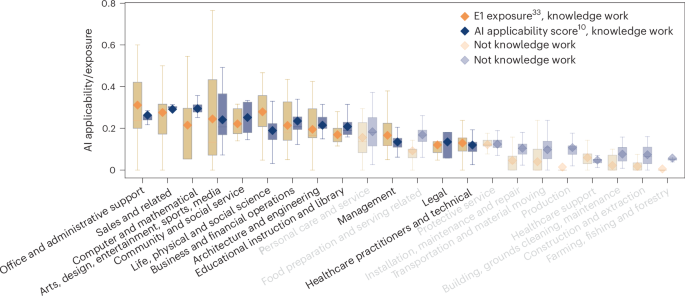
The authors reference data on AI exposure across occupational groups and global internet traffic patterns to ChatGPT, revealing significant inequities in access and usage. While AI tools like GitHub Copilot and Microsoft 365 Copilot have demonstrated measurable productivity gains — particularly for lower-skilled workers who see the largest relative improvements — concerns remain about displacement in creative fields such as translation, illustration, and media. The paper also draws on Bloom's taxonomy to frame how AI affects different cognitive task levels and warns that uncritical reliance on AI can actually harm learning outcomes.
The perspective calls for both technical and social interventions to ensure AI democratizes rather than concentrates knowledge work. Issues such as multilingual AI performance gaps, regional digital divides, and uneven organizational adoption are identified as key barriers. The authors argue that without deliberate action, generative AI risks exacerbating existing inequalities among workers and across nations, rather than bridging them.
This article surveys AI agent use cases for knowledge workers that are delivering measurable ROI in 2026, distinguishing between deployments that work and those that remain overhyped. The highest-consistency wins center on document processing (contract review time down 60–80%), research synthesis and competitive intelligence, financial reporting automation (reclaiming 4–8 analyst hours per week), code assistance (55%+ faster task completion), and meeting summarization with action-item extraction. These successful use cases share common traits: high volume, well-defined structure, language-heavy inputs/outputs, and human review before final decisions.
The article is equally specific about what isn't working yet: fully autonomous multi-step decision-making, AI-generated creative strategy, end-to-end customer interaction handling, and AI-driven hiring decisions all remain premature or problematic. The practical guidance recommends starting with repetitive, measurable tasks, keeping humans in the loop, and matching agent architecture — triggered, scheduled, on-demand, or autonomous pipeline — to the specific workflow. MindStudio, the article's sponsor, is positioned as a no-code platform for building custom knowledge-work agents with 1,000+ integrations and 200+ AI models, particularly suited when off-the-shelf tools can't handle organization-specific processes or proprietary data.

Daniel Miessler argues that AI will inevitably replace most knowledge work — not because AI is extraordinary, but because the current state of corporate work is deeply dysfunctional. Drawing on 25+ years of consulting across hundreds of Fortune 10,000 companies, he describes a landscape of unclear vision, inconsistent processes, undocumented institutional knowledge, empire-building politics, and blind leadership that can't even see what their organizations are doing. He frames this chaos as what AI is actually competing against, noting that $50+ trillion is spent annually on knowledge workers where only 21% are engaged and the majority are doing the minimum or actively disengaged.
Miessler dismantles the "human reliability myth" by drawing parallels between LLMs and human cognition — arguing that humans don't know where their thoughts come from, can't predict how they'll finish sentences, and have deeply flawed memory systems. He introduces a capability stack (knowledge, understanding, intelligence, creativity) and contends that AI already matches or exceeds humans on the first three layers, which constitute the vast majority of knowledge work. The real gap, he argues, is an "articulation gap" — expertise trapped in human heads that hasn't been documented into AI-executable skills and SOPs. This gap is closing through a one-way "expertise ratchet" where captured knowledge permanently enters the collective AI pool.
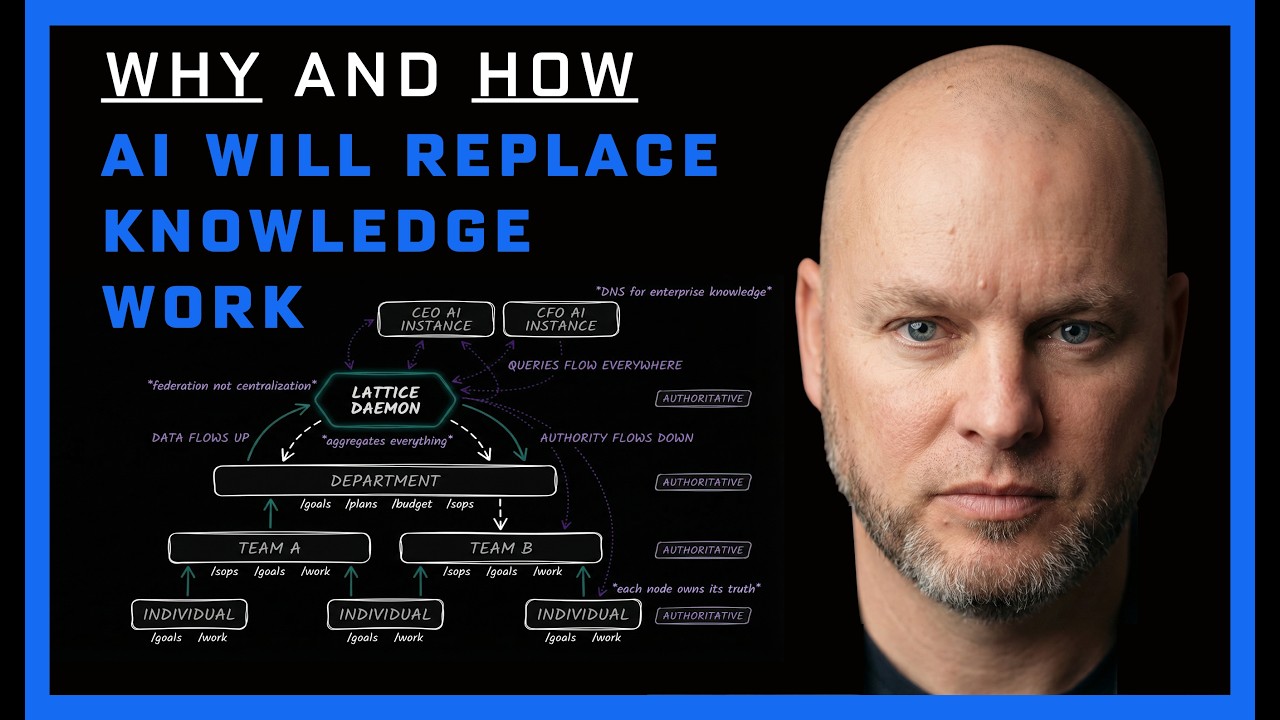
He proposes an architecture called the Lattice — an open-source system where every individual, team, department, and company broadcasts its goals, SOPs, metrics, and work items via APIs, giving leaders real-time visibility into operations. In this model, humans shift from being doers to overseers, leveraging what AI fundamentally lacks: subjective experience and desire. Miessler frames this transition as "Human 3.0" — moving from survival to corporate drudgery to creative self-expression — arguing that the loss of knowledge work jobs is ultimately liberation from a system everyone already knew was broken.