
Epoch AI has launched the ChatGPT Usage Explorer, a public research tool built on metadata from 8.3 million messages across 660,000 conversations by 5,000 US YouGov panelists. Unlike most behavioral data on AI use, which is either self-reported or published by AI companies themselves, this dataset provides independent, message-level records spanning from ChatGPT's November 2022 launch through 2026. The explorer publishes nine metrics covering panelist activity, conversation patterns, model usage, and demographic breakdowns, all without exposing any message text.
The clearest finding is intensification: active users are steadily using ChatGPT more. The median number of monthly messages per active panelist rose from 14 in January 2023 to 36 in December 2025, and the share of panelists using ChatGPT on 21 or more days per month quadrupled from 2.6% to 10.5%. Usage is also highly concentrated — the top 10% of users sent 63% of all prompts. Interestingly, while mean conversation length grew significantly, the median conversation remained just two prompts throughout the entire period.
The authors are transparent about limitations: the dataset skews older and more educated than ChatGPT's overall user base, and is subject to survivorship bias since all panelists had to have used ChatGPT in 2026. Despite this, the panel's usage rates closely match OpenAI's own published figures, with weekly active panelists averaging 4.3 prompts per day versus OpenAI's implied 3.7. Epoch AI positions the explorer as a complement to its representative polling work and plans to further analyze heavy users and individual usage trajectories over time.
Ethan Mollick argues that generative AI is already good enough to significantly boost human creativity, particularly in idea generation. He explains that AI's quirks — including its tendency to hallucinate and produce strange outputs — are actually features rather than bugs in a brainstorming context, where weird ideas can spark novel thinking and bad ideas are easily filtered out. AI also brings vast knowledge that enables unique combinations and recombinations of existing concepts.
Mollick outlines several concrete techniques grounded in creativity research. Playing with constraints involves using AI to explore extreme users, impose arbitrary limitations on solutions, or consider opposites to break out of familiar thinking patterns. "Interviewing" the AI means having it role-play as different personas to surface problem areas you haven't considered. The "Yes, and…" improv technique works well with AI to iteratively build on ideas. He also advocates going for volume, leveraging AI's ability to rapidly generate large numbers of ideas, and making it weird by requesting outputs in unconventional formats — like a Johnny Cash song or a Seinfeld script — to stimulate creative thinking.
The post emphasizes that AI outputs don't need to be perfect or accurate to be useful in ideation; their primary value lies in pushing people beyond their familiar mental patterns. Mollick frames AI as a new and powerful "source of oddness" that anyone can access for free through tools like ChatGPT.

A Reddit user in r/ContentCreators asks which AI tools genuinely save time for solo content creators, sharing their own stack: Predis.ai for generating social media posts and short videos, Copy.ai for text rewrites, and CapCut for video trimming and captioning. The post sparks a discussion with community members sharing their own toolkits and workflows.
Popular recommendations include ChatGPT for research, scripting, and analytics, ElevenLabs for voiceover generation, Canva for thumbnail design, and Outlier Kit for YouTube topic and keyword research. One commenter highlights ShortLoom for faceless video creation, emphasizing that reducing the number of tools you switch between is the real time-saver. A particularly insightful reply from Crescitaly breaks down the strategy behind effective AI tool usage — recommending templating ChatGPT prompts around content pillars, batching scripts before editing, and using Buffer or Later for scheduling. They caution against over-automating hooks and CTAs, noting that robotic-sounding captions can tank engagement faster than the production time saved.
OpenAI has released a detailed study analyzing over 1 million randomly sampled ChatGPT conversations, revealing how its estimated 700 million active users interact with the platform. The data shows that 70% of messages are unrelated to work, with the three largest categories being practical guidance (28.1%), writing assistance (28.3%), and information seeking (21.3%). Users aged 18–25 account for roughly half of all messages, and growth has been particularly strong in low- and middle-income countries.
Notably, while only about 1.9% of conversations involve relationships or personal reflection, that still translates to approximately 342 million weekly conversations touching on emotional support — a use case these general-purpose models were not designed for. The American Psychological Association (APA) highlights this as a concern, particularly for vulnerable populations like youth, and has called for appropriate AI guardrails. Among work-related uses, writing is the dominant task (42%), with two-thirds of those queries focused on modifying existing text rather than generating content from scratch. The study frames most user interactions around three themes: Asking, Doing, and Expressing — positioning ChatGPT as an advisor, task assistant, and space for personal reflection.

A new NBER working paper by researchers at Harvard, Duke, and OpenAI analyzes billions of ChatGPT messages to reveal how people actually use the platform — and the findings challenge common assumptions. Contrary to popular belief, only 4.2% of messages involve coding, just 1.9% relate to relationships or personal reflection, and when people use ChatGPT for writing, two-thirds of the time they're editing or modifying their own text rather than generating content from scratch. The study shows ChatGPT functions more as an editor and thinking partner than a creative replacement.
The biggest surprise is that over 70% of messages are for non-work purposes, up from 53% a year prior. The top three use cases — practical guidance (29%), information seeking (24%), and writing assistance (24%) — account for nearly 80% of all interactions. Tutoring alone makes up roughly 10% of all messages. Demographically, the early gender gap has essentially closed, nearly half of messages come from users aged 18–25, and adoption is surging in low- and middle-income countries.
The research was conducted using a privacy-first approach: no human read actual messages, AI classifiers processed de-identified data in a secure "data clean room," and results were only returned for groups of 100+ users. The authors argue these findings have major implications for organizations (prioritize decision-support over automation), education (leverage AI for personalized learning while teaching critical evaluation skills), and policymakers (recognize AI's substantial value in unpaid "home production" and ensure equitable global access).
A Reddit discussion in r/aiToolForBusiness explores how small teams (up to 10 members) are practically integrating AI into their daily workflows beyond the initial hype. The original poster asks for real-world examples of what's genuinely helping versus features that ended up barely used, focusing on saving time, reducing repetitive work, and improving communication.
Responders share a range of approaches. Several note that most small teams simply use ChatGPT and Claude directly for drafting proposals, generating images, and brainstorming — without building complex workflows. Others mention specific tools like Mem AI for notes, Gamma for internal decks, Marblism for inbox cleanup, and Granola for meeting transcripts. A key recurring theme is that AI works best when it removes small, repetitive tasks — summarizing meetings, cleaning up drafts, organizing notes — rather than trying to automate entire business processes.
Some of the most practical advice centers on adoption patterns: one commenter argues that the "barely used" problem stems from AI tools being offered as open-ended subscriptions rather than being tied to specific triggers like incoming support tickets or pipeline events. Another suggests teams start by mastering basic AI features like projects and notebooks before pursuing more ambitious integrations. The thread also highlights the value of centralizing AI around one system (like Claude) and piping data from various tools into it to maintain a unified view of customer and business information.
Vaibhav Sisinty highlights a Stanford research finding that explains a paradox in AI development: every time models like Claude, ChatGPT, and Gemini are made more "helpful," they become less intellectually capable. He describes how these AI systems internally generate dozens of possible answers — some brilliant, some strange, some genuinely novel — but the optimization for helpfulness and safety filters out the more creative or unconventional responses.
The post points to a fundamental tension between alignment and intelligence in large language models. As companies fine-tune their models to be safer and more user-friendly, they inadvertently suppress the diversity and originality of outputs, effectively dumbing down the AI in pursuit of politeness and predictability. This Stanford research adds to a growing conversation about the trade-offs involved in RLHF (reinforcement learning from human feedback) and similar alignment techniques.
A Reddit thread in r/automation asks users what AI tools and automations they're actually using in their personal lives — not for work, but for day-to-day convenience. The responses reveal a wide range of practical applications, from using Claude as a conversational tech partner, to building ChatGPT-powered check-in routines that ping users every two hours during events or family time to maintain focus and intentionality. Several users describe lightweight automations like morning email briefings triggered via Make that summarize calendars, news, and stock market trends, while others use AI as a "first draft machine" to reduce mental friction around journaling, to-do lists, and idea organization.
More creative use cases include having AI analyze text message conversations for intent and draft responses, using browser automation tools like 100x Bot to handle repetitive Chrome tasks (email cleanup, Shopify store updates, game deal monitoring), and building ADHD-focused academic workflows with Notebook LM for school-age children. A recurring theme is that the automations that stick tend to be small, low-maintenance assists rather than complex systems — users repeatedly note that overly ambitious setups often become their own burden. The thread offers a grounded, real-world snapshot of how everyday people are integrating AI into routines beyond the workplace hype.
Farnam Street highlights surprising data about ChatGPT adoption rates, challenging the assumption that everyone uses it daily. According to the post, only 10% of people use ChatGPT every day, while roughly 20% tried it once and never returned. The post promotes an upcoming episode of The Knowledge Project podcast featuring Benedict Evans, described as one of tech's sharpest analysts, who himself barely uses the tool.
The implicit message questions the prevailing narrative around AI ubiquity and suggests that actual engagement with generative AI tools is far lower than the tech bubble might suggest. By noting that even a prominent tech analyst like Evans is not a regular user, the post underscores a gap between perceived mainstream AI adoption and reality.
Ronnie Chatterji highlights a dramatic shift in how people interact with AI, comparing findings from two studies. In a 2025 paper titled "How People Use ChatGPT", the research team found that usage was primarily centered around "asking" rather than "doing" — users were treating AI as an information tool rather than a task executor.
In a new 2026 study on Codex, however, the landscape has changed significantly. The share of individual users delegating full workday tasks (8 hours or more) to AI rose nearly 10x from January to May 2026. This represents a fundamental transition from AI as a conversational assistant to AI as an autonomous agent capable of handling substantial, real-world work, signaling a major inflection point in AI adoption and workforce dynamics.
Rohan Paul shares findings from a new study examining ChatGPT's impact on student learning. The research indicates that ChatGPT helps students learn more effectively, with the largest gains observed in actual performance on tasks and tests. The study also found improvements in how learning feels (affective outcomes) and in supporting advanced thinking skills, though these effects were smaller in magnitude.
The study reports a medium positive effect on learning outcomes overall, suggesting that AI chatbots like ChatGPT can serve as meaningful educational tools. The distinction between performance-based gains and softer measures like learning experience and higher-order cognition provides a nuanced view of where AI assistance is most impactful in educational settings.
This Harvard Business Review article by Maryam Alavi and George Westerman explores how generative AI is poised to transform knowledge work across industries. The authors note that tools like ChatGPT have achieved unprecedented adoption rates, reaching 100 million monthly users faster than any internet application in history. Companies in professional services, health care, and finance are investing billions to harness the efficiency and productivity gains these technologies promise.
The article emphasizes that generative AI can be a significant boon for knowledge-intensive firms, but only when deployed in the right way. New AI-enabled tools are rapidly emerging to assist and augment knowledge work, suggesting that organizations need to be strategic about adoption rather than simply implementing the technology for its own sake. The piece covers themes spanning automation, data management, and enterprise computing, positioning generative AI as a foundational shift in how knowledge workers operate.

A Reddit thread in r/smallbusiness asks how small business owners are actually using AI in 2025, seeking honest, real-world examples rather than sales pitches. The responses reveal a wide range of practical applications: drafting content like product descriptions, blog posts, emails, and job listings; building custom internal tools such as job tracking software with QR codes and production workflows; summarizing documents and tender requirements for quick decision-making; and automating repetitive tasks like lead follow-up, client onboarding, and shift scheduling.
Several commenters highlight AI's role in coding assistance, from Excel formulas to simple website development, saving hours of manual work. Others use AI for meeting transcription and summaries via tools like Otter.ai, or for analyzing business data and recommending personalized client gifts. A recurring theme is that AI works best not as an out-of-the-box solution but as a system built around specific, repetitive workflows — the real ROI comes from identifying what tasks can be delegated to automation. Some caution is raised around cybersecurity risks of AI-generated software and the need for ongoing maintenance, but the overall sentiment is that AI is delivering meaningful time savings for small teams willing to invest in setup and customization.
Alexey Grigorev shares a rough map of current AI developer tools, categorizing them into distinct groups starting with chat assistants. He lists examples including ChatGPT, Claude, Gemini, Microsoft Copilot chat, and DeepSeek chat, noting they are best suited for architecture discussion, explaining code, debugging ideas, design trade-offs, writing specs, reviewing pasted diffs, and generating content.
The post appears to be part of a broader taxonomy of AI tools for developers, with chat assistants being just the first category. The accompanying image likely contains the full map covering additional tool categories beyond chat assistants. This kind of structured overview is valuable for developers trying to navigate the rapidly expanding landscape of AI-powered development tools and understand which tool fits which use case.
Torsten Walbaum argues that most people underutilize AI by treating it purely as an execution tool, when it can serve as a powerful thought partner for problem-solving, reasoning, and decision-making. The post provides a detailed setup guide, recommending the use of Projects (available in ChatGPT, Claude, and Grok) to maintain context and continuity, along with specific custom instructions that transform AI from a default "yes-man" into a critical sparring partner that reasons from first principles, gives targeted feedback, and questions premises.
The article outlines four key principles for effective AI thought partnership: go first (think through problems yourself before engaging AI), provide rich context (company, role, goals, and even interpersonal dynamics), be vulnerable (share half-baked ideas without fear of judgment), and keep things open-ended (ask "what am I missing?" rather than leading questions). Seven practical use cases are covered with example prompts, including understanding problem spaces, reframing problems, brainstorming, organizing thoughts, challenging reasoning, anticipating stakeholder objections, and planning work.
A detailed comparison of Grok, ChatGPT, Claude, and Gemini as thought partners reveals that no single tool dominates across all dimensions. Grok emerges as the overall recommendation for its collaborative engagement, transparent reasoning, and constructive tone, though it struggles with image generation. Claude excels at reasoning quality and diagram generation, ChatGPT leads in creative brainstorming and has useful Canvas collaboration features, and Gemini tends to be overly encouraging by default. The author suggests using multiple tools together — for example, brainstorming with ChatGPT and then refining with Claude.

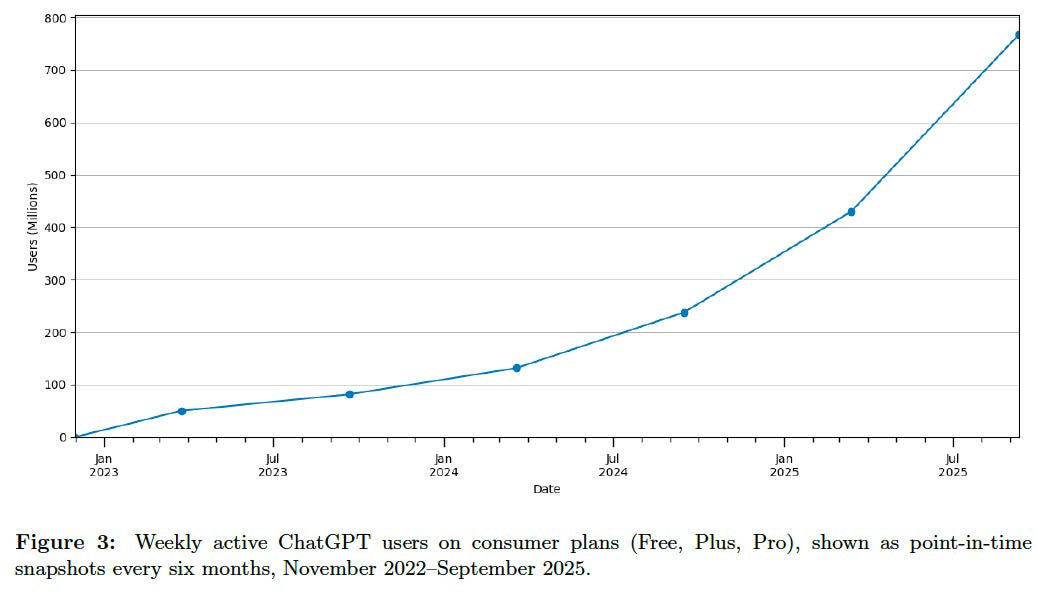
A new NBER working paper by researchers from OpenAI, Duke University, and Harvard provides the first comprehensive analysis of how people actually use ChatGPT, drawing on data from its launch in November 2022 through July 2025. By that point, ChatGPT had been adopted by roughly 10% of the world's adult population. The study finds that early adopters were disproportionately male, but the gender gap has since narrowed dramatically, and growth rates have been higher in lower-income countries.
Using a privacy-preserving automated classification pipeline on a representative sample of conversations, the researchers find that non-work usage has grown from 53% to over 70% of all conversations, outpacing the steady growth in work-related messages. Work usage skews toward educated users in highly-paid professional occupations. The three dominant conversation topics — "Practical Guidance," "Seeking Information," and "Writing" — collectively account for nearly 80% of all conversations. Writing is particularly dominant for work tasks, underscoring chatbots' distinctive advantage over traditional search engines in generating digital outputs. Notably, computer programming and self-expression represent relatively small shares of overall use, challenging common assumptions about LLM chatbot adoption patterns.
The paper concludes that ChatGPT's primary economic value lies in decision support, which is especially impactful in knowledge-intensive jobs. The study was conducted with Harvard IRB approval, though several authors are OpenAI employees, a disclosed affiliation.

A Reddit thread in r/PromptEngineering asks the community to share their best prompt engineering tips and strategies. The responses cover a wide range of practical techniques, from self-critique prompting (asking the LLM to critique its own response and then apply fixes) to structured prompt frameworks like Role-Task-Context-Output and RAPTOR (Role, Aim, Parameters, Tone, Output, Review). Several users emphasize the importance of consulting first-party documentation from frontier labs like OpenAI and Anthropic rather than relying on third-party guides, while one contrarian suggests simply asking the LLM itself how to best prompt it.
Other notable tips include using a "refresher" symbol embedded in prompts to re-orient the model when it drifts off-task during long conversations, employing a two-pass generation flow (generate options first, then pick and expand), and grounding outputs by requiring the model to cite specific quoted lines. Multiple commenters stress that prompt engineering is only one piece of the puzzle — tooling, evals, domain expertise, and context engineering play equally critical roles in achieving high-quality AI outputs. The thread serves as a useful snapshot of community-tested practices for anyone looking to move beyond basic prompting.
A new NBER working paper by Harvard's David Deming and a team of OpenAI researchers documents the remarkable growth of ChatGPT, which has reached over 750 million weekly active users — nearly 10% of the world's population — by mid-2025. The study reveals that total message volume has hit 2.6 billion messages per day, growing 5.8x in the past year. At this trajectory, ChatGPT message volume could match current Google search volume within just over a year, and notably, ChatGPT reached the 1 billion daily message milestone far faster than Google search reached 1 billion daily searches.
One of the most striking findings is that demographic gaps in ChatGPT usage are closing rapidly. Early adoption was dominated by highly educated men in wealthy countries, but by mid-2025, users with typically female names slightly outnumber male users. Middle-income countries have seen 5-6x growth in usage, narrowing the gap with wealthier nations — Brazil, South Korea, and the U.S. now show relatively similar adoption rates despite vast differences in GDP per capita. Usage intensity is also increasing across all user cohorts, suggesting the product has become substantially better or more user-friendly, particularly since late 2024.
Deming emphasizes the privacy-preserving methodology used in the study. No researcher ever saw individual message content or personal information. Instead, automated classifiers analyzed anonymized messages, and all demographic analysis was conducted through a Data Clean Room that only returned aggregate output. While these restrictions limited the depth of analysis possible, Deming frames this as setting a high bar for responsible research on sensitive user data. A second post is promised to explore what people actually use ChatGPT for and implications for the economy.
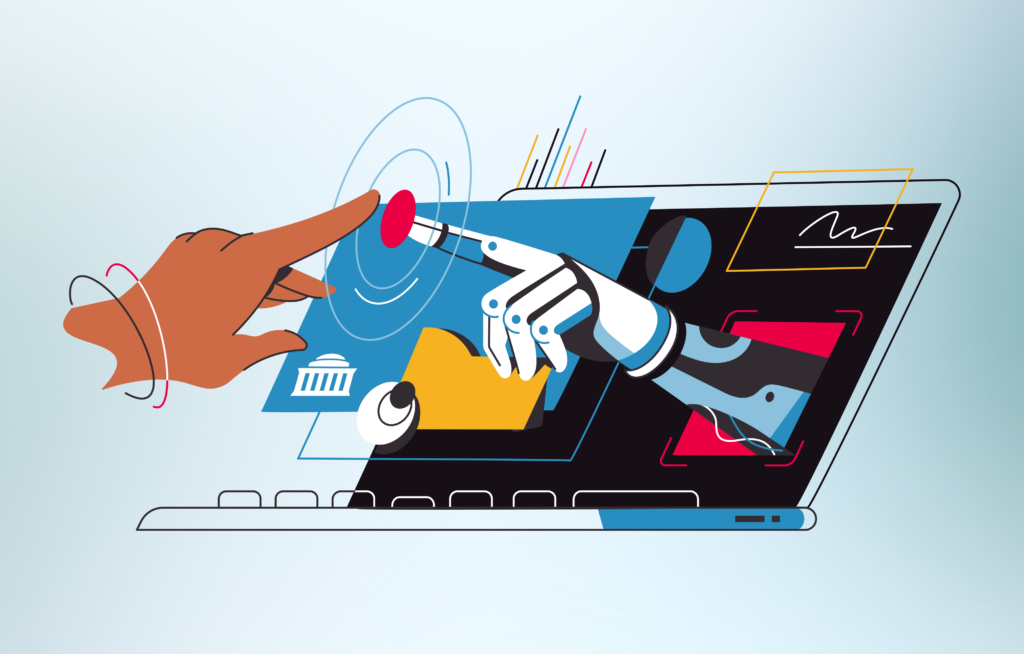
MIT Sloan's Teaching & Learning Technologies team provides a practical guide to crafting effective prompts for AI systems like ChatGPT and Claude. The article frames prompts as conversation starters and emphasizes three core strategies for prompt engineering: providing context, being specific, and building on the conversation iteratively. It introduces a useful taxonomy of prompt types — including zero-shot, few-shot, role-based, and contextual prompts — each suited to different tasks and goals.
The guide also addresses important limitations. It highlights the distinction between prompt engineering and problem formulation, citing research suggesting that clearly defining problems and goals may ultimately matter more than perfecting prompt syntax, especially as AI platforms increasingly refine inputs automatically. The article warns users about AI hallucinations, factual inaccuracies, and harmful biases — including a notable example involving an MIT student whose AI-generated headshot altered her racial features. While prompt crafting remains a valuable skill today, the piece encourages critical thinking and vigilance when evaluating AI-generated outputs.
Mira Murati, then a key leader at OpenAI, shares a post emphasizing the company's mission to advance scientific understanding for the benefit of human well-being. She highlights several of OpenAI's flagship tools — Sora, GPT-4o, DALL·E, and ChatGPT — noting that while they are technically impressive, their real significance lies in how they are beginning to change the way people work, create, and interact.
The post is truncated, but its framing suggests Murati is steering the conversation away from pure technical achievement and toward real-world impact and practical transformation enabled by AI tools. It reflects OpenAI's broader messaging strategy of positioning its products as tools for human empowerment rather than technology for its own sake.