Editor's Synopsis
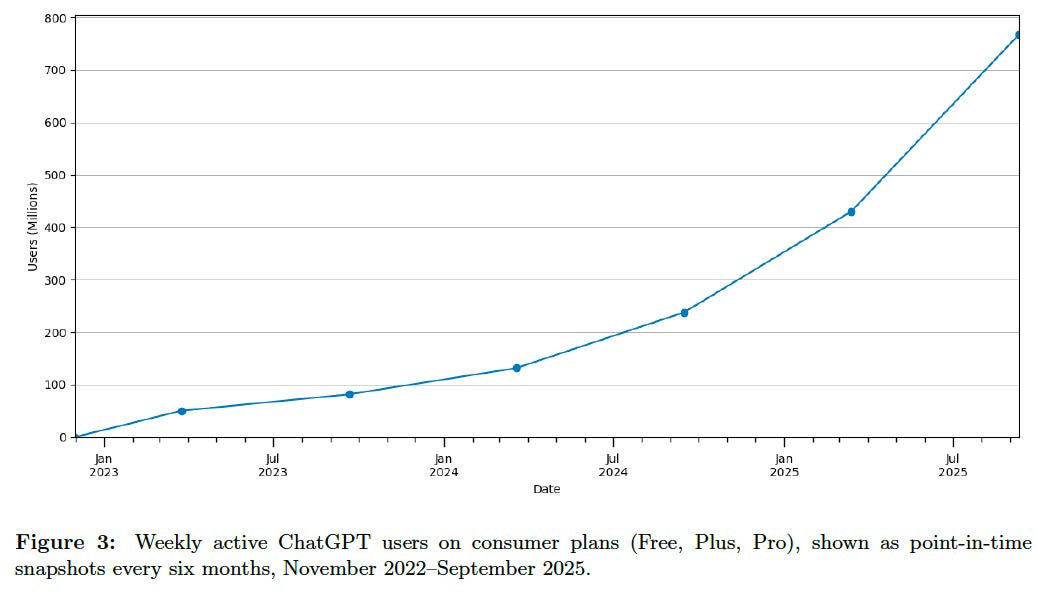
A new NBER working paper by Harvard's David Deming and a team of OpenAI researchers documents the remarkable growth of ChatGPT, which has reached over 750 million weekly active users — nearly 10% of the world's population — by mid-2025. The study reveals that total message volume has hit 2.6 billion messages per day, growing 5.8x in the past year. At this trajectory, ChatGPT message volume could match current Google search volume within just over a year, and notably, ChatGPT reached the 1 billion daily message milestone far faster than Google search reached 1 billion daily searches.
One of the most striking findings is that demographic gaps in ChatGPT usage are closing rapidly. Early adoption was dominated by highly educated men in wealthy countries, but by mid-2025, users with typically female names slightly outnumber male users. Middle-income countries have seen 5-6x growth in usage, narrowing the gap with wealthier nations — Brazil, South Korea, and the U.S. now show relatively similar adoption rates despite vast differences in GDP per capita. Usage intensity is also increasing across all user cohorts, suggesting the product has become substantially better or more user-friendly, particularly since late 2024.
Deming emphasizes the privacy-preserving methodology used in the study. No researcher ever saw individual message content or personal information. Instead, automated classifiers analyzed anonymized messages, and all demographic analysis was conducted through a Data Clean Room that only returned aggregate output. While these restrictions limited the depth of analysis possible, Deming frames this as setting a high bar for responsible research on sensitive user data. A second post is promised to explore what people actually use ChatGPT for and implications for the economy.