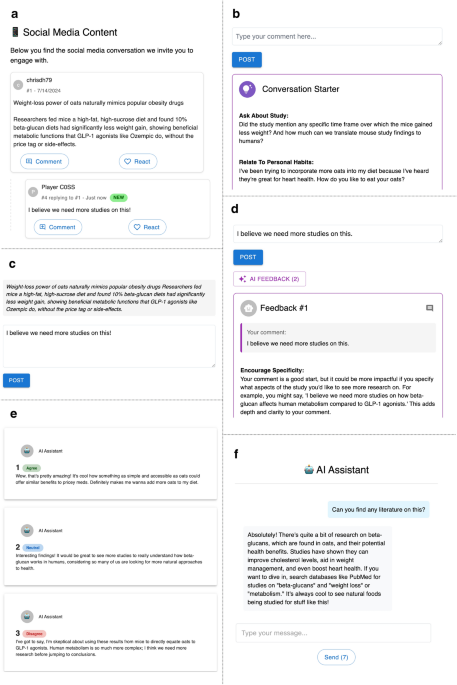
A controlled experiment involving 680 U.S. participants investigates how four distinct generative AI tools—Chat assistance, Conversation Starters, Feedback on drafts, and reply Suggestions—affect both content producers and consumers in a realistic social media environment. Participants were organized into groups of five and discussed three topics (dogs vs. cats, health benefits of oats, and universal basic income) across different experimental conditions. The study reveals a critical duality: while AI tools increase user engagement, content volume, and participation equality, they simultaneously decrease perceived quality and authenticity of discussions. Consumers rated AI-assisted content as more "robotic" and "generic," and all AI treatments significantly increased dislike reactions compared to the control group.
The research uncovers nuanced usage patterns across tools and topics. Chat was widely adopted (94.4%) with users adapting their prompts to context—casual queries for lighter topics, fact-checking for scientific discussions, and political engagement for divisive subjects. Conversation Starters improved participation equality but were often misaligned with user intent, with 27.5% of users diverging entirely from AI suggestions. Feedback was most valued in high-stakes discussions requiring argumentation and credibility, while Suggestions showed a notable bias toward agreeing stances in controversial topics. Critically, no single AI tool improved both producer and consumer experiences simultaneously.
Based on these findings, the authors propose four design principles for integrating AI into social media: transparent disclosure of AI-generated content, user-focused personalization, context-sensitivity accounting for topic and intent, and intuitive user interfaces. The study represents one of the first direct experimental tests of whether generative AI can genuinely elevate online discussions, with evidence suggesting it more likely amplifies low-quality interaction and creates negative spillover effects on conversations—even affecting users who don't use the AI tools themselves.
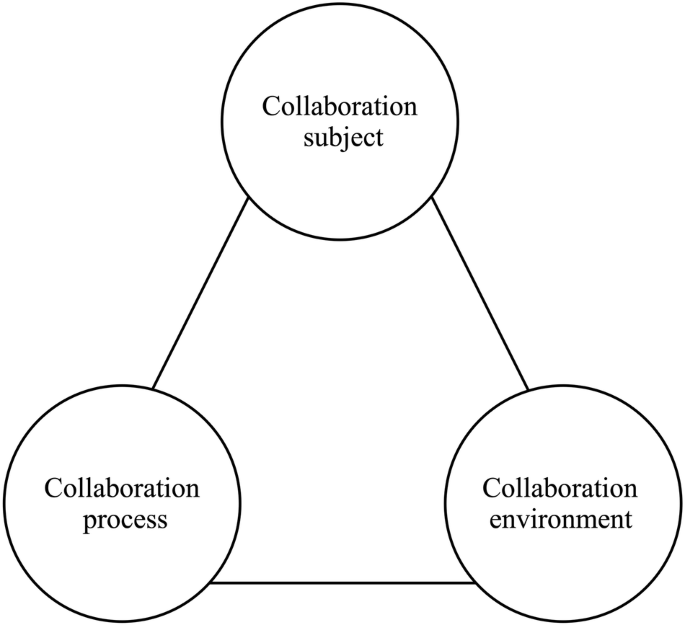
This study introduces the Human–AI Synergy Degree Model (HAI-SDM) to evaluate and understand collaboration between human teachers and AI systems (specifically educational robots) in hybrid intelligence learning environments. The researchers propose that effective human–AI classroom collaboration can be analyzed through three subsystems: collaboration subject (teachers, students, and AI machines), collaboration process (goals, methods, and teaching processes), and collaboration environment (space–time structure, infrastructure, and key technologies). The model draws on Haken's synergetics theory to measure both the order degree within each subsystem and the synergy degree across the entire system.
A case study was conducted in an eighth-grade English class in Beijing, China, involving 40 students, one teacher, and an educational robot across 12 teaching activities over a 40-minute lesson. The findings reveal that the order degree between human teacher and AI machines remains at a moderate level with dynamic fluctuations, while the synergy degree fluctuates between low and moderate levels. This suggests that while the three subsystems develop in a relatively orderly fashion individually, one subsystem may exhibit disordered behavior relative to the others, undermining overall collaboration effectiveness. The research highlights the need for more deliberate design strategies to optimize human–AI collaboration in classrooms and provides a quantitative framework that moves beyond purely technological assessments of AI in education toward evaluating the systemic dynamics of human–AI interaction.
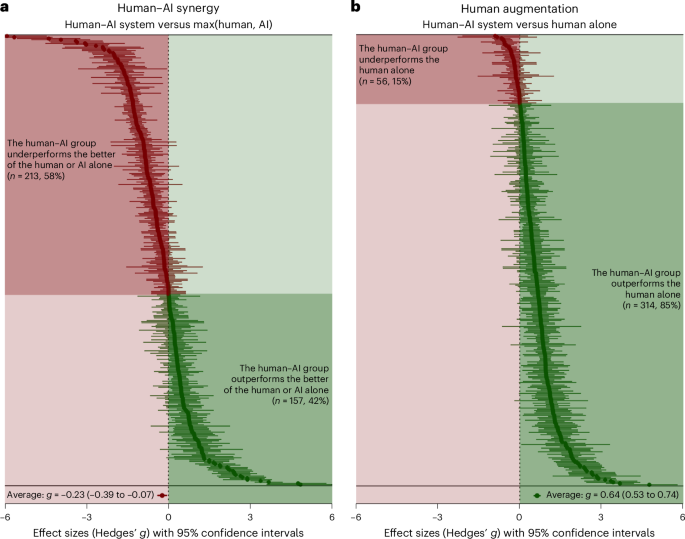
A systematic review and meta-analysis published in Nature Human Behaviour examines whether combining humans and AI yields better performance than either alone. Researchers analyzed 106 experimental studies with 370 effect sizes published between January 2020 and June 2023, finding that on average, human–AI systems performed significantly worse than the best of humans or AI alone (Hedges' g = −0.23). However, these combinations did outperform humans working alone, demonstrating what the authors call human augmentation (g = 0.64). The findings challenge the widespread assumption that pairing humans with AI automatically produces superior results.
The study identifies critical moderating factors. Task type matters significantly: decision tasks (choosing among finite options) showed performance losses, while creation tasks (generating open-response content) showed performance gains from human–AI collaboration. The relative performance gap between human and AI also proved crucial — when humans outperformed AI alone, the combination achieved genuine synergy (g = 0.46), but when AI outperformed humans, the combination suffered losses (g = −0.54). The authors hypothesize that when humans are more skilled at a task, they are also better at judging when to trust their own judgment versus the AI's suggestions.
Notably, factors that have received significant research attention — such as providing AI explanations or confidence scores — did not significantly affect human–AI system performance. The authors suggest researchers should shift focus toward less-studied but more impactful factors like task type, baseline performance differences, and division of labor between humans and AI. They also note that only 3 of 100+ experiments explored predetermined delegation of subtasks to humans and AI, pointing to a largely unexplored but promising design approach for achieving genuine human–AI complementarity.
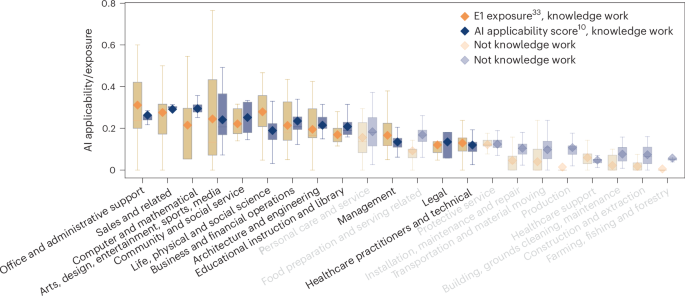
A Nature Computational Science perspective article by Microsoft Research authors explores how generative AI is reshaping knowledge work — and who actually benefits. Recent empirical research shows that people primarily use generative AI for high-complexity, knowledge-work tasks, but the distribution of these benefits is far from equal. The paper examines social and place-based divides in AI adoption, highlighting disparities across demographics, geographies, and economic contexts.
The authors reference data on AI exposure across occupational groups and global internet traffic patterns to ChatGPT, revealing significant inequities in access and usage. While AI tools like GitHub Copilot and Microsoft 365 Copilot have demonstrated measurable productivity gains — particularly for lower-skilled workers who see the largest relative improvements — concerns remain about displacement in creative fields such as translation, illustration, and media. The paper also draws on Bloom's taxonomy to frame how AI affects different cognitive task levels and warns that uncritical reliance on AI can actually harm learning outcomes.
The perspective calls for both technical and social interventions to ensure AI democratizes rather than concentrates knowledge work. Issues such as multilingual AI performance gaps, regional digital divides, and uneven organizational adoption are identified as key barriers. The authors argue that without deliberate action, generative AI risks exacerbating existing inequalities among workers and across nations, rather than bridging them.
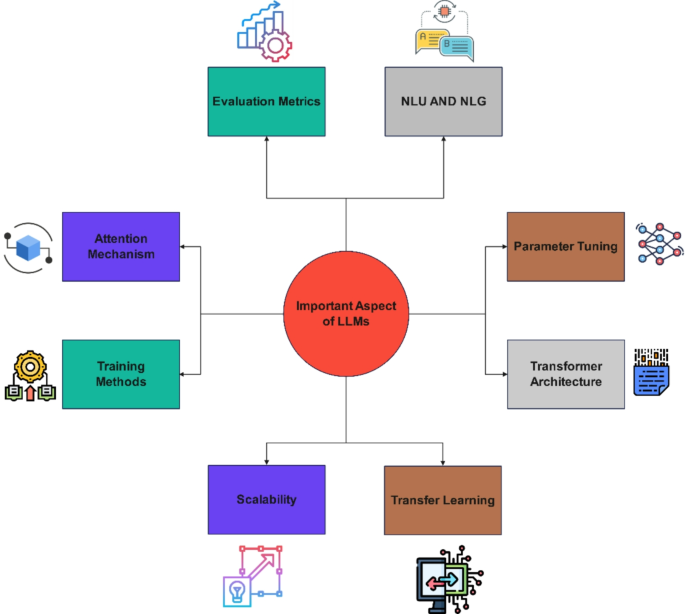
This Scientific Reports paper provides a comprehensive review of large language models (LLMs) and their applications across major industries. The authors trace the evolution of LLMs from early statistical language models and RNNs through the introduction of transformer architectures, which enabled breakthroughs like BERT, GPT, and LLaMA. The review covers key technical aspects including attention mechanisms, training methods, and evaluation metrics, providing a foundation for understanding how these models function at scale.
The study examines LLM applications across five major industries: healthcare and medicine (disease diagnosis, treatment planning, patient data management), automotive (predictive maintenance, autonomous driving), e-commerce (recommendation systems, consumer behavior analysis), education (personalized learning, automated grading), and finance and banking (fraud detection, risk management, customer service automation). The authors distinguish their work from prior reviews by covering multiple industries simultaneously rather than focusing on just one or two domains.
Despite the transformative potential, the paper highlights significant challenges including ethical concerns, biases in training data, data security and privacy issues, and substantial computational resource requirements. The authors argue these must be addressed for responsible and sustainable deployment. The review synthesizes over 100 research articles from 2020–2024, offering researchers a consolidated view of the current state and future directions of industrial LLM adoption.