Tencent Games is pursuing a multi-layered global strategy that goes beyond simply acquiring studios and forcing them into live-service development. The article, prompted by the shutdown of Highguard, argues that Tencent's approach is more nuanced than it appears: rather than imposing a universal formula, the company targets studios like Funcom, Fatshark, and Grinding Gear Games that already possess long-cycle game development DNA, then layers on its structural advantages in live-ops analytics, regional publishing, and infrastructure.
On the premium side, minority investments in studios like Larian Studios and FromSoftware reflect Tencent's interest in understanding how evergreen IPs compound value over multiple product cycles — prioritizing exposure to durable creative philosophies over outright ownership. The article highlights AI as potentially the most disruptive element, arguing that Chinese developers may adopt AI-driven production tools faster due to fewer labor, copyright, and creative ownership constraints compared to Western studios.
Tencent's overarching thesis is framed as building games that become player ecosystems, supporting studios capable of enduring franchise creation, and leveraging AI to reshape development economics. The article notes significant execution risks, citing past studio separations and failed investments, and points to Dune: Awakening as an early test of whether this refined, capability-driven investment framework can deliver results.

Barry O'Reilly shares his personal journey from burnout and overwhelm to building an AI-powered productivity system that transformed how he works as a leader. Drawing from nearly a decade of experimentation—starting with tools like Rev.com for dictating his book and Otter.ai for meeting notes—he describes how he systematically identified tasks to offload and automate, ultimately reclaiming hours each week for strategic thinking and deep work.
The article presents findings from a survey of over 5,000 leaders, revealing that 72% don't know where to start with AI, 61% lack a clear AI strategy, yet 92% believe AI could significantly boost their productivity. O'Reilly argues that the core challenge is strategic and behavioral, not technical. He outlines four key principles: start with tasks rather than tools, treat AI like a junior analyst rather than a magic wand, design workflows before automating them, and pair AI's velocity with strategic clarity. Real-world examples show leaders saving 5–10 hours per week through targeted AI integration.
The piece pushes back against the tendency to simply play with AI tools for the dopamine hit, urging leaders to shift from prompt-playing to workflow design and from task automation to outcome architecture. O'Reilly offers free assessment tools and cohort programs as next steps, concluding with the insight that AI amplifies existing leadership habits—making intentional calendar and priority design essential before layering on technology.

Neil Perkin argues that AI's greatest value isn't just efficiency — it's serving as a thought partner that challenges assumptions, surfaces blind spots, and opens new lines of exploration. He warns against cognitive debt, the tendency to grow intellectually lazy by outsourcing thinking to AI, and advocates for systematizing approaches that combine AI with human cognition to generate genuinely new possibilities.
The post outlines several concrete techniques for using AI this way. Perspective triangulation involves curating a syllabus of source material and asking the model to contrast clashing viewpoints on a topic, forcing it to reason across tensions rather than averaging them. The Board of Brains method, borrowed from Anthropic's Lani Assaf, involves creating persistent AI projects that embody specific advisors or experts, each reviewing your work through their unique lens. Role-play debate simulates live multi-perspective discussions that reveal hidden assumptions.
Perkin also shares several prompting techniques: norm switching (applying norms from unrelated sectors), constraint reversal (imposing absurd constraints to force lateral thinking), counterfactual storyboards (narratives where key assumptions are inverted), forced analogy engines (mapping random domains to your challenge), negative inversion (listing spectacular failure modes then inverting them), and ladder up/ladder down (toggling between strategic 'why' and executional 'how' to expose gaps between intent and action). The overarching message is that intellectual curiosity becomes even more important in the AI era — using AI like a search engine means missing its potential to take your thinking to places you couldn't reach alone.

Y Combinator presents a resource from its Startup Library on how to use AI in your startup. While the full content of the page was not available in the saved version, the resource is part of YC's curated library of advice for founders. It likely covers practical strategies for integrating artificial intelligence into early-stage companies, including guidance on where AI can add the most value, common pitfalls to avoid, and how startups can leverage AI tools effectively to build better products and gain competitive advantages.
As part of YC's broader educational library, this piece is aimed at startup founders and teams looking to understand and adopt AI technologies in a meaningful way rather than simply following hype. The resource reflects YC's ongoing emphasis on helping founders make pragmatic, high-impact decisions about emerging technologies.

Lenny Rachitsky challenges conventional wisdom about how AI will impact product management, arguing that the truth is the opposite of what most people expect. While polls suggest PMs believe low-level execution and communication tasks will be most affected by AI, Rachitsky contends that AI will have the most profound impact on high-level strategic skills — developing strategy, crafting vision, identifying opportunities, and setting goals — because AI excels at analyzing massive amounts of data and producing insightful answers. He draws parallels to AlphaGo's famous move 37, Sam Altman's plan to have AGI figure out OpenAI's business model, and Jensen Huang's prediction that AI will replace programming.
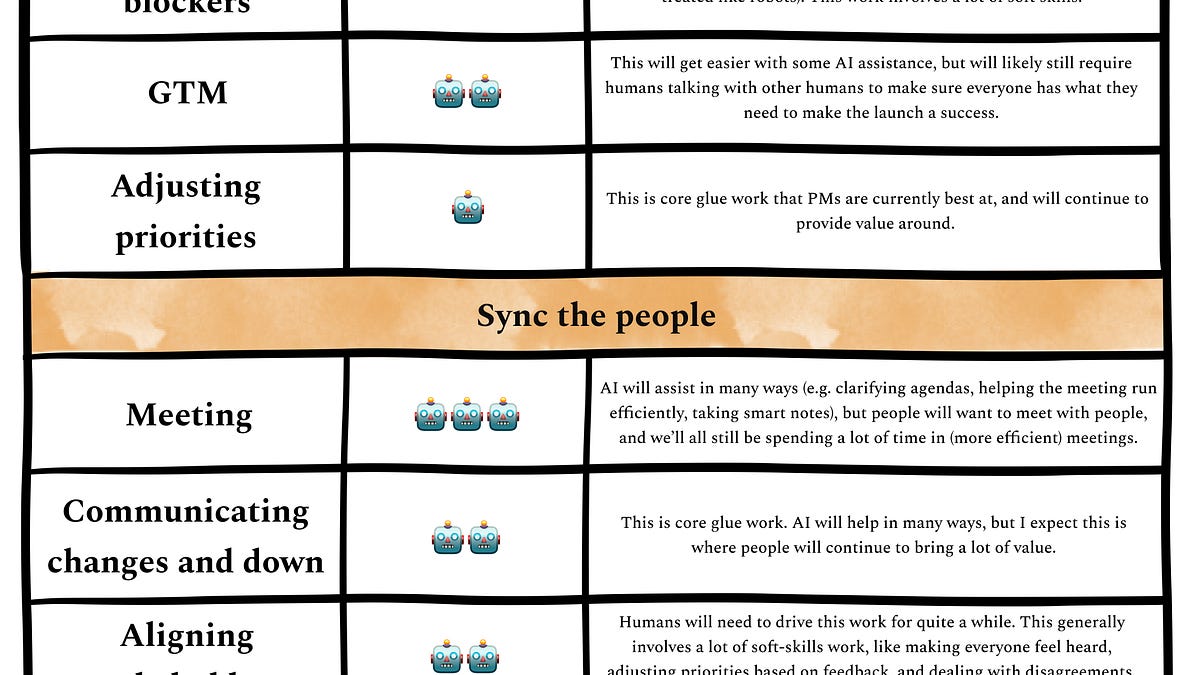
Conversely, Rachitsky argues that soft skills will become even more valuable and serve as key differentiators among companies. Skills like aligning stakeholders, unblocking teams, building buy-in, understanding nuance, and creating delightful user experiences are where humans will retain an edge for the longest. He frames the PM role as consisting of three core jobs — shaping the product, shipping the product, and enabling the team — and ranks each sub-task on a 1-to-5 scale of AI disruption. Strategy and goal-setting receive the highest disruption scores (4 out of 5), while tasks like giving design feedback and building roadmaps score lower, reflecting the continued need for human judgment, collaboration, and creativity. The key takeaway: PMs should double down on soft skills while learning to leverage AI as a force multiplier for their hard skills.
Egon Zehnder explores how AI is transforming the product management function across three critical dimensions: shaping the product (strategy, discovery, goal setting), shipping the product (execution, QA, resource management), and communication and collaboration. AI-powered tools now enable data-driven product strategy at unprecedented scale, assist in drafting user stories via NLP and generative AI, predict project risks, and streamline cross-functional coordination through automated meeting summaries and stakeholder updates.
The article argues that AI is not replacing product managers but elevating the role toward higher-value activities. As tactical tasks become automated, PMs must shift focus to strategic vision, user-centric innovation, ethical considerations, and emotional intelligence. The piece categorizes PM tasks into three tiers: those significantly impacted by AI (strategy development, QA, roadmap optimization), those enhanced but still human-driven (spec creation, stakeholder communication), and those that will always require a human touch (critical thinking, creative problem solving, strategic storytelling).
Key recommendations include upskilling in data literacy and strategic thinking, leveraging AI tools while maintaining human oversight, and fostering organizational cultures of continuous learning and experimentation. The core takeaway is that product managers who learn to pair machine intelligence with human insight will define the future of the function, while those who ignore AI risk being left behind.