
Sachin Rekhi observes that while AI is transforming the product manager role, the impact has been uneven across different PM responsibilities. He highlights customer discovery as one area where AI is making significant strides, enabling PMs to generate robust interview scripts and synthesize customer insights more efficiently.
The post appears to be the beginning of a longer thread exploring how AI tools are reshaping specific aspects of product management work, distinguishing between areas seeing rapid AI-driven transformation and those where the impact remains more limited.
A product manager with 3–4 years of experience in AI products shares a candid critique of the "AI Product Manager" role as it exists today, particularly in the Indian startup ecosystem. The author argues that many positions marketed as AI PM roles are actually implementation and customer success roles disguised with an AI label. In these roles, the core AI platform is already built by engineering teams, and the PM's job reduces to configuring prompts, designing conversation flows, and deploying the system for enterprise clients — not shaping the product's roadmap or working on core AI capabilities.
The post highlights a frustrating career trap: after spending one or two years in such a role, professionals find themselves stuck. They lack the ML engineering background that companies building serious AI infrastructure demand, yet their experience is too AI-focused for generic PM roles. The author also challenges the prevailing hype, estimating that AI improves enterprise workflow efficiency by roughly 20–25 percent — far from the transformational claims commonly made. Many startups, the author notes, are essentially API wrappers built on top of OpenAI or Anthropic, yet hiring expectations still reflect an older era when AI products required deep ML research expertise.
Commenters largely validate the observations, with several noting that the implementation-vs-core-product distinction is a longstanding pattern in PM hiring that AI has merely amplified. Others draw parallels to previous hype cycles around mobile, blockchain, and growth PM titles, predicting that "AI PM" will eventually dissolve into standard product management as the technology matures. The consensus advice: before accepting an AI PM role, carefully evaluate whether the position involves building and evolving the core product or merely deploying it for clients.
Aakash Gupta discusses a notable career move by Logan, the Head of Product on Google AI Studio and the Gemini API, who has dropped the Product Management title in favor of "member of the technical staff." Gupta poses the question of whether this signals a broader shift in how the PM role is evolving, particularly in AI-driven organizations.
Gupta argues this is not a preview of the future of product management, noting that Logan was not a traditional PM — his previous role was in Developer Relations. The implication is that this title change reflects Logan's unique background and the specific nature of his work rather than a systemic trend away from the PM function. The post touches on ongoing debates about the relevance and evolution of product management roles in highly technical, AI-focused teams.
A Reddit discussion in r/ProductManagement tackles the question of what an AI Product Manager actually is, sparked by a user returning to the field after an academic break. The community's responses range from dismissive — calling it "marketing BS" and just a PM who works on AI products — to more nuanced takes that draw meaningful distinctions. A recurring theme is that most people slapping "AI PM" on their title are simply regular PMs who integrate LLM features into existing products, not specialists with deep AI expertise.
Several commenters offer more substantive frameworks. One CEO/CPO distinguishes between PMs who merely leverage an LLM for a use case and true AI PMs who understand MLOps, RLOps, LLMOps, and work on core AI platforms or models. Another commenter separates the role into Platform AI PMs (building AI/GenAI infrastructure) and Applied AI PMs (integrating AI experiences into products), predicting all PMs will eventually shift to the latter category. A practical insight emerges that 75% of what stakeholders request as "AI" is better served by traditional ML models rather than generative AI, though this claim is contested by others who note LLMs are now state-of-the-art for NLP tasks.
The thread also surfaces frustrations about the hiring landscape, where years of ML experience are dismissed because candidates lack specific LLM experience, and seasoned PMs worry their tenure counts for nothing without AI credentials. The consensus leans toward AI PM being a legitimate specialization when it involves deep technical knowledge of AI systems, but largely a buzzword when applied to PMs simply adding chatbot features to existing products.
Marty Cagan and Marily Nika outline what makes AI product management distinct from conventional product management, framing it through the lens of four critical product risks: feasibility, usability, value, and viability. They argue that just as "Mobile PM" was once a specialized skill that eventually became table stakes, AI product management will soon be expected of all product managers. The article focuses specifically on AI-powered applications rather than underlying infrastructure, drawing a parallel to the platform-versus-experience product distinction.
The authors detail how each risk category intensifies with AI. Feasibility risk is heightened because generative AI is probabilistic, not deterministic — making training data quality, error rates, and appropriate use-case matching paramount. Usability risk demands new approaches to transparency, explainability, and trust-building in the user experience. Value risk requires product managers to ensure AI features deliver genuine incremental benefit rather than serving as marketing checkboxes. Viability risk encompasses unit economics (still uncertain for many AI products), data provenance and copyright concerns, legal liability for probabilistic outputs, and ethical considerations around bias, hallucinations, and misuse by bad actors. The piece underscores that these viability questions fall squarely on the AI product manager's shoulders, making deep knowledge of users, data, business context, and technology more critical than ever.

Aaron Levie, CEO of Box, observes a growing trend of product managers using AI to create functional product prototypes. He notes that this approach is accelerating the ideation phase by roughly 5-10X, primarily because ideas can be demonstrated much more quickly, which in turn sparks faster conversations and feedback loops. The post appears to be the beginning of a longer thread, hinting at a "but" that likely addresses caveats or limitations of this AI-driven prototyping approach.
Marty Cagan of Silicon Valley Product Group reflects on two years of generative AI's impact on product management, distinguishing between AI as a feature in products versus AI as a tool that changes how products are built. He acknowledges that despite a flood of announcements and bold predictions, the actual transformation has been slower than he hoped — his end-of-2023 predictions proved too optimistic about the pace of change.
Cagan highlights that most industry discussion focuses on delivery team product owners or feature team product managers, rather than empowered team product management, which is his primary area of interest. He notes that while AI tools clearly accelerate code creation and design work, faster production doesn't necessarily translate into better outcomes. The article poses several unresolved questions for product model companies, including how generative AI changes product discovery, which PM skills become more or less important, and whether AI will drive genuine innovation or merely incremental optimizations.
A key tension Cagan identifies is the pairing of strong product judgment with AI tools — he sees enormous potential when someone with deep product sense uses generative AI, but worries about the risks when people lacking foundational product skills rely on the same tools. Two years in, he concludes that while real progress has been made, the industry is still at the beginning of understanding AI's role in product management.
Aaron Levie, CEO of Box, shares his perspective on product management for AI agents, calling it "the wildest form of product management in history." He draws a contrast between traditional product management — which focuses on designing interfaces for people to interact with deterministic systems — and the emerging challenge of building products around AI agents. The post appears to be truncated, but the core insight highlights how conventional PM assumptions break down when the system itself is non-deterministic and the user's role shifts from direct interaction to delegation and oversight.
Aaron Levie, CEO of Box, shares a core product management principle for AI agents: the key challenge is determining what a very smart person — starting with zero context — would need to successfully complete a given task. He argues that the entire "game" of AI agent product design comes down to getting exactly the right information into the context window. This insight highlights how building effective AI agents is less about raw intelligence and more about context engineering — curating and delivering the precise inputs an agent needs to reason and act correctly.
Lenny Rachitsky challenges conventional wisdom about how AI will impact product management, arguing that the truth is the opposite of what most people expect. While polls suggest PMs believe low-level execution and communication tasks will be most affected by AI, Rachitsky contends that AI will have the most profound impact on high-level strategic skills — developing strategy, crafting vision, identifying opportunities, and setting goals — because AI excels at analyzing massive amounts of data and producing insightful answers. He draws parallels to AlphaGo's famous move 37, Sam Altman's plan to have AGI figure out OpenAI's business model, and Jensen Huang's prediction that AI will replace programming.
Conversely, Rachitsky argues that soft skills will become even more valuable and serve as key differentiators among companies. Skills like aligning stakeholders, unblocking teams, building buy-in, understanding nuance, and creating delightful user experiences are where humans will retain an edge for the longest. He frames the PM role as consisting of three core jobs — shaping the product, shipping the product, and enabling the team — and ranks each sub-task on a 1-to-5 scale of AI disruption. Strategy and goal-setting receive the highest disruption scores (4 out of 5), while tasks like giving design feedback and building roadmaps score lower, reflecting the continued need for human judgment, collaboration, and creativity. The key takeaway: PMs should double down on soft skills while learning to leverage AI as a force multiplier for their hard skills.
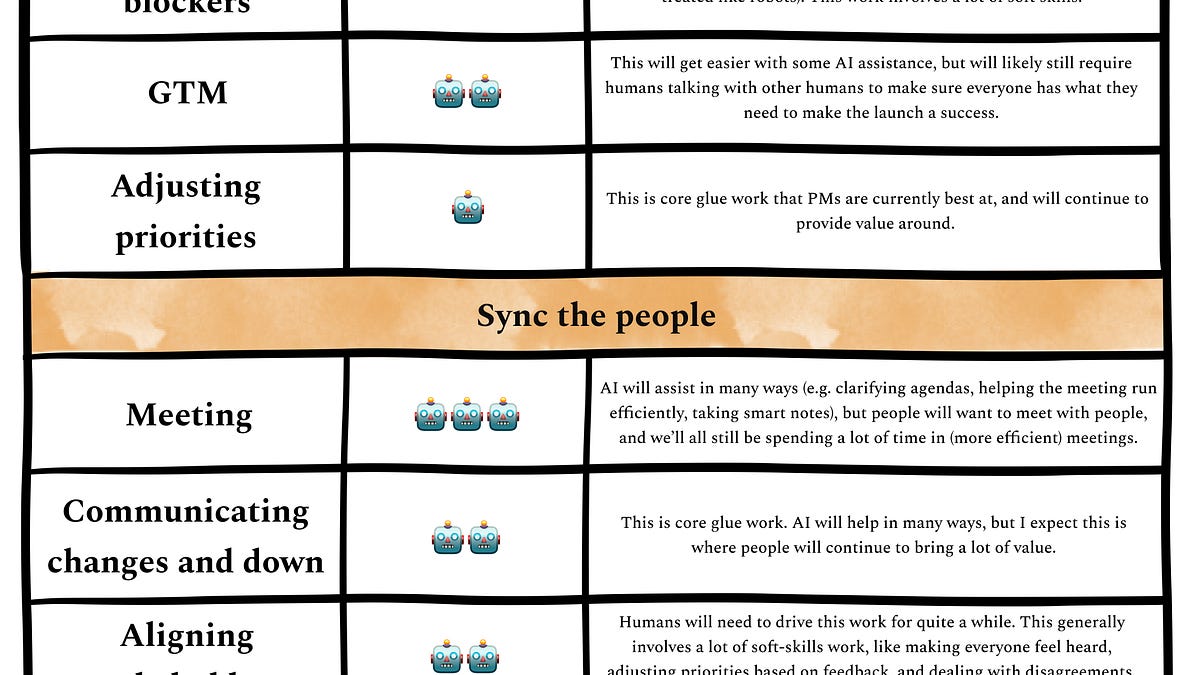
Egon Zehnder explores how AI is transforming the product management function across three critical dimensions: shaping the product (strategy, discovery, goal setting), shipping the product (execution, QA, resource management), and communication and collaboration. AI-powered tools now enable data-driven product strategy at unprecedented scale, assist in drafting user stories via NLP and generative AI, predict project risks, and streamline cross-functional coordination through automated meeting summaries and stakeholder updates.
The article argues that AI is not replacing product managers but elevating the role toward higher-value activities. As tactical tasks become automated, PMs must shift focus to strategic vision, user-centric innovation, ethical considerations, and emotional intelligence. The piece categorizes PM tasks into three tiers: those significantly impacted by AI (strategy development, QA, roadmap optimization), those enhanced but still human-driven (spec creation, stakeholder communication), and those that will always require a human touch (critical thinking, creative problem solving, strategic storytelling).
Key recommendations include upskilling in data literacy and strategic thinking, leveraging AI tools while maintaining human oversight, and fostering organizational cultures of continuous learning and experimentation. The core takeaway is that product managers who learn to pair machine intelligence with human insight will define the future of the function, while those who ignore AI risk being left behind.

Amanda Pratt and Melissa Valentine argue in Harvard Business Review that driving AI adoption requires more than prompt engineering or context engineering skills. While crafting effective inputs for large language models is useful, the real value emerges when employees learn to apply generative AI to improve their actual workflows. This demands capabilities like defining valuable problems, evaluating possible solutions, rapid experimentation, and sustainable integration of new practices into daily work—disciplines that are fundamentally core to product management.
The article reframes the AI skills gap not as a technical challenge but as an organizational one. Rather than focusing narrowly on how to talk to AI tools, teams should build the product management mindset needed to identify where AI creates genuine value, test solutions quickly, and embed changes into ongoing processes. This perspective shifts the conversation from tool proficiency to workflow transformation, suggesting that companies investing in product management competencies across their teams will see far greater returns from their AI investments.

Andrew Ng argues that as software development — particularly prototyping — becomes increasingly cheaper, the value shifts toward those who can decide what to build rather than those who build it. He highlights the role of Product Managers (PMs) as the key decision-makers on software teams and predicts that AI Product Management has a particularly bright future in this evolving landscape. The core insight is that reduced development costs will drive increased demand for strategic product thinking and vision.