
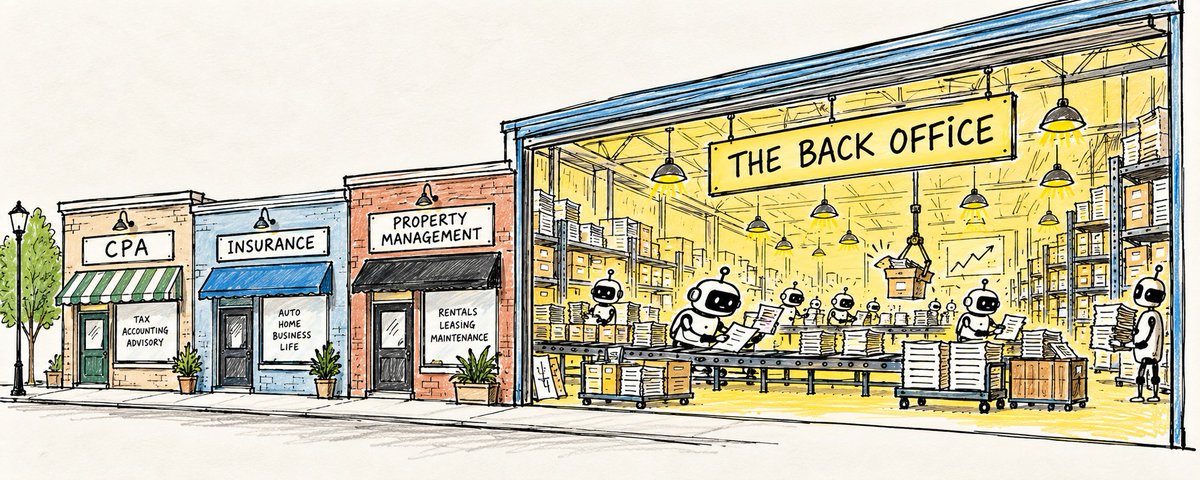
Greg Isenberg lays out a detailed playbook for what he calls AI roll-ups — acquiring small, boring service businesses from retiring baby boomers and using AI agents to dramatically increase profit margins. He argues that roughly $5 trillion worth of American businesses will change hands by 2035, mostly small firms in industries like accounting, property management, insurance, and IT services. The core thesis: buy these businesses at low multiples based on their current ~10% EBITDA margins, then rebuild the back office with AI agents to push margins to 30-40%, effectively tripling the value of the acquisition without changing the client base or revenue.
Isenberg highlights real examples including Thrive Holdings (which bought nearly 50 accounting practices and committed $1 billion more), General Catalyst ($1.5 billion allocated to this strategy), and Long Lake Property Management ($100M EBITDA in under two years). He emphasizes that this opportunity is especially accessible to solo founders and small operators, since the big funds can't economically pursue the vast majority of these sub-$2M businesses, and the AI tools (like OpenAI Codex and Claude Code) are available to anyone.
The guide goes deep into practical execution: a folder structure for the holding company, specific agent architectures separating preparers from reviewers, a scoring rubric for evaluating targets, a 100-day integration plan, and a weekly dashboard tracking five key metrics. He also covers what breaks — key people leaving, automating trust away, buying faster than you can integrate — and stresses that the relationship side of the business must stay human while the back office gets automated.
Chamath Palihapitiya highlights a new investment strategy being tested by major venture firms including Khosla Ventures, General Catalyst, and Thrive Capital. The approach involves acquiring mature, low-tech service businesses — such as call centers, accounting firms, and similar operations — and modernizing them internally using AI tools.
This signals a notable shift in venture capital strategy, moving beyond funding startups toward buying established businesses with stable revenue and applying AI to dramatically improve their efficiency and margins. The trend suggests that some of the biggest returns from AI may come not from building new products, but from transforming traditional service industries that have been slow to adopt modern technology.
Molly O'Shea highlights General Catalyst's AI Roll-Up strategy, noting that the firm screened 70 industries but exercised strict discipline by selecting only 10 for their approach. The post breaks down the compelling unit economics: even modest 20% revenue growth combined with a flat cost base and 20–30% task automation can transform a business running 10–15% EBITDA margins into one achieving roughly 30% margins, effectively doubling free cash flow. This illustrates how AI-driven operational efficiency, rather than top-line hypergrowth alone, can be the real value creation lever in roll-up strategies.