
This review article from Frontiers in Artificial Intelligence examines the intersection of AI deployment, privacy protection, and ethical standards. The authors explore how algorithmic techniques — specifically differential privacy, homomorphic encryption, and federated learning — can serve as effective tools for safeguarding individual privacy while preserving the utility of AI systems. The paper uses the Bletchley Summit as a case study, where 28 governments signed the Bletchley Declaration acknowledging AI's potentially catastrophic risks, and examines the tensions between the US and UK over leadership in AI regulation, including the establishment of the American AI Safety Institute within NIST.
Beyond privacy-preserving technologies, the study addresses broader ethical considerations including algorithmic bias, transparency, and accountability in AI decision-making. It discusses techniques like permutation importance, SHAP values, and LIME for improving model interpretability. The paper also examines AI deployment challenges across sensitive domains such as healthcare, finance, criminal justice, defence, and human resources, noting the need for compliance with frameworks like GDPR, HIPAA, and MiFID II.
The authors conclude that a comprehensive, multidisciplinary approach combining technological innovation with ethical and regulatory strategies is essential for responsible AI deployment. They call for "Ethics by Design" — integrating ethical considerations into the development phase rather than treating them as afterthoughts — and highlight future research needs including longitudinal assessment of AI governance models and the impact of quantum computing on current encryption methods.

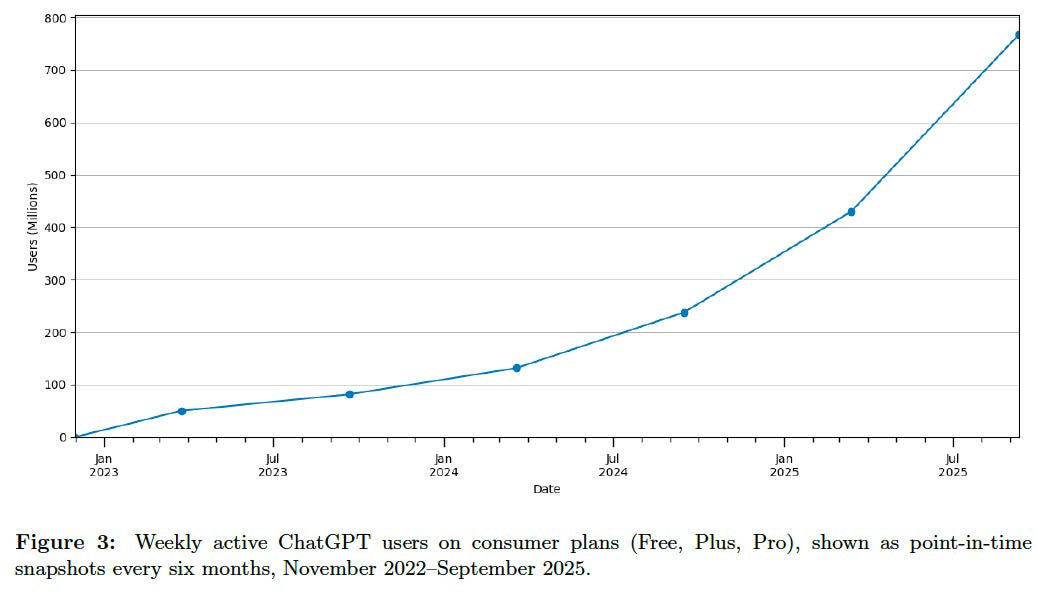
A new NBER working paper by Harvard's David Deming and a team of OpenAI researchers documents the remarkable growth of ChatGPT, which has reached over 750 million weekly active users — nearly 10% of the world's population — by mid-2025. The study reveals that total message volume has hit 2.6 billion messages per day, growing 5.8x in the past year. At this trajectory, ChatGPT message volume could match current Google search volume within just over a year, and notably, ChatGPT reached the 1 billion daily message milestone far faster than Google search reached 1 billion daily searches.
One of the most striking findings is that demographic gaps in ChatGPT usage are closing rapidly. Early adoption was dominated by highly educated men in wealthy countries, but by mid-2025, users with typically female names slightly outnumber male users. Middle-income countries have seen 5-6x growth in usage, narrowing the gap with wealthier nations — Brazil, South Korea, and the U.S. now show relatively similar adoption rates despite vast differences in GDP per capita. Usage intensity is also increasing across all user cohorts, suggesting the product has become substantially better or more user-friendly, particularly since late 2024.
Deming emphasizes the privacy-preserving methodology used in the study. No researcher ever saw individual message content or personal information. Instead, automated classifiers analyzed anonymized messages, and all demographic analysis was conducted through a Data Clean Room that only returned aggregate output. While these restrictions limited the depth of analysis possible, Deming frames this as setting a high bar for responsible research on sensitive user data. A second post is promised to explore what people actually use ChatGPT for and implications for the economy.
Google's Gemini has introduced an AI Inbox feature that processes users' entire email history — summarizing threads, answering questions about years of archived messages, and learning to mimic individual writing styles. According to Sooraj (@iAnonymous3000), the feature goes further by explicitly inferring personal relationships from message content and constructing a behavioral model of users based on their communication patterns.
This development raises significant privacy and surveillance concerns, as it means an AI system is actively analyzing intimate communication data at scale to build detailed profiles of how people write, who they interact with, and how those relationships function. The post highlights the growing tension between AI-powered convenience and the depth of personal data these tools consume to deliver it.