
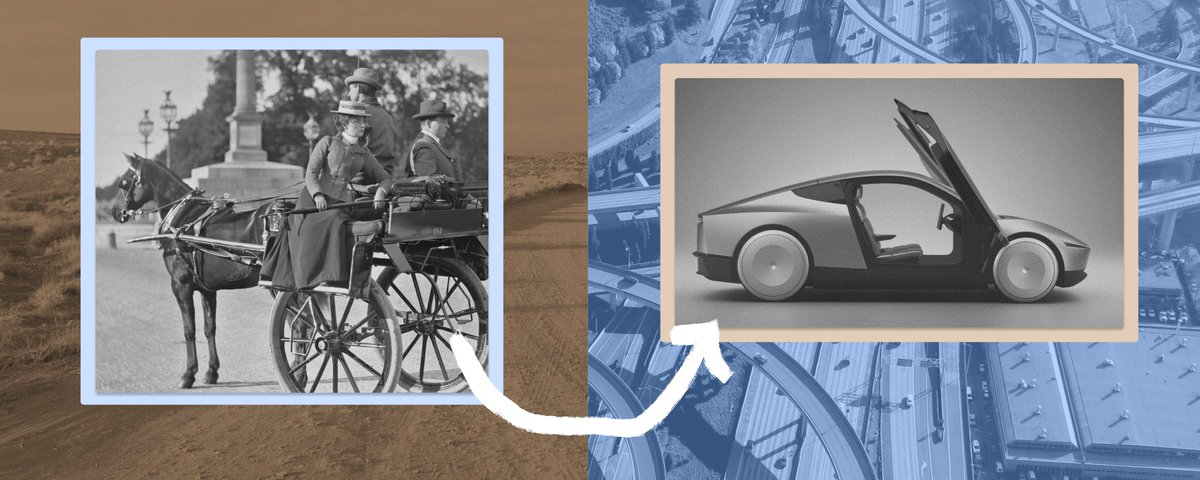
Joanne Chen of Foundation Capital presents findings from interviews with 25 companies about how AI is driving structural organizational change, not just individual productivity gains. The research reveals dramatic shifts: a 120-person engineering team planning to shrink to 25, expert-to-generalist ratios moving from 1:6 to a target of 1:100, and traditional roles like product, engineering, and design collapsing into fewer hybrid positions. The piece draws an analogy to factories switching from steam to electricity — the real gains came not from swapping power sources but from redesigning the entire system around the new technology.
The article identifies four human roles that remain essential in the AI-augmented org: chief accountability officers (executives who own outcomes), systems architects (who design human-agent collaboration), relationship experts (who maintain human-to-human trust), and validators (who review and approve agent outputs). Validator demand is expected to follow a bell curve, peaking in 2–4 years before declining as AI systems self-improve — but a critical "one-generation problem" emerges: if agents handle all junior work, the next generation of experts may never develop the foundational skills needed to validate AI output.
Chen maps four company archetypes along digital-vs-physical and product-vs-service axes, each facing distinct reorg patterns. Digital services firms face the most immediate pressure, as agents increasingly are the product. Seven startup opportunities emerge from these shifts, including tools for human system architects (like Arize), validator platforms (like Turing), agent-native infrastructure (like Sixtyfour), and AI-native services firms (like ConverzAI and Tessera Labs). The piece concludes that systems thinking — the ability to design workflows across humans and agents — is the most valuable and hardest-to-develop skill in the emerging organization.
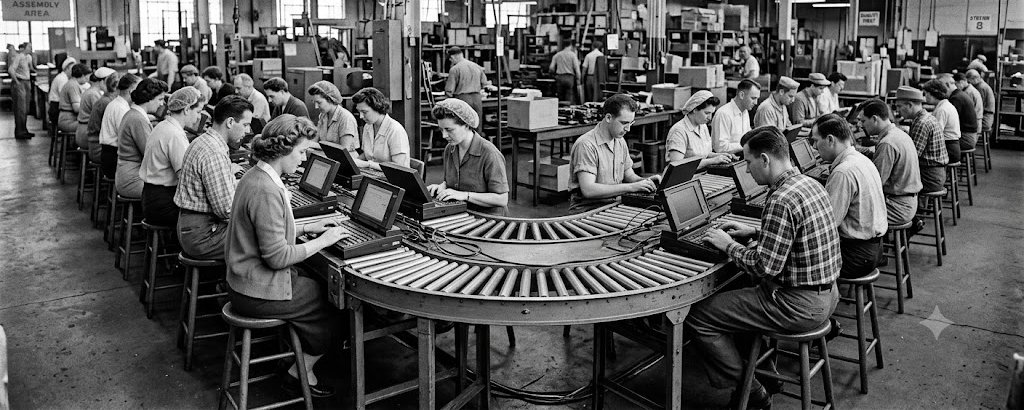
Alex Lieberman introduces the concept of the Software Factory, an engineering paradigm where building software shifts from individual craft to an industrialized production line. Rather than humans writing every line of code, agents handle writing, reviewing, testing, and deploying software while humans design the system and set guardrails. He cites examples like StrongDM (where code must not be written or reviewed by humans), Ryan Carson's "Code Factory" (shipping over a thousand pull requests via agents), and major companies like Anthropic (90%+ AI-written code) and Google (75% AI-generated code) as proof points.
The article presents a Software Factory Ladder with five levels (0–4), ranging from fully manual "Artisan" work to an "Autonomous Factory" where agents catch bugs, fix them, and ship changes before any human is aware. Lieberman provides diagnostic questions to help leaders assess where their engineering org sits on this ladder and practical guidance for climbing each rung — from simply giving engineers AI tools (Level 0→1) to eliminating the human review bottleneck (Level 2→3) by defining "low-risk" criteria and letting agent-reviewed, test-passing changes auto-merge.
Beyond engineering, Lieberman argues that verifiability is the key criterion determining which business function becomes the next "factory." Functions with automatically checkable outputs, digital workflows, high volume, and reversible mistakes — such as QA, data pipelines, DevOps, and parts of finance — are most ready for industrialization. Strategy, design taste, and relationship-building remain least factory-ready due to their subjective nature. He emphasizes that the real metric isn't "percentage of code written by AI" but how much of the production line runs without a human in it.
Arvind Narayanan comments on Anthropic's new Claude Tag feature, describing it as "extremely useful" for enterprises while simultaneously flagging significant concerns. He highlights the pricing model and the risk of lock-in as potential dangers for enterprise customers adopting the feature.
Narayanan notes that four major changes collectively shift the interaction paradigm — users now engage with Claude as a coworker rather than a tool, with persistent context and continuity across sessions. The post suggests a tension between the productivity gains of deeper AI integration and the strategic risks of becoming dependent on a single provider's ecosystem.
Sarah Guo shares an essay arguing that AI adoption is fundamentally a coordination problem, not a technology problem. She highlights that individuals adapt to AI faster than organizations do, and this gap between personal and institutional adoption is the primary source of confusion around seemingly "slow" AI adoption rates.
The core insight is that the bottleneck isn't people's willingness or ability to use AI tools — it's the organizational structures, workflows, and coordination mechanisms that lag behind. This framing recontextualizes the narrative around AI adoption speed and suggests that the real challenge lies in reshaping how organizations operate rather than convincing individuals of AI's value.
Julian Harris shares a reflection on the quote "Automation is the last step, not the first," calling it profoundly relevant to why companies are slow to embrace AI. He highlights that the process begins with understanding how things are done today — a phase so critical that consultants dedicate entire discovery phases to it, which alone can be costly and time-consuming.
The post underscores a key insight for organizations pursuing AI adoption: before automating any workflow, companies must first thoroughly map and comprehend their existing processes. This sequential approach — understand first, automate later — is presented as a fundamental reason why enterprise AI transformation takes longer than many expect.
Aaron Levie, CEO of Box, highlights what he sees as a growing execution gap between those who integrate AI agents into their workflows and those who don't. He argues that individuals, teams, and companies that adapt or build workflows around AI agents will have a significant velocity advantage for the foreseeable future. The post appears to be the beginning of a longer thread where Levie shares observations from recent conversations, suggesting real-world evidence is already emerging of this divergence in productivity and speed of execution.
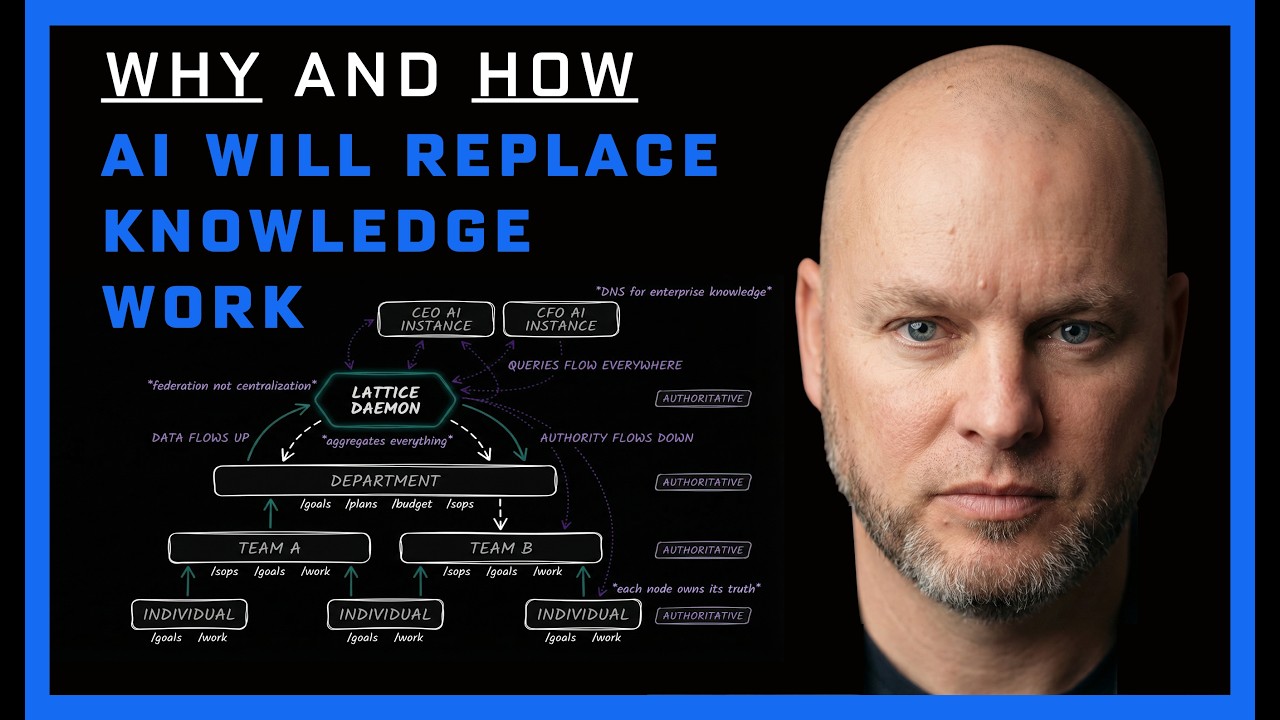
Daniel Miessler argues that AI will inevitably replace most knowledge work — not because AI is extraordinary, but because the current state of corporate work is deeply dysfunctional. Drawing on 25+ years of consulting across hundreds of Fortune 10,000 companies, he describes a landscape of unclear vision, inconsistent processes, undocumented institutional knowledge, empire-building politics, and blind leadership that can't even see what their organizations are doing. He frames this chaos as what AI is actually competing against, noting that $50+ trillion is spent annually on knowledge workers where only 21% are engaged and the majority are doing the minimum or actively disengaged.
Miessler dismantles the "human reliability myth" by drawing parallels between LLMs and human cognition — arguing that humans don't know where their thoughts come from, can't predict how they'll finish sentences, and have deeply flawed memory systems. He introduces a capability stack (knowledge, understanding, intelligence, creativity) and contends that AI already matches or exceeds humans on the first three layers, which constitute the vast majority of knowledge work. The real gap, he argues, is an "articulation gap" — expertise trapped in human heads that hasn't been documented into AI-executable skills and SOPs. This gap is closing through a one-way "expertise ratchet" where captured knowledge permanently enters the collective AI pool.
He proposes an architecture called the Lattice — an open-source system where every individual, team, department, and company broadcasts its goals, SOPs, metrics, and work items via APIs, giving leaders real-time visibility into operations. In this model, humans shift from being doers to overseers, leveraging what AI fundamentally lacks: subjective experience and desire. Miessler frames this transition as "Human 3.0" — moving from survival to corporate drudgery to creative self-expression — arguing that the loss of knowledge work jobs is ultimately liberation from a system everyone already knew was broken.
Paul Hsu shares key takeaways from an AI Ship Day (ASD) demos event, emphasizing that AI-native firms are fundamentally redesigning workflows rather than simply automating existing ones. He argues that competitive advantage comes from building workflows around value propositions curated for human judgment and AI execution, not from bolting AI onto legacy processes.
The core insight is that three elements matter most: workflows, value propositions, and curation. Hsu stresses that merely automating traditional workflows with AI is insufficient for gaining a competitive edge — instead, companies need to rethink their processes from the ground up with AI capabilities in mind.