Aakash Gupta discusses a notable career move by Logan, the Head of Product on Google AI Studio and the Gemini API, who has dropped the Product Management title in favor of "member of the technical staff." Gupta poses the question of whether this signals a broader shift in how the PM role is evolving, particularly in AI-driven organizations.
Gupta argues this is not a preview of the future of product management, noting that Logan was not a traditional PM — his previous role was in Developer Relations. The implication is that this title change reflects Logan's unique background and the specific nature of his work rather than a systemic trend away from the PM function. The post touches on ongoing debates about the relevance and evolution of product management roles in highly technical, AI-focused teams.
A Reddit discussion in r/ProductManagement tackles the question of what an AI Product Manager actually is, sparked by a user returning to the field after an academic break. The community's responses range from dismissive — calling it "marketing BS" and just a PM who works on AI products — to more nuanced takes that draw meaningful distinctions. A recurring theme is that most people slapping "AI PM" on their title are simply regular PMs who integrate LLM features into existing products, not specialists with deep AI expertise.
Several commenters offer more substantive frameworks. One CEO/CPO distinguishes between PMs who merely leverage an LLM for a use case and true AI PMs who understand MLOps, RLOps, LLMOps, and work on core AI platforms or models. Another commenter separates the role into Platform AI PMs (building AI/GenAI infrastructure) and Applied AI PMs (integrating AI experiences into products), predicting all PMs will eventually shift to the latter category. A practical insight emerges that 75% of what stakeholders request as "AI" is better served by traditional ML models rather than generative AI, though this claim is contested by others who note LLMs are now state-of-the-art for NLP tasks.
The thread also surfaces frustrations about the hiring landscape, where years of ML experience are dismissed because candidates lack specific LLM experience, and seasoned PMs worry their tenure counts for nothing without AI credentials. The consensus leans toward AI PM being a legitimate specialization when it involves deep technical knowledge of AI systems, but largely a buzzword when applied to PMs simply adding chatbot features to existing products.
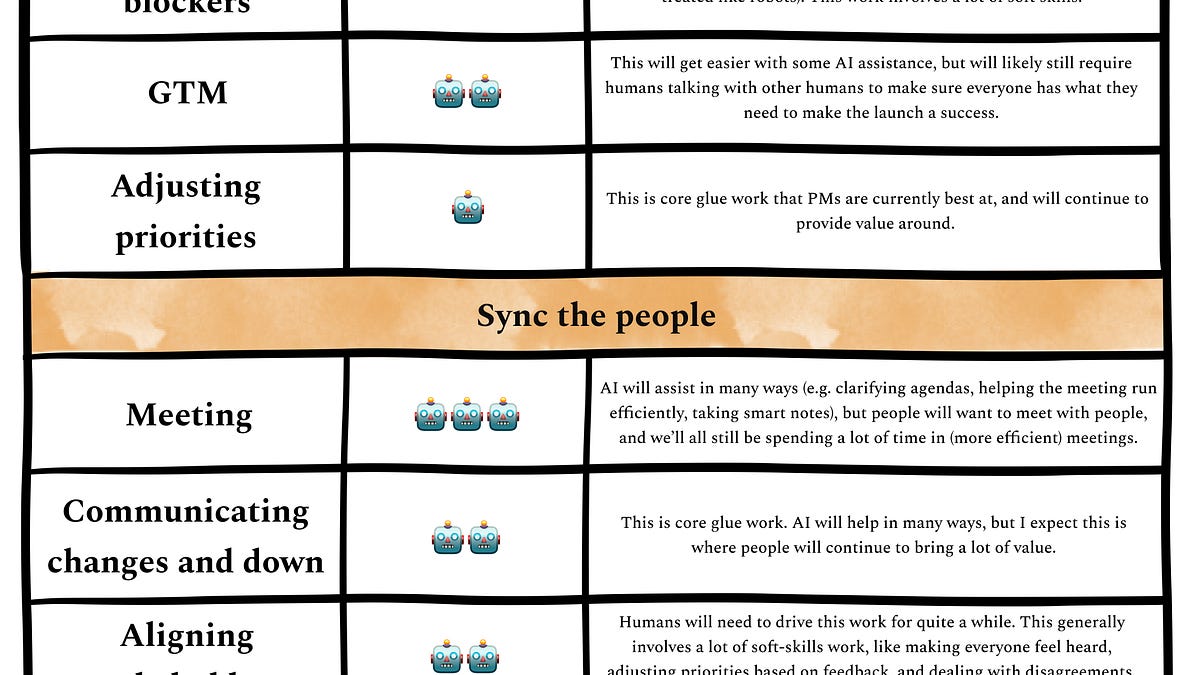
Lenny Rachitsky challenges conventional wisdom about how AI will impact product management, arguing that the truth is the opposite of what most people expect. While polls suggest PMs believe low-level execution and communication tasks will be most affected by AI, Rachitsky contends that AI will have the most profound impact on high-level strategic skills — developing strategy, crafting vision, identifying opportunities, and setting goals — because AI excels at analyzing massive amounts of data and producing insightful answers. He draws parallels to AlphaGo's famous move 37, Sam Altman's plan to have AGI figure out OpenAI's business model, and Jensen Huang's prediction that AI will replace programming.
Conversely, Rachitsky argues that soft skills will become even more valuable and serve as key differentiators among companies. Skills like aligning stakeholders, unblocking teams, building buy-in, understanding nuance, and creating delightful user experiences are where humans will retain an edge for the longest. He frames the PM role as consisting of three core jobs — shaping the product, shipping the product, and enabling the team — and ranks each sub-task on a 1-to-5 scale of AI disruption. Strategy and goal-setting receive the highest disruption scores (4 out of 5), while tasks like giving design feedback and building roadmaps score lower, reflecting the continued need for human judgment, collaboration, and creativity. The key takeaway: PMs should double down on soft skills while learning to leverage AI as a force multiplier for their hard skills.