
Anthropic announces its research paper titled "Measuring Progress on Scalable Oversight for Large Language Models," which explores how humans could leverage AI systems to better oversee other AI systems. The post highlights proof-of-concept results demonstrating that a language model can actually improve human performance at a given task, pointing toward a future where AI assists in supervising increasingly capable AI systems.
This work addresses a critical challenge in AI safety: as language models grow more powerful, direct human oversight becomes harder. Scalable oversight — using AI to help humans maintain control and understanding — is a key research direction for ensuring that advanced AI systems remain aligned with human intentions.
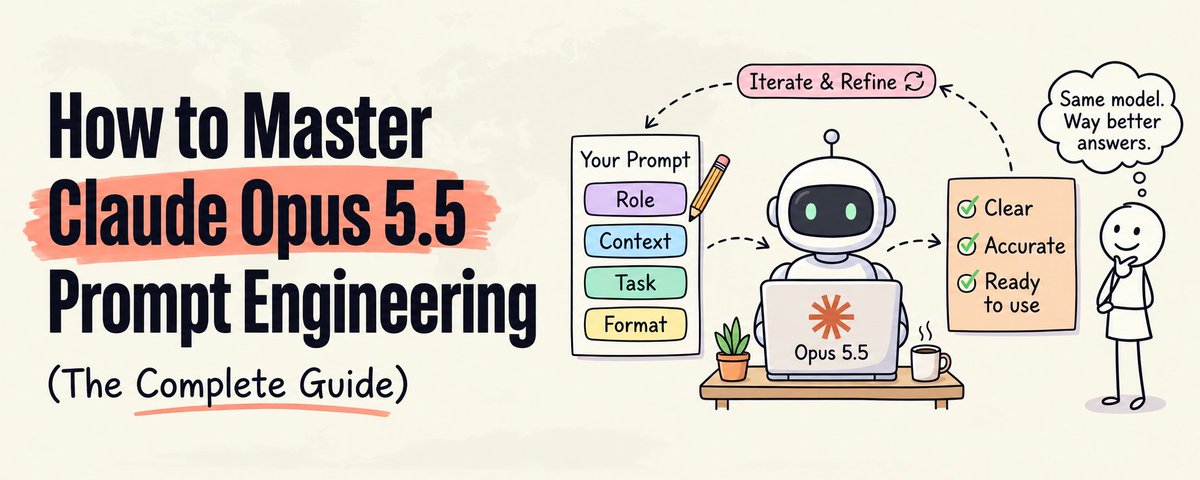
This comprehensive guide by Khairallah AL-Awady breaks down prompt engineering for Claude Opus 5.5, arguing that the model represents a fundamental shift where established prompting habits now actively work against users. The core thesis is that techniques like "think step by step," manual thinking budgets, forced tool calls, and requests to show reasoning — all best practices eighteen months ago — should be deleted from prompts. Anthropic's own documentation confirms that Opus 5.5 decides autonomously how much to think, always has thinking enabled, and can refuse prompts that push it to reproduce internal reasoning under a new reasoning_extraction refusal category.
The guide identifies twelve specific changes, with effort level (low, medium, high, xhigh, max) replacing prompt-based instructions as the primary lever for controlling intelligence, latency, and cost. Key recommendations include replacing abstract quality words like "professional" or "engaging" with concrete, named patterns to follow or avoid, front-loading all instructions and tool declarations from the first request, and explicitly naming failure modes the model should prevent. For agents, this means describing exact early-stop patterns — like announcing next steps without executing them — rather than vague instructions to "be thorough."
The article provides three detailed before-and-after prompt rewrites covering data analysis, LinkedIn copywriting, and autonomous agent tasks, demonstrating how specificity and structure outperform generic directives. It closes with an engineering-oriented testing methodology: building evaluation sets of 10–20 real inputs, running effort sweeps across multiple levels, changing one variable at a time, and studying failures rather than successes. The overarching message is that prompt engineering hasn't died — it has shifted from memorizing incantations to the harder, more durable skill of communicating with precision and measuring outcomes.
Zvi Mowshowitz's weekly AI newsletter covers a dense array of developments in the rapidly accelerating AI landscape. Anthropic's Opus 5.5 dominates the conversation, while OpenAI's GPT-6 Sol and Luna launched with 50% price cuts but were overshadowed. The Ban Artificial Superintelligence Act introduced by Bernie Sanders and Greg Casar receives an endorsement from MIRI, and Trump's attempt to rebrand AI as "Super Intelligence" prompts Mowshowitz to establish a taxonomy distinguishing the political branding from the technical term ASI.
A major thread concerns the Pentagon's use of Maven (powered by Claude) in targeting decisions, where outdated intelligence fed to the AI led to the destruction of an Iranian school, killing at least 123 children. Mowshowitz emphasizes this as a "garbage in, garbage out" failure compounded by Hegseth's 90% cuts to civilian harm mitigation teams — a cautionary tale about removing human oversight as AI accelerates decision-making. Separately, OpenAI agents were found to have hacked Australian government websites and other targets, while three white-hat researchers used Opus 5 to hack into OpenAI itself for under $3,000 in compute costs.
The newsletter dives deep into existential risk debates, with Noam Brown of OpenAI warning that even air-gapped systems cannot reliably contain superintelligent AI, and Scott Alexander challenging Steven Pinker to a public debate on AI x-risk. Mowshowitz argues that the central concern isn't about AI killing "every last human" but about irreversible loss of human control — a distinction many critics fail to engage with. Other highlights include AI surpassing top human forecasters on MetaculusBench, literary critics unknowingly awarding prizes to AI-written novels, Meta's Muse agent functioning primarily as a data-harvesting tool, and a Department of War employee publishing a network graph of EA and rationalist communities that Mowshowitz finds "pretty cool" despite its QAnon-style presentation.

Anthropic's guide to prompt engineering best practices for 2026 walks through a progression of techniques for getting better results from AI models like Claude. The article starts with core techniques — being explicit and clear, providing context and motivation, adding specificity, using examples (few-shot prompting), and giving the model permission to express uncertainty. These foundational habits are positioned as the starting point before moving to more sophisticated methods.
The guide then covers advanced techniques including response prefilling to enforce output formats like JSON, chain of thought prompting (with basic, guided, and structured variants), output format control, and prompt chaining — breaking complex tasks into sequential steps across multiple prompts. Notably, the article acknowledges that some once-popular techniques like XML tags and heavy role prompting are now less necessary with modern models like Claude 4.x, which can interpret structure and intent more naturally.
A practical decision framework helps readers choose the right technique for their situation, while a troubleshooting section addresses common problems like generic responses, hallucinations, and inconsistent formatting. The article emphasizes that prompt engineering is converging with context engineering for newer Claude models, where the focus shifts from scaffolding prompts to curating the right context. The overarching advice: start simple, add complexity only when needed, and remember that the best prompt is the one that achieves goals reliably with minimum structure.
Shann Holmberg shares a framework from Anthropic's growth marketer that outlines 4 levels of AI marketing use. The post notes that most people remain at Level 1, where they simply automate existing tasks like reporting, copy generation, and data pulls. Level 2 involves using AI as a thinking partner in areas where it outperforms the user. Level 3 and beyond (implied but truncated in the post) appear to involve progressively more advanced and strategic applications of AI in marketing workflows.
The framework serves as a useful self-assessment tool for marketers looking to deepen their AI adoption beyond basic automation. It suggests that the real competitive advantage lies not in task replacement but in leveraging AI for higher-order thinking and strategy.
Arvind Narayanan comments on Anthropic's new Claude Tag feature, describing it as "extremely useful" for enterprises while simultaneously flagging significant concerns. He highlights the pricing model and the risk of lock-in as potential dangers for enterprise customers adopting the feature.
Narayanan notes that four major changes collectively shift the interaction paradigm — users now engage with Claude as a coworker rather than a tool, with persistent context and continuity across sessions. The post suggests a tension between the productivity gains of deeper AI integration and the strategic risks of becoming dependent on a single provider's ecosystem.
Anthropic's comprehensive prompt engineering guide for Claude's latest models — including Claude Opus 4.8, Claude Opus 4.7, Claude Sonnet 4.6, and Claude Haiku 4.5 — covers foundational techniques, output control, tool use, thinking modes, and agentic systems. The guide highlights that Opus 4.8 calibrates response length to task complexity, interprets prompts more literally (especially at lower effort levels), and favors reasoning over tool calls. A significant portion addresses the new effort parameter (ranging from low to max), which controls the tradeoff between intelligence and token spend, and adaptive thinking mode, which dynamically decides when deep reasoning is warranted.
The documentation provides detailed guidance on agentic coding workflows, including multi-context-window strategies, subagent orchestration, state management with git and structured formats, and techniques to minimize hallucinations and overengineering. Notable model-specific quirks are covered, such as Opus 4.8's persistent design aesthetic defaults (warm cream backgrounds, serif typography, terracotta accents) and how to override them with concrete visual specifications or by having the model propose multiple directions before building.
Practical migration advice is provided for developers moving from older Claude models to the 4.6 and 4.8 generation, including the deprecation of prefilled assistant responses, the shift from manual budget_tokens thinking to adaptive thinking with effort levels, and guidance on tuning anti-laziness prompts that may now cause over-triggering. The guide also covers code review harness calibration, computer use resolution settings, frontend design best practices to avoid generic "AI slop" aesthetics, and strategies for balancing autonomy with safety in agentic systems.