
This guide from AI @ Work offers a practical, intentionally selective overview of AI tool categories suited for small, non-technical teams. Rather than listing specific products, it categorizes tools into four areas: general-purpose AI assistants for drafting and summarizing, writing and editing tools for improving communication clarity, research and summarization tools for handling information overload, and meeting and note tools for capturing action items and reducing note-taking burden.
The page emphasizes a minimalist approach to AI adoption, advising teams to start with one general-purpose tool and only add specialized tools when a clear gap appears. It explicitly warns against premature adoption of automation platforms, workflow builders, and multi-tool integrations, arguing these add unnecessary complexity before teams have established patterns. The recommended testing process is straightforward: pick one real task, try one tool, review the output together, and decide whether it helped.
A key theme throughout is that AI tools should serve as thinking aids, drafting assistants, and clarity tools — not replacements for people or entire workflows. The bottom line: small teams succeed not by adopting more AI tools, but by using the right few, thoughtfully, ensuring tools reduce friction without requiring technical expertise.
Alex Lieberman, founder of Morning Brew, shares reflections on his latest venture — what he describes as "McKinsey for AI" — six months after launching. The business is 100% bootstrapped and, according to Lieberman, is the fastest-growing business he's ever started. He notes that it has pushed him harder than any previous endeavor.
The post teases a thread of lessons, musings, and reflections, opening with the observation that most engineering organizations are still 6 to 12 months behind in AI adoption. The full thread appears to explore the gap between AI's potential and how companies are actually implementing it, positioning his consultancy-style business as a bridge for that gap.
Farnam Street highlights surprising data about ChatGPT adoption rates, challenging the assumption that everyone uses it daily. According to the post, only 10% of people use ChatGPT every day, while roughly 20% tried it once and never returned. The post promotes an upcoming episode of The Knowledge Project podcast featuring Benedict Evans, described as one of tech's sharpest analysts, who himself barely uses the tool.
The implicit message questions the prevailing narrative around AI ubiquity and suggests that actual engagement with generative AI tools is far lower than the tech bubble might suggest. By noting that even a prominent tech analyst like Evans is not a regular user, the post underscores a gap between perceived mainstream AI adoption and reality.
ICIC (Initiative for a Competitive Inner City) has published a report titled AI in Business: How Small Business Owners Are Learning, Using, and Navigating Challenges with AI Tools, examining AI adoption among small businesses. Based on a survey of over 3,700 small business owners and five focus groups, the research finds that nearly 89% of surveyed small businesses are already using AI tools for everyday tasks such as drafting emails, creating marketing content, and analyzing data. More than 60% report increased productivity and improved employee job satisfaction as a result of AI adoption.
Despite widespread usage, the report highlights persistent knowledge gaps, implementation challenges, and concerns about responsible AI adoption. Small business owners express a strong preference for hands-on, flexible learning formats — including online courses, podcasts, and peer learning groups — to build AI confidence. The report offers targeted recommendations: educational programs should reflect the diverse needs of small business owners, employees should be included in technology decision-making, and greater transparency about AI's benefits and risks is needed to promote responsible use.
The research is particularly notable for its focus on under-resourced communities, aligning with ICIC's mission to drive inclusive economic prosperity. By identifying where AI education and training can have the greatest impact, the report aims to help policymakers, educators, and business support organizations ensure that AI adoption is both effective and equitable across the small business landscape.
GoWest.ai's Director of Operations, Lesley, argues that small teams consistently outperform large organizations in practical AI adoption — not because of superior resources, but because of how they work. The post identifies four key advantages: the ability to move quickly and adapt without layers of bureaucratic approval, clear ownership where the person testing a tool is the same person who feels the problem, faster feedback loops that enable continuous improvement rather than waiting for quarterly reviews, and a pragmatic "does this actually help" mindset that avoids adopting technology for optics.
The core insight is that large companies often get bogged down in strategy meetings, cross-departmental ownership confusion, and pressure to demonstrate they're "doing something with AI," while small teams simply try tools, evaluate results quickly, and keep what works. These habits — curiosity, willingness to experiment, learning by doing, and focusing on practical value — are positioned as transferable to organizations of any size. The post serves as both a reflection on effective AI adoption patterns and a subtle pitch for GoWest.ai's consulting approach of cutting through AI noise to focus on meaningful, outcome-driven applications.
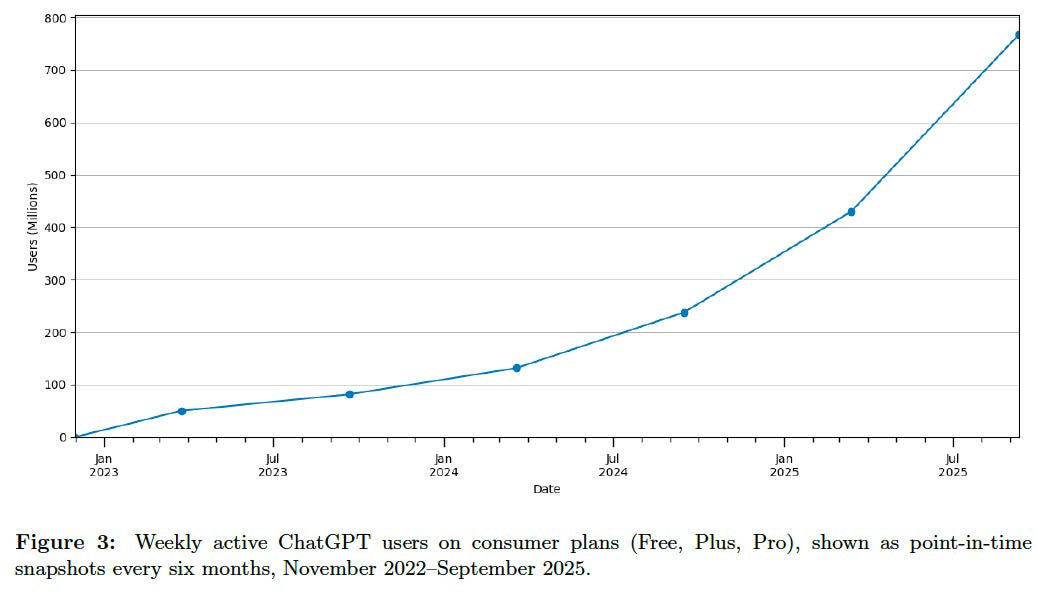
A new NBER working paper by Harvard's David Deming and a team of OpenAI researchers documents the remarkable growth of ChatGPT, which has reached over 750 million weekly active users — nearly 10% of the world's population — by mid-2025. The study reveals that total message volume has hit 2.6 billion messages per day, growing 5.8x in the past year. At this trajectory, ChatGPT message volume could match current Google search volume within just over a year, and notably, ChatGPT reached the 1 billion daily message milestone far faster than Google search reached 1 billion daily searches.
One of the most striking findings is that demographic gaps in ChatGPT usage are closing rapidly. Early adoption was dominated by highly educated men in wealthy countries, but by mid-2025, users with typically female names slightly outnumber male users. Middle-income countries have seen 5-6x growth in usage, narrowing the gap with wealthier nations — Brazil, South Korea, and the U.S. now show relatively similar adoption rates despite vast differences in GDP per capita. Usage intensity is also increasing across all user cohorts, suggesting the product has become substantially better or more user-friendly, particularly since late 2024.
Deming emphasizes the privacy-preserving methodology used in the study. No researcher ever saw individual message content or personal information. Instead, automated classifiers analyzed anonymized messages, and all demographic analysis was conducted through a Data Clean Room that only returned aggregate output. While these restrictions limited the depth of analysis possible, Deming frames this as setting a high bar for responsible research on sensitive user data. A second post is promised to explore what people actually use ChatGPT for and implications for the economy.
The JPMorgan Chase Institute published the first report in its Small Business in the Age of AI series, analyzing de-identified Chase Business Banking transaction data from 4.6 million small businesses between 2019 and 2025. The study tracks actual payments to AI services rather than relying on self-reported survey data, revealing that AI adoption among small businesses reached 17.7 percent by the end of 2025 — with dramatically accelerating uptake. The 2025 cohort of new businesses reached a 10 percent adoption rate in just six months, compared to over six years for the 2019 cohort, representing an unprecedented speed of technology diffusion compared to historical general-purpose technologies like electricity, PCs, and the internet.
Beyond adoption rates, the report finds that small businesses are moving from sporadic experimentation toward consistent, diversified AI usage. The ratio of consistent to sporadic AI users climbed to nearly 1.8 by 2025, and firms increasingly pay for multiple AI services across categories like generative AI, marketing automation, and customer relationship management. Newer adopters entered at roughly 50 percent lower spending levels than earlier cohorts, reflecting the availability of low-cost subscription-based tools that lowered barriers to entry, while established adopters maintained or increased their spending over time.
Significant adoption gaps persist, however. Employer firms consistently outpace nonemployer firms regardless of revenue, and knowledge-intensive industries like information and professional services show adoption rates three to four times higher than labor-intensive sectors like construction and food services. The authors suggest that broader adoption will require addressing skills gaps through training programs, building trust via transparency frameworks, and ensuring a robust ecosystem of AI service providers tailored to diverse business needs.
Sarah Guo shares an essay arguing that AI adoption is fundamentally a coordination problem, not a technology problem. She highlights that individuals adapt to AI faster than organizations do, and this gap between personal and institutional adoption is the primary source of confusion around seemingly "slow" AI adoption rates.
The core insight is that the bottleneck isn't people's willingness or ability to use AI tools — it's the organizational structures, workflows, and coordination mechanisms that lag behind. This framing recontextualizes the narrative around AI adoption speed and suggests that the real challenge lies in reshaping how organizations operate rather than convincing individuals of AI's value.