
Justine Castellon addresses the never-ending debate around whether punctuation marks like em dashes, semicolons, and colons have become telltale signs of AI-generated writing. She highlights a troubling consequence: many writers have begun self-censoring their punctuation choices, swapping these marks for commas or restructuring otherwise sharp, effective sentences into blander alternatives—all to avoid the suspicion of having used AI.
The post touches on a growing tension in the writing community where legitimate stylistic tools are being abandoned due to their association with large language model outputs. Castellon's observation underscores how AI's influence is not just changing how text is generated, but also how human writers compose and present their own work, potentially diminishing the richness of written expression.
Venture capitalist Justine Moore clarifies a previous statement about AI and writing that she says was intentionally misinterpreted. She emphasizes that she does not believe AI will replace human writers, but she does expect that many writers will increasingly incorporate AI tools into their creative process. She draws an analogy to the range of tools and assistance authors already use today, such as word processors, suggesting AI is simply another addition to the writer's toolkit rather than a wholesale replacement for human creativity.
The Authors Guild has published updated best practices for writers navigating the use of generative AI in their profession, originally released in February 2024 and refreshed as of May 2026. The guidelines emphasize that authorship means the words, thoughts, and creativity are genuinely your own, and that AI-generated text is not copyrightable, not considered original authorship, and may violate publishing contract warranties. The document warns that all major commercial LLMs were trained on pirated, unlicensed books without compensating authors, and that AI outputs may contain fabricated information, biases, or regurgitated copyrighted material from training data.
The recommended practices span a spectrum of AI uses, from acceptable background research and spell-checking to ethically problematic direct copying of AI-generated text into professionally authored work. Key recommendations include disclosing AI-generated content on copyright registration applications, informing publishers and agents of any AI use, fact-checking all AI outputs, and publicly disclosing substantial AI text generation to readers. Authors are also urged to protect fellow creators — including translators, illustrators, narrators, and voice actors — by avoiding AI tools that displace human professionals and by seeking out models trained on licensed content. The Guild additionally advises writers to use written contracts with ghostwriters and collaborators that prohibit undisclosed AI-generated text, and to be cautious about uploading drafts or research into public chatbots that may use inputs for model training.
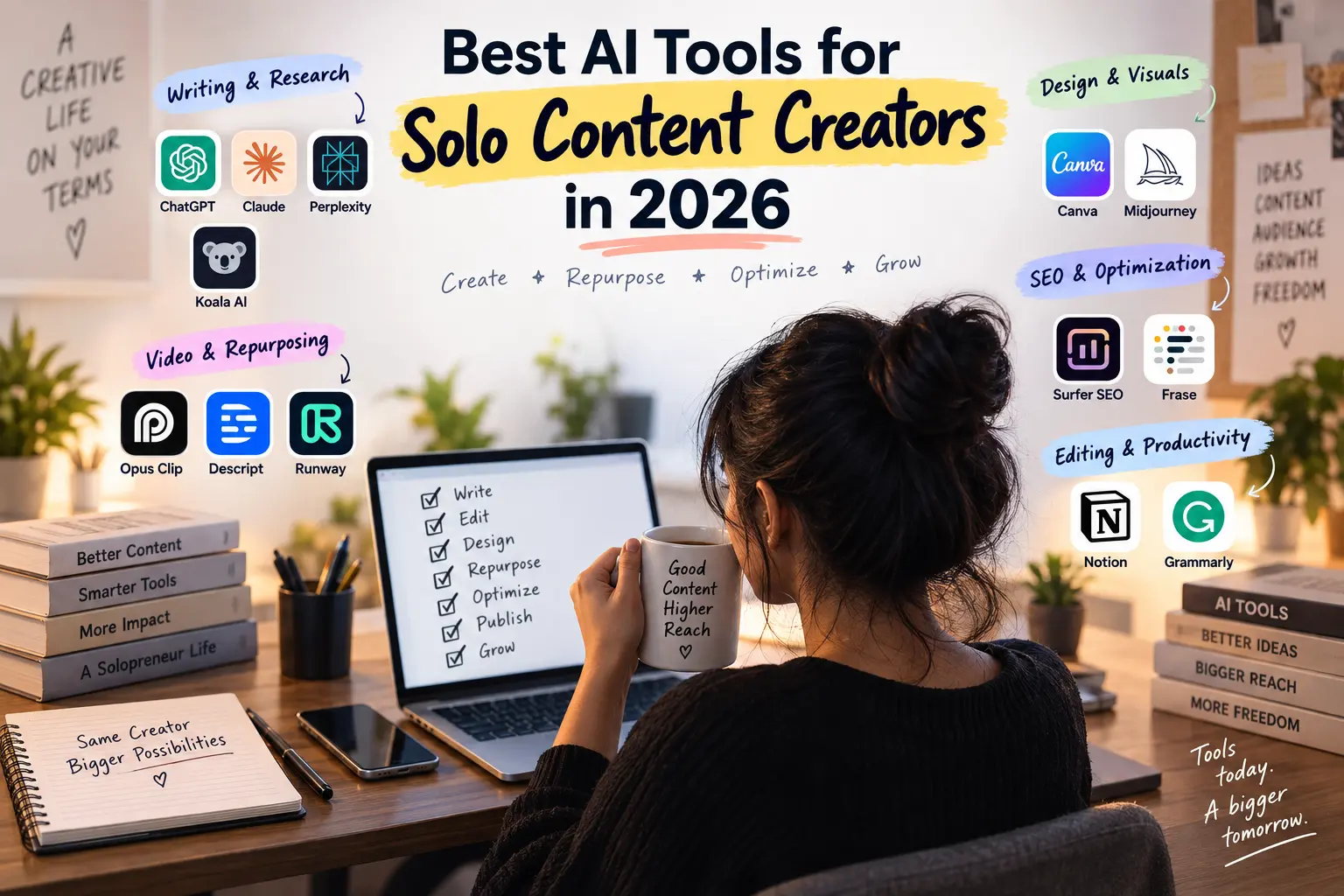
This guide breaks down the best AI tools for solo content creators in 2026, organized not by marketing hype but by the actual bottlenecks creators face: writing, repurposing, design, SEO, and editing. For writing and research, Claude excels at long-form coherence while ChatGPT serves as a flexible generalist, and Perplexity has replaced the ten-tab research session with source-cited answers. Koala AI is flagged as a budget-friendly alternative, while Jasper is noted as having moved upmarket and away from solo creators.
On the repurposing front, Opus Clip automates clipping and captioning long-form video, and Descript lets creators edit video by editing a transcript. Runway offers more advanced production capabilities for those willing to invest the learning time. For design, Canva's AI layer handles fast, professional-looking output, while Midjourney offers far more creative freedom at the cost of a steeper learning curve. SEO gets addressed through Surfer SEO, Frase, and Writesonic, the latter serving as a middle-ground option that combines SEO-aware drafting without requiring a separate platform. Grammarly is highlighted for solving the underappreciated problem of AI-generated text that reads as robotic.
The article provides practical budget tiers ranging from $20–$25/month (one writing AI plus Canva free) up to $120–$160/month for a full stack including video repurposing. The core advice: identify your actual bottleneck before buying anything, and master two or three tools rather than paying for eight you'll barely use.
Nat Eliason shares his frustration with current AI writing apps, arguing that most of them try to take over the writing process entirely. He points out that AI isn't a great writer on its own, and that real writers still want to do the actual writing themselves. Instead of full automation, he expresses a desire for AI that serves as a better assistant to the writing process rather than a replacement for it.
The post is truncated but captures a key tension in the AI writing tool space: the difference between AI as a co-pilot versus AI as an autopilot. Eliason's perspective reflects a growing sentiment among professional writers who want AI to enhance their workflow without stripping away creative ownership.
James Kemp describes a common frustration with using AI for content creation: the first drafts consistently sound like press releases rather than reflecting his natural voice. Despite using AI extensively for internal work posts, tweets, and blog drafts, he finds himself spending excessive time rewriting the output to match his personal tone.
To solve this problem, he built Voiceprint, a tool built on Claude that appears designed to capture and replicate a user's unique writing style. The post hints at a broader challenge many AI-assisted writers face — bridging the gap between generic AI output and authentic, personalized communication.
Michelle La Rosa argues that AI is fundamentally different from simple tools like spell-check, despite how people may try to rationalize its use. She contends that when writers rely on AI to flesh out their ideas, they forfeit the most critical element of the writing process: thinking itself. The post links to an external article that presumably expands on this argument.
The core insight is that the value of writing lies not in the finished output but in the cognitive work required to develop and articulate ideas. By outsourcing that process to AI, writers may be undermining the very skill and intellectual engagement that makes writing meaningful.
David Tost argues that most people using AI daily are getting measurably worse at thinking — their judgment flattens and their writing weakens, all while the polished output masks the decline. He shares his own experience of freezing up when trying to write without AI after six months of dependency, which prompted him to completely rebuild his approach.
The core distinction he draws is between using AI as a crutch versus a thinking partner. A crutch gives you answers; a partner gives you better questions. Every time you skip the mental effort by outsourcing thinking to a chatbot, you miss the "rep" — and thinking, like a muscle, atrophies without strain. His foundational rule is simple: always make your own attempt first. Write your messy take, your bad draft, your half-formed argument before engaging AI. This ensures you remain the author while AI serves as the editor, sharpening ideas that are already yours rather than replacing them entirely.
The full system — including specific prompts, daily and weekly workflows, and rules for what to delegate versus protect — is reserved for paid subscribers. But the free portion establishes a compelling philosophical framework for anyone concerned about maintaining cognitive sharpness in an AI-saturated workflow.
David Perell reflects on how AI is undermining writing's value as proof of work. He points to a long-standing genre of books that functioned essentially as glorified business cards — authored not to be read, but to signal credibility. With AI making it trivially easy to produce polished text, this kind of performative writing loses even its symbolic weight. The post suggests a broader shift in how we evaluate written content in an age of AI-generated text.
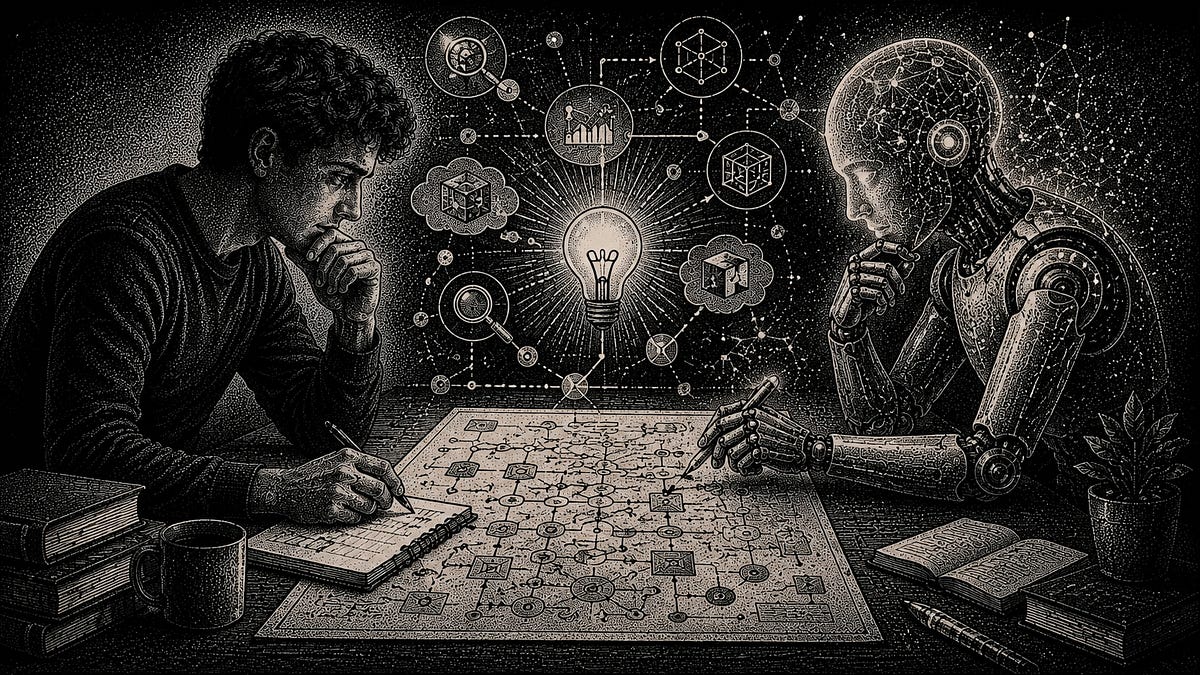
Assistant Professor Mina Lee at the University of Chicago and collaborators from Cambridge, Princeton, NYU, The Alan Turing Institute, and MIT have published a perspective study reimagining AI not as a passive tool but as a "thought partner" for humans. The research proposes three core desiderata for effective AI collaboration: the model should understand the user, the user should understand the model, and both should share an understanding of the world. Central to this vision is a Bayesian framework that models human reasoning by accounting for uncertainty and adapting iteratively to individual users' needs, preferences, and cognitive limitations — a marked departure from current one-size-fits-all AI systems.
The study outlines practical applications across multiple domains. In programming, a Bayesian AI could model a coder's flawed mental model and help patch conceptual bugs. In storytelling, it could infer whether a writer is brainstorming, drafting, or polishing and tailor suggestions accordingly. In medicine, it could account for clinicians' time constraints and diagnostic habits to provide targeted, non-redundant recommendations. The researchers draw on collaborative thinking modes like sensemaking, deliberation, and ideation to define how AI should engage with users dynamically rather than statically.
Lee also highlights ethical concerns, particularly the risk of overreliance on AI in educational settings, where such systems could undermine the development of creativity and critical thinking skills. The team advocates for designing AI that fosters synergistic collaboration — augmenting human cognition without replacing it. Future projects from Lee's lab will investigate how AI transforms writing education and how users' creative and analytical capacities are affected by AI interaction.

A new study published in Science Advances explores whether generative AI actually boosts human creativity, using OpenAI's GPT-4 to help participants write short stories. Researchers recruited 293 people, measured their baseline creativity, then split them into groups: one writing unaided, one receiving a single AI-generated story idea, and a third receiving up to five ideas. The vast majority (88.4%) of those offered AI assistance chose to use it.
The results revealed a "leveling effect": writers who scored lower on inherent creativity saw the biggest improvement in their output quality when using AI, while already-creative writers gained little benefit. However, the study also uncovered a significant downside — stories produced with AI assistance were more similar to each other than those written entirely by humans, both in semantics and content. Researcher Tuhin Chakrabarty of Columbia University noted that AI writing tends to be exposition-heavy and full of stereotypes, observing that "good writing is all about showing, not telling. AI is always telling."
The findings suggest that while AI can help individuals become more creative, it reduces collective creativity by homogenizing output. The researchers warn that if industries like publishing widely adopt generative AI, the resulting works could become increasingly uniform, since they all draw from models trained on the same data. Co-author Oliver Hauser emphasized the importance of studying both AI's capabilities and its limitations as society navigates the technology's rapid evolution.

Techmeme shares an article from The Atlantic by Jasmine Sun exploring how AI's post-training process actively suppresses the creativity and whimsicality that were present in earlier language models like GPT-2. The piece argues that this refinement process — which includes reinforcement learning from human feedback (RLHF) and other alignment techniques — leads to homogenized, formulaic output, resulting in bad writing from many top AI models.
The insight highlights a tension in AI development: as models become more capable and "safe," they simultaneously lose the unpredictable, expressive qualities that made raw language models occasionally produce genuinely interesting prose. This matters for anyone relying on AI for creative work, as the post-training pipeline may be systematically trading literary quality for consistency and compliance.
Andrew Chen shares his approach to using AI tools when blogging and writing on his personal site. Unfortunately, the full content of the post was not captured in the archived page, so specific details about his workflow, preferred AI tools, and writing techniques are unavailable from this snapshot. Based on the title, the post likely covers how a well-known tech essayist and venture capitalist integrates AI into his content creation process, potentially discussing topics like drafting, editing, ideation, and maintaining authentic voice while leveraging AI assistance.