
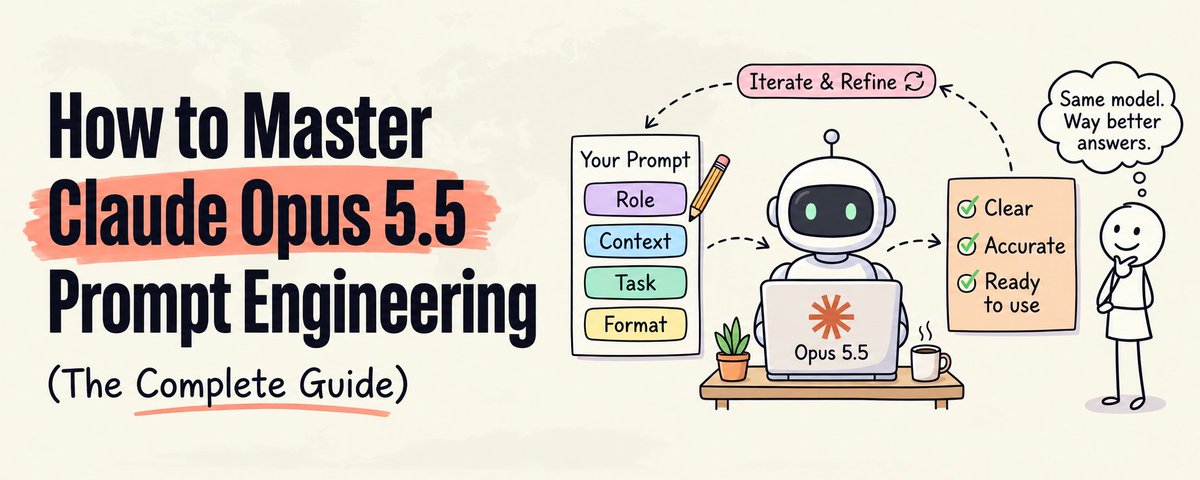
This comprehensive guide by Khairallah AL-Awady breaks down prompt engineering for Claude Opus 5.5, arguing that the model represents a fundamental shift where established prompting habits now actively work against users. The core thesis is that techniques like "think step by step," manual thinking budgets, forced tool calls, and requests to show reasoning — all best practices eighteen months ago — should be deleted from prompts. Anthropic's own documentation confirms that Opus 5.5 decides autonomously how much to think, always has thinking enabled, and can refuse prompts that push it to reproduce internal reasoning under a new reasoning_extraction refusal category.
The guide identifies twelve specific changes, with effort level (low, medium, high, xhigh, max) replacing prompt-based instructions as the primary lever for controlling intelligence, latency, and cost. Key recommendations include replacing abstract quality words like "professional" or "engaging" with concrete, named patterns to follow or avoid, front-loading all instructions and tool declarations from the first request, and explicitly naming failure modes the model should prevent. For agents, this means describing exact early-stop patterns — like announcing next steps without executing them — rather than vague instructions to "be thorough."
The article provides three detailed before-and-after prompt rewrites covering data analysis, LinkedIn copywriting, and autonomous agent tasks, demonstrating how specificity and structure outperform generic directives. It closes with an engineering-oriented testing methodology: building evaluation sets of 10–20 real inputs, running effort sweeps across multiple levels, changing one variable at a time, and studying failures rather than successes. The overarching message is that prompt engineering hasn't died — it has shifted from memorizing incantations to the harder, more durable skill of communicating with precision and measuring outcomes.
Diyi Yang announces an ACL 2025 tutorial focused on human-AI collaboration, highlighting the premise that humans and AI work better together. The tutorial promises an interdisciplinary overview covering the goals, evaluation methods, and societal impacts of human-AI collaboration, making it a resource for researchers and practitioners interested in the intersection of AI systems and human interaction.
This guide from Prompt Engineering Guide outlines foundational tips for designing effective prompts for large language models. It emphasizes starting simple and iterating incrementally, treating prompt design as an experimental process where complexity is added gradually. The guide recommends using clear command verbs like "Write," "Classify," or "Summarize" and separating instructions from context with delimiters like "###" for clarity.
A central theme is the importance of specificity over vagueness — rather than asking for "a short explanation," a well-crafted prompt specifies the exact length, audience, and format desired. The guide also addresses the common pitfall of telling models what not to do, demonstrating through a movie recommendation chatbot example that positive instructions (stating what the model should do) produce far better results than negative constraints. Each tip is illustrated with concrete before-and-after prompt examples, making the advice immediately actionable for practitioners at any level.