
Tom Dörr shares a project involving simulating one million AI agents on social media. The post links to an external resource and includes a media attachment, suggesting a large-scale experiment or research effort exploring how AI-generated agents behave and interact within social media environments. This type of simulation could provide insights into emergent behavior, information propagation, and the dynamics of AI-driven online communities at massive scale.
Keith Teare shared a link on X (formerly Twitter) on October 19, 2024. The post contains only a URL (https://t.co/bRrPwldlpH) without any additional commentary or context. The actual content of the linked page is not available from the archived version, making it impossible to determine the subject matter of what was shared.
Julie Zhuo shares a link in a brief post on X (formerly Twitter) dated September 24, 2026. The post contains only a URL with no additional context or commentary provided in the archived content. Without access to the linked content, the substance of what Zhuo is sharing remains unknown, though her posts typically relate to product design, management, and tech leadership, given her background as a former VP of Design at Facebook/Meta.
Typefully shares a brief social media post on X (formerly Twitter) containing a link. The post, dated February 17, 2026, provides minimal context beyond the shared URL, making it difficult to determine the specific content being referenced. The link appears to direct users to an external resource promoted by the Typefully account, which is known as a writing and publishing tool for Twitter/X content creators.
Aaron Levie, CEO of Box, shares a link in a brief post on X (formerly Twitter) dated December 26, 2025. The actual content of the linked resource is not available from the archived page, as only the URL shortener link (t.co) is preserved without the destination content or any accompanying commentary beyond the link itself.
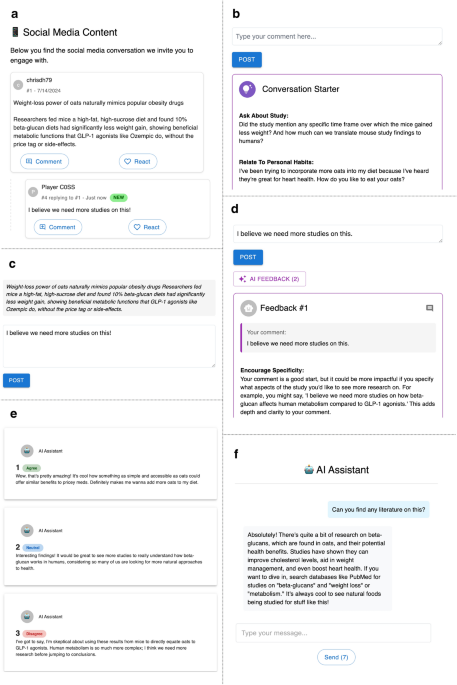
A controlled experiment involving 680 U.S. participants investigates how four distinct generative AI tools—Chat assistance, Conversation Starters, Feedback on drafts, and reply Suggestions—affect both content producers and consumers in a realistic social media environment. Participants were organized into groups of five and discussed three topics (dogs vs. cats, health benefits of oats, and universal basic income) across different experimental conditions. The study reveals a critical duality: while AI tools increase user engagement, content volume, and participation equality, they simultaneously decrease perceived quality and authenticity of discussions. Consumers rated AI-assisted content as more "robotic" and "generic," and all AI treatments significantly increased dislike reactions compared to the control group.
The research uncovers nuanced usage patterns across tools and topics. Chat was widely adopted (94.4%) with users adapting their prompts to context—casual queries for lighter topics, fact-checking for scientific discussions, and political engagement for divisive subjects. Conversation Starters improved participation equality but were often misaligned with user intent, with 27.5% of users diverging entirely from AI suggestions. Feedback was most valued in high-stakes discussions requiring argumentation and credibility, while Suggestions showed a notable bias toward agreeing stances in controversial topics. Critically, no single AI tool improved both producer and consumer experiences simultaneously.
Based on these findings, the authors propose four design principles for integrating AI into social media: transparent disclosure of AI-generated content, user-focused personalization, context-sensitivity accounting for topic and intent, and intuitive user interfaces. The study represents one of the first direct experimental tests of whether generative AI can genuinely elevate online discussions, with evidence suggesting it more likely amplifies low-quality interaction and creates negative spillover effects on conversations—even affecting users who don't use the AI tools themselves.
Pangram announces the release of its Chrome Extension designed to automatically flag AI-generated content as users scroll through their social media feeds. The tool addresses growing frustration with "AI slop" — low-quality, machine-generated text that has become increasingly pervasive on social platforms.
The post reflects on how, for most of human history, grammatical and coherent writing could generally be trusted as human-produced, but that assumption no longer holds. Pangram's extension aims to restore some of that trust by providing real-time detection of AI-generated posts, helping users distinguish between authentic human writing and machine output as they browse.
Zvi Mowshowitz shares a link on X (formerly Twitter) without additional context or commentary. The post consists solely of a URL redirect (t.co link), making it difficult to determine the specific content being shared from the archived page alone.
Without access to the linked content, the substance of this post remains unclear. Zvi Mowshowitz is known for his commentary on AI policy, rationality, and decision-making, so the linked content likely relates to one of these topics.
Zvi Mowshowitz shares a link on X (formerly Twitter) in a brief post from March 11, 2026. The actual content of the linked page is not available from the archived version, as only the tweet metadata and a shortened URL (t.co link) are preserved. Without access to the linked content, the specific topic or insight Mowshowitz is sharing cannot be determined from this archive alone.
The ThursdAI Podcast page on X (formerly Twitter) failed to load its content, returning an error message instead. The page suggests that privacy-related browser extensions may be causing the issue and recommends disabling them. As a result, no substantive content from the ThursdAI podcast's social media profile is available for analysis.