
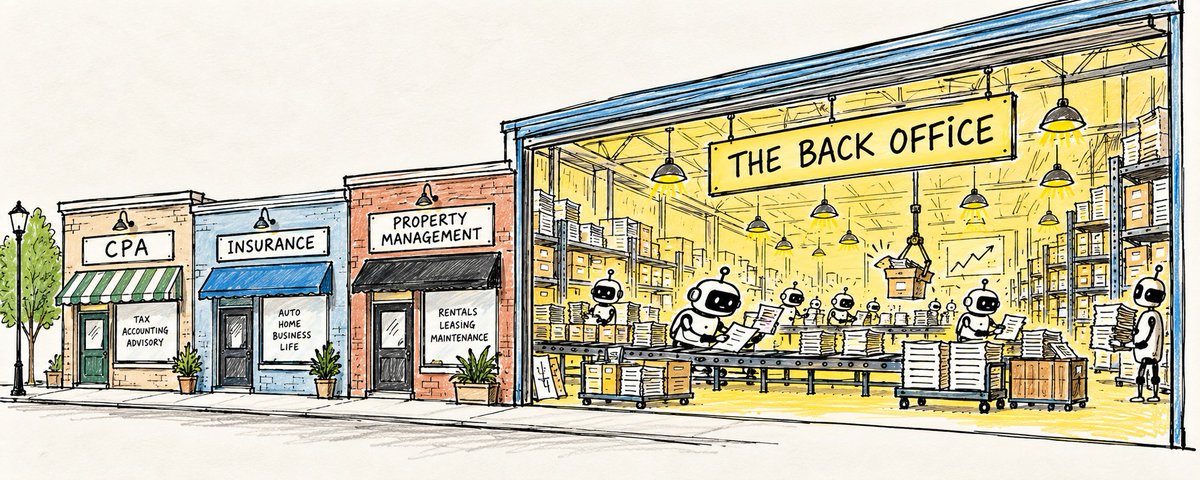
Greg Isenberg lays out a detailed playbook for what he calls AI roll-ups — acquiring small, boring service businesses from retiring baby boomers and using AI agents to dramatically increase profit margins. He argues that roughly $5 trillion worth of American businesses will change hands by 2035, mostly small firms in industries like accounting, property management, insurance, and IT services. The core thesis: buy these businesses at low multiples based on their current ~10% EBITDA margins, then rebuild the back office with AI agents to push margins to 30-40%, effectively tripling the value of the acquisition without changing the client base or revenue.
Isenberg highlights real examples including Thrive Holdings (which bought nearly 50 accounting practices and committed $1 billion more), General Catalyst ($1.5 billion allocated to this strategy), and Long Lake Property Management ($100M EBITDA in under two years). He emphasizes that this opportunity is especially accessible to solo founders and small operators, since the big funds can't economically pursue the vast majority of these sub-$2M businesses, and the AI tools (like OpenAI Codex and Claude Code) are available to anyone.
The guide goes deep into practical execution: a folder structure for the holding company, specific agent architectures separating preparers from reviewers, a scoring rubric for evaluating targets, a 100-day integration plan, and a weekly dashboard tracking five key metrics. He also covers what breaks — key people leaving, automating trust away, buying faster than you can integrate — and stresses that the relationship side of the business must stay human while the back office gets automated.
Bluevine shares findings from its latest research on AI adoption among small and medium-sized businesses (SMBs). The data reveals that 74% of SMB owners are already using or testing AI, and 68% believe it will benefit their business. However, the company notes that the narrative around AI transforming small businesses is more nuanced than it appears — confidence in AI has its limits despite widespread experimentation.
The post highlights the gap between AI adoption rates and full confidence in its impact, suggesting that while SMB owners are open to AI, skepticism and uncertainty remain part of the picture. Bluevine appears to be teasing a deeper dive into the data, positioning itself as a resource for understanding how AI is truly reshaping the small business landscape.
Plainstack's guide targets independent consultants and freelancers — a group largely overlooked by mainstream AI tool coverage that tends to focus on enterprise buyers or venture-backed startups. The guide covers six specific high-impact jobs where AI tools can reduce unbilled time: proposal writing, scheduling, invoicing and bookkeeping, meeting transcription, email management, and data privacy. Each sub-guide follows a consistent structure with plain-language verdicts, vendor-sourced pricing, and honest assessments of fit, while explicitly disclosing that evaluations are desk-researched rather than based on hands-on daily use.
The guide grounds its relevance in concrete adoption data: 24% of small employers were using AI tools as of NFIB's March 2025 survey, while the OECD reports adoption jumped from 14.2% to 20.2% of firms between 2024 and 2025. A key insight is that solo consultants adopting AI for specific, genuinely useful tasks are still ahead of most peers, not behind them. The pricing landscape varies significantly by category — scheduling and transcription tools often have usable free tiers, while all-in-one business management platforms typically run $9–$29/month for solo-relevant features. The guide emphasizes transparency, with visible "as of" dates on pricing and quarterly review commitments.
A Reddit discussion in r/aiToolForBusiness explores how small teams (up to 10 members) are practically integrating AI into their daily workflows beyond the initial hype. The original poster asks for real-world examples of what's genuinely helping versus features that ended up barely used, focusing on saving time, reducing repetitive work, and improving communication.
Responders share a range of approaches. Several note that most small teams simply use ChatGPT and Claude directly for drafting proposals, generating images, and brainstorming — without building complex workflows. Others mention specific tools like Mem AI for notes, Gamma for internal decks, Marblism for inbox cleanup, and Granola for meeting transcripts. A key recurring theme is that AI works best when it removes small, repetitive tasks — summarizing meetings, cleaning up drafts, organizing notes — rather than trying to automate entire business processes.
Some of the most practical advice centers on adoption patterns: one commenter argues that the "barely used" problem stems from AI tools being offered as open-ended subscriptions rather than being tied to specific triggers like incoming support tickets or pipeline events. Another suggests teams start by mastering basic AI features like projects and notebooks before pursuing more ambitious integrations. The thread also highlights the value of centralizing AI around one system (like Claude) and piping data from various tools into it to maintain a unified view of customer and business information.
Small teams are increasingly bypassing the traditional developer hiring bottleneck by using no-code AI automation platforms to build workflows tailored to their specific needs. The article illustrates this through a five-person specialty food distributor team that eliminated a two-hour weekly manual reconciliation process by building their own automation over two afternoons, without writing any code. Tools like Airtable serve as flexible database foundations, allowing non-technical users to model their actual workflows and layer automation on top.
The piece identifies a critical pattern in successful small-team automation: automating the "noticing" rather than the "deciding." Rule-based, repetitive tasks like flagging order discrepancies are ideal candidates for automation, while genuinely ambiguous judgment calls should remain with humans. The article also pushes back against marketing claims of instant setup, noting that building something that fits a team's real, messy workflow requires meaningful iteration — but that investment pays off. Ironically, small teams often end up with better-fitting solutions than larger companies because the people building the tool are the same ones living with the problem daily, catching nuances that would be lost in a formal requirements document.

Steijnpelle argues that small businesses have been overlooked in the AI landscape, suggesting there is a significant opportunity to build a great AI company focused on serving this segment. The post includes a link and an image, implying further context about the idea or a specific product/company pursuing this vision.
The core thesis is that while AI development has largely targeted enterprises and consumers, the small business market remains underserved — representing a potentially large and untapped opportunity for an AI-native company to address their unique needs.
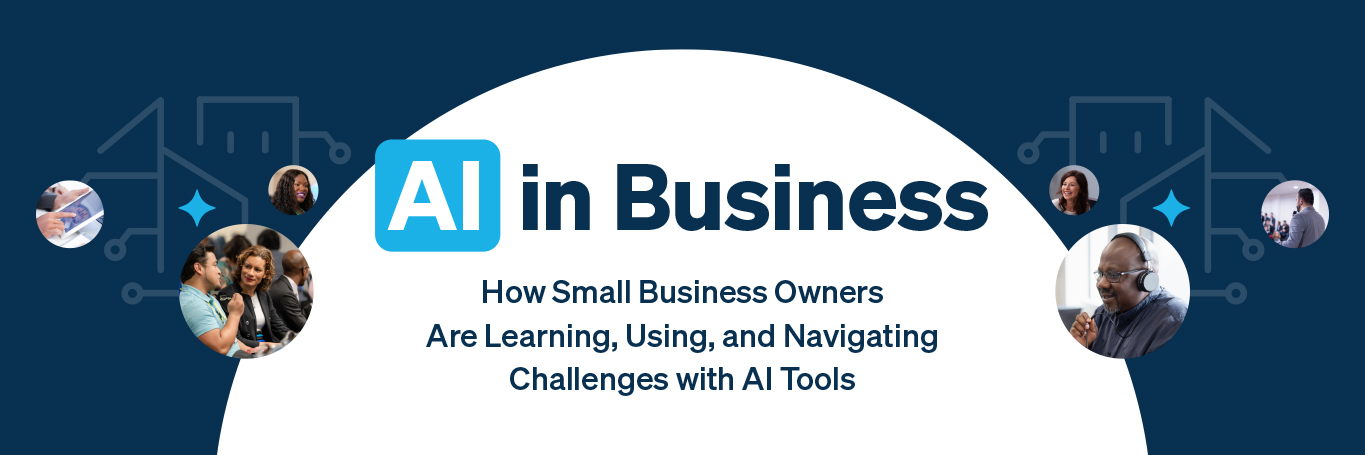
ICIC (Initiative for a Competitive Inner City) has published a report titled AI in Business: How Small Business Owners Are Learning, Using, and Navigating Challenges with AI Tools, examining AI adoption among small businesses. Based on a survey of over 3,700 small business owners and five focus groups, the research finds that nearly 89% of surveyed small businesses are already using AI tools for everyday tasks such as drafting emails, creating marketing content, and analyzing data. More than 60% report increased productivity and improved employee job satisfaction as a result of AI adoption.
Despite widespread usage, the report highlights persistent knowledge gaps, implementation challenges, and concerns about responsible AI adoption. Small business owners express a strong preference for hands-on, flexible learning formats — including online courses, podcasts, and peer learning groups — to build AI confidence. The report offers targeted recommendations: educational programs should reflect the diverse needs of small business owners, employees should be included in technology decision-making, and greater transparency about AI's benefits and risks is needed to promote responsible use.
The research is particularly notable for its focus on under-resourced communities, aligning with ICIC's mission to drive inclusive economic prosperity. By identifying where AI education and training can have the greatest impact, the report aims to help policymakers, educators, and business support organizations ensure that AI adoption is both effective and equitable across the small business landscape.
A Reddit thread in r/smallbusiness asks how small business owners are actually using AI in 2025, seeking honest, real-world examples rather than sales pitches. The responses reveal a wide range of practical applications: drafting content like product descriptions, blog posts, emails, and job listings; building custom internal tools such as job tracking software with QR codes and production workflows; summarizing documents and tender requirements for quick decision-making; and automating repetitive tasks like lead follow-up, client onboarding, and shift scheduling.
Several commenters highlight AI's role in coding assistance, from Excel formulas to simple website development, saving hours of manual work. Others use AI for meeting transcription and summaries via tools like Otter.ai, or for analyzing business data and recommending personalized client gifts. A recurring theme is that AI works best not as an out-of-the-box solution but as a system built around specific, repetitive workflows — the real ROI comes from identifying what tasks can be delegated to automation. Some caution is raised around cybersecurity risks of AI-generated software and the need for ongoing maintenance, but the overall sentiment is that AI is delivering meaningful time savings for small teams willing to invest in setup and customization.
GoWest.ai's Director of Operations, Lesley, argues that small teams consistently outperform large organizations in practical AI adoption — not because of superior resources, but because of how they work. The post identifies four key advantages: the ability to move quickly and adapt without layers of bureaucratic approval, clear ownership where the person testing a tool is the same person who feels the problem, faster feedback loops that enable continuous improvement rather than waiting for quarterly reviews, and a pragmatic "does this actually help" mindset that avoids adopting technology for optics.
The core insight is that large companies often get bogged down in strategy meetings, cross-departmental ownership confusion, and pressure to demonstrate they're "doing something with AI," while small teams simply try tools, evaluate results quickly, and keep what works. These habits — curiosity, willingness to experiment, learning by doing, and focusing on practical value — are positioned as transferable to organizations of any size. The post serves as both a reflection on effective AI adoption patterns and a subtle pitch for GoWest.ai's consulting approach of cutting through AI noise to focus on meaningful, outcome-driven applications.
This IBM article explores how generative AI is transforming small business entrepreneurship, with more than 20% of new businesses now incorporating gen AI technologies according to a Gusto report. Carnegie Mellon professor and entrepreneur Sean Ammirati describes gen AI as a potential "digital co-founder" — not a final decision-maker, but a helpful partner that assists across ideation, validation, and scaling. His students demonstrated dramatically accelerated progress in building startups when equipped with AI tools, accomplishing in a semester what previously took much longer.
The piece outlines several practical applications for entrepreneurs: content generation for marketing campaigns, social media, and business documents; research assistance through LLMs for exploring complex questions about markets, regulations, and competition; and application-layer innovation where specialized tools built on top of foundation models add domain-specific value. Ammirati cautions that LLMs have limitations, including hallucinations, and should be treated as thought starters rather than definitive advisors — but notes that reducing a 10-hour research project to one hour represents meaningful value.
The article highlights a growing ecosystem of "AI-native" startups and tools being built on top of LLMs, citing Sequoia Capital's observation that what were once dismissed as "LLM wrappers" have evolved into "cognitive architectures." Ammirati's own startup, Growth Signals, exemplifies this trend by helping executives and researchers translate market and technology signals into actionable innovation concepts using AI-powered competitive analysis and agent-based research capabilities.

Dr. DVD shares a New York Times article titled "The Small-Business Owners Managing Whole Armies of A.I. Employees." The piece explores how small-business owners are increasingly deploying multiple AI agents to handle tasks traditionally performed by human employees, effectively building automated workforces. The shared link points to a growing trend where entrepreneurs leverage AI tools at scale to run operations, raising questions about the future of work, productivity, and the evolving role of AI in everyday business management.
The JPMorgan Chase Institute published the first report in its Small Business in the Age of AI series, analyzing de-identified Chase Business Banking transaction data from 4.6 million small businesses between 2019 and 2025. The study tracks actual payments to AI services rather than relying on self-reported survey data, revealing that AI adoption among small businesses reached 17.7 percent by the end of 2025 — with dramatically accelerating uptake. The 2025 cohort of new businesses reached a 10 percent adoption rate in just six months, compared to over six years for the 2019 cohort, representing an unprecedented speed of technology diffusion compared to historical general-purpose technologies like electricity, PCs, and the internet.
Beyond adoption rates, the report finds that small businesses are moving from sporadic experimentation toward consistent, diversified AI usage. The ratio of consistent to sporadic AI users climbed to nearly 1.8 by 2025, and firms increasingly pay for multiple AI services across categories like generative AI, marketing automation, and customer relationship management. Newer adopters entered at roughly 50 percent lower spending levels than earlier cohorts, reflecting the availability of low-cost subscription-based tools that lowered barriers to entry, while established adopters maintained or increased their spending over time.
Significant adoption gaps persist, however. Employer firms consistently outpace nonemployer firms regardless of revenue, and knowledge-intensive industries like information and professional services show adoption rates three to four times higher than labor-intensive sectors like construction and food services. The authors suggest that broader adoption will require addressing skills gaps through training programs, building trust via transparency frameworks, and ensuring a robust ecosystem of AI service providers tailored to diverse business needs.
A Reddit user in the r/AiForSmallBusiness community poses an open question to small business owners about which AI tools and workflows are genuinely delivering results in day-to-day operations. The post highlights several common use cases, including automating customer support, generating marketing content, qualifying leads, and handling repetitive admin tasks.
The author also references specific examples from the automotive dealership industry, where AI agents are being used to respond to leads, book appointments, and follow up with customers automatically. The post invites responses from other industries, seeking practical, real-world feedback on what's actually saving time and money rather than just generating hype.