
This article introduces the concept of AI workflows — series of automated tasks that chain multiple AI tools together to complete repeatable processes in software development. The author explains key terminology like AI models, AI tools, and workflow orchestrators, using AWS Lambda-based TypeScript examples to illustrate how tools like Claude and Cursor can be coordinated for tasks such as automated code review and documentation generation.
A central concern is the problem of constant prompting, where providing unclear or insufficient input to AI models leads to compounded errors that degrade output quality across workflow steps. The article advocates for designing workflows with clear goals, selecting appropriate AI tools, and implementing validation checkpoints between steps. A commenter reinforces the importance of repeatability and auditability, noting that without validation points between tools, downstream steps simply inherit confident mistakes.
The article is transparently AI-generated using Groq (LLaMA 3.3 70B) and remains fairly high-level, offering conceptual best practices rather than deeply technical implementation guidance. The code examples demonstrate orchestration patterns but are simplified illustrations rather than production-ready solutions.

Microsoft's Azure Foundry documentation provides a comprehensive guide to prompt engineering techniques for GPT models, covering foundational concepts through advanced strategies. The article breaks down prompts into key components — instructions, primary content, examples, cues, and supporting content — explaining how each element shapes model behavior. It emphasizes that GPT models fundamentally predict the most likely next words based on training data, making prompt design more art than science. Notably, these techniques are not recommended for reasoning models like GPT-5 and o-series models.
The guide dives into practical strategies including few-shot learning, chain-of-thought prompting, output structure specification, and the use of affordances like search to ground model responses in factual data. It demonstrates how breaking complex tasks into smaller steps, repeating instructions, and using clear syntax (such as Markdown or XML separators) can significantly improve output quality. The article also covers temperature and Top_p parameters for controlling randomness, and provides grounding context techniques to reduce hallucinations.
A set of best practices rounds out the guide: be specific, be descriptive, leverage recency bias by placing instructions strategically, and give models an "out" to avoid fabricated responses. The article also addresses space efficiency, noting that tabular data formats are more token-efficient than JSON, and that careful whitespace management can help maximize the limited context window available in GPT models.

Alex Prompter shares findings from an MIT research study that analyzed 667 people solving problems with AI, concluding that prompt engineering is fundamentally a social skill rather than a technical one. The researchers reportedly used Bayesian statistics to isolate two different skill dimensions involved in effective AI interaction.
The post suggests this finding challenges conventional assumptions about working with AI, implying that interpersonal communication abilities — such as clarity, context-setting, and conversational intuition — may matter more than technical knowledge when crafting effective prompts. The full thread appears to elaborate further on the study's methodology and implications, but only the opening of the thread is captured in this archived version.
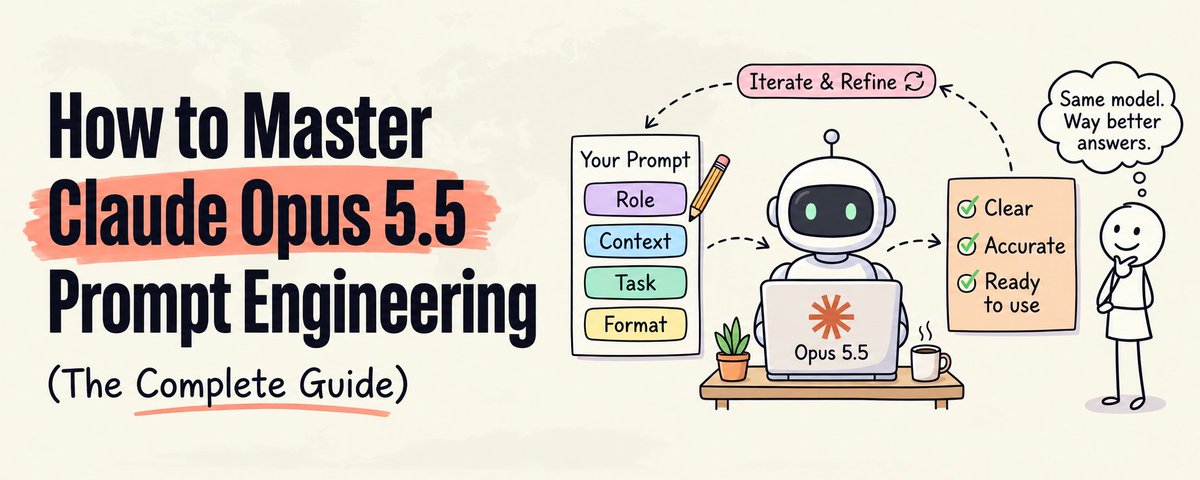
This comprehensive guide by Khairallah AL-Awady breaks down prompt engineering for Claude Opus 5.5, arguing that the model represents a fundamental shift where established prompting habits now actively work against users. The core thesis is that techniques like "think step by step," manual thinking budgets, forced tool calls, and requests to show reasoning — all best practices eighteen months ago — should be deleted from prompts. Anthropic's own documentation confirms that Opus 5.5 decides autonomously how much to think, always has thinking enabled, and can refuse prompts that push it to reproduce internal reasoning under a new reasoning_extraction refusal category.
The guide identifies twelve specific changes, with effort level (low, medium, high, xhigh, max) replacing prompt-based instructions as the primary lever for controlling intelligence, latency, and cost. Key recommendations include replacing abstract quality words like "professional" or "engaging" with concrete, named patterns to follow or avoid, front-loading all instructions and tool declarations from the first request, and explicitly naming failure modes the model should prevent. For agents, this means describing exact early-stop patterns — like announcing next steps without executing them — rather than vague instructions to "be thorough."
The article provides three detailed before-and-after prompt rewrites covering data analysis, LinkedIn copywriting, and autonomous agent tasks, demonstrating how specificity and structure outperform generic directives. It closes with an engineering-oriented testing methodology: building evaluation sets of 10–20 real inputs, running effort sweeps across multiple levels, changing one variable at a time, and studying failures rather than successes. The overarching message is that prompt engineering hasn't died — it has shifted from memorizing incantations to the harder, more durable skill of communicating with precision and measuring outcomes.
Noah MacCallum shares his enthusiasm for GPT-4.1, declaring it his new daily driver. He notes that his team has spent hundreds of hours experimenting to optimize the model's performance and offers to share key learnings to help others get the most out of it from day one.
A primary takeaway highlighted in the post is GPT-4.1's strength in agentic workflows, suggesting the model excels when used in autonomous, multi-step task execution scenarios. The post appears to be part of a longer thread with an accompanying image, likely containing more detailed tips and best practices for working with the model.
Nate Herk distills 5,000 hours of building with AI into 12 practical lessons, arguing that the real edge isn't about memorizing prompts or mastering a specific tool — it's about turning experience into context, managing AI like an employee, and tying every project to a measurable business outcome. He emphasizes collecting "receipts" (documented before-and-after results) over demo builds, staying tool-agnostic by focusing on transferable skills like problem decomposition and clear communication, and making AI your default starting point even when it only handles 25% of the work.
Several lessons focus on operational discipline for AI agents: building verification loops so agents prove their own work, restricting tool access rather than relying on prompt-level instructions (citing a real incident where an agent emailed 150,000 people unsolicited), and running evals against golden datasets before deploying agents to real customers. On the business strategy side, Herk advises finding the actual constraint — the "clog or leak" in the business pipeline — before building anything, assigning each project a single North Star metric, and routing tasks to the cheapest model capable of handling them to control token costs. The final lesson encourages practitioners to do the work before waiting for a title or permission, automating real tasks and documenting results to build credibility organically.

Allie K. Miller shares a summary of six prompting tips derived from a comprehensive review of over 1,500 research papers on prompt engineering. The tips she highlights include using more examples in prompts whenever reasonable and randomly ordering those examples rather than clustering similar ones together. The post references what AI experts consider a foundational paper on prompt engineering, positioning it as essential reading for anyone working with large language models.
While the full thread appears truncated, the visible tips emphasize the importance of few-shot prompting best practices — specifically that quantity and ordering of examples significantly impact AI model performance. This kind of research-backed guidance is valuable for practitioners looking to move beyond intuition-based prompting toward more systematic, evidence-driven approaches.
Daniel Ch provides a comprehensive guide to GPT-6.1 Sol, OpenAI's newly released model positioned between the flagship GPT-6 Astra and the lightweight GPT-6 Luna. Sol delivers near-Astra performance on complex coding, computer use, and professional document work at roughly one-fifth of Astra's token prices, making it the practical default for serious everyday work rather than a cheaper fallback. The guide covers benchmark results across DeepSWE, GDP.pdf, AutomationBench, OSWorld 2.0, and Terminal-Bench Science, while emphasizing that teams should validate performance against their own workflows rather than relying on public scores.
The core framework centers on seven principles: start with Sol as the default for complex work, route tasks by successful outcomes rather than token price, match reasoning effort (low through max) to task difficulty, describe the finished state rather than a topic, use the Responses API for tool-based workflows, reuse context efficiently with prompt caching, and escalate to Astra only when Sol measurably falls short. Specific advice covers structuring prompts with explicit goals, deliverables, and approval boundaries, managing the 1,050,000-token context window, and building confidence gates around outputs. The article identifies five high-value workflows — repository-level coding, professional document intelligence, multi-step business operations, computer-use automation, and decision-oriented research — where Sol's cost structure can deliver significant savings. Pricing sits at $2.00 per million input tokens and $10.00 per million output tokens, with cached input at just $0.10 per million tokens.

Anthropic's guide to prompt engineering best practices for 2026 walks through a progression of techniques for getting better results from AI models like Claude. The article starts with core techniques — being explicit and clear, providing context and motivation, adding specificity, using examples (few-shot prompting), and giving the model permission to express uncertainty. These foundational habits are positioned as the starting point before moving to more sophisticated methods.
The guide then covers advanced techniques including response prefilling to enforce output formats like JSON, chain of thought prompting (with basic, guided, and structured variants), output format control, and prompt chaining — breaking complex tasks into sequential steps across multiple prompts. Notably, the article acknowledges that some once-popular techniques like XML tags and heavy role prompting are now less necessary with modern models like Claude 4.x, which can interpret structure and intent more naturally.
A practical decision framework helps readers choose the right technique for their situation, while a troubleshooting section addresses common problems like generic responses, hallucinations, and inconsistent formatting. The article emphasizes that prompt engineering is converging with context engineering for newer Claude models, where the focus shifts from scaffolding prompts to curating the right context. The overarching advice: start simple, add complexity only when needed, and remember that the best prompt is the one that achieves goals reliably with minimum structure.
Garry Tan, CEO of Y Combinator, describes the compounding personal AI system he's built over the past five months, arguing that AI should be treated not as a chat window but as an operating system. His open-source stack — GBrain for knowledge infrastructure, OpenClaw/Hermes Agent as thin routing harnesses, and GStack for coding — maintains a structured knowledge base of roughly 100,000 pages covering every person, meeting, book, and idea he engages with. The system runs 100+ cron jobs daily, automatically ingesting meeting transcripts, triaging email, and propagating updates across entity pages to create what he calls a "nervous system" rather than a filing cabinet.
The centerpiece concept is skillification: a meta-skill called Skillify that observes a manual workflow, extracts the repeatable pattern, and writes a tested skill file with triggers and edge cases. Tan illustrates this with his book-mirror pipeline, which takes a book like Pema Chödrön's When Things Fall Apart, runs sub-agents to summarize each chapter, and maps every idea to his specific life context — family history, founder conversations, therapy notes — producing a 30,000-word personalized analysis in 40 minutes. He's done this with 20+ books, each mirror enriching the next because the brain's context grows.
Tan advocates a "fat skills, fat code, thin harness" architecture where the routing layer is minimal, the skills encode deep operational knowledge (100+ markdown skill files), and multiple models — Opus 4.7, GPT-5.5, DeepSeek V4-Pro, Groq/Llama — are dispatched by the skill based on the task. Cross-modal evaluation catches errors by having models score each other's output. He open-sources everything at github.com/garrytan/gbrain and urges builders to start by doing something they care about, iterating until it's good, then skillifying the pattern into reusable infrastructure that compounds over time.

This guide by Amine Raji argues that most developers drastically underutilize their AI copilots, treating them as simple autocomplete tools rather than leveraging their full capabilities. The article promises 20 power techniques that unlock 90% of AI copilot potential, covering tools like Claude Code, GitHub Copilot, and Cursor. Raji claims that implementing these techniques across enterprise teams resulted in a 40% reduction in feature development time and 60% fewer code review iterations on AI-generated code.
The core mindset shift emphasized is moving from using AI for trivial code completion to providing rich, contextual prompts that enable AI to generate complete, production-ready systems. Rather than saving seconds on typing, the guide advocates for treating AI copilots as architectural collaborators capable of building entire features with 80% less effort. The full article is paywalled on Medium, but the preview illustrates the contrast between basic and advanced AI copilot usage with concrete examples.
Markus Egger argues that applications without AI Copilot features are now legacy, declaring a paradigm shift comparable to the transitions from command-line to Windows, desktop to web, and web to mobile. The article explains how Azure OpenAI services enable developers to integrate large language models (LLMs) into their own applications, starting with simple completions and chat implementations in both Python and C#. Egger walks through setting up Azure OpenAI resources, deploying models like GPT-3.5, and building a streaming chatbot with custom system prompts.
The core of the article focuses on the Retrieval Augmented Generation (RAG) pattern — a technique for grounding AI responses in your own proprietary data rather than relying solely on the LLM's training data. Egger uses a vacation rental business as an example, demonstrating how to detect user intent, generate search terms using few-shot prompt engineering, retrieve relevant documents from Azure Cognitive Search, and augment prompts with that data to produce accurate, context-specific answers. He also covers practical considerations like token limits, model selection tradeoffs between cost and capability, temperature settings for predictability, and the pros and cons of streaming responses versus verifying output before displaying it. The article positions itself as a starting point, promising deeper explorations of search indexing, SQL Server integration, and advanced intent detection in future installments.
Lakera's comprehensive guide to prompt engineering in 2026 covers the full spectrum of techniques for interacting with large language models, from foundational concepts to advanced adversarial security considerations. The guide categorizes prompt types — including zero-shot, few-shot, chain-of-thought, and role-based prompting — with practical examples showing when each is most effective and how they can be combined for complex tasks. It emphasizes that clear structure and specificity consistently outperform clever wording, and provides model-specific tips for GPT, Claude, and Gemini.
Beyond output optimization, the guide explores advanced techniques like prompt compression for token efficiency, multi-turn memory prompting for persistent context across sessions, and prompt scaffolding for jailbreak resistance — wrapping user inputs in defensive templates to prevent adversarial exploitation. The article draws on real-world examples, including viral prompting trends like action figure generators and custom GPT consultants, to illustrate how structure and modularity drive consistent results at scale.
A significant portion is dedicated to adversarial prompting and AI security, using Lakera's Gandalf red-teaming platform as a case study. The guide walks through escalating attack levels — from simple direct requests to chain querying, roleplay exploits, and multilingual bypass techniques — demonstrating that the boundary between aligned and adversarial model behavior is alarmingly thin. The takeaway is that prompt engineering is not just a productivity skill but a critical layer in AI security, requiring defenders to anticipate how prompts can be weaponized against LLM-powered applications.

A Reddit thread in r/PromptEngineering asks the community to share their best prompt engineering tips and strategies. The responses cover a wide range of practical techniques, from self-critique prompting (asking the LLM to critique its own response and then apply fixes) to structured prompt frameworks like Role-Task-Context-Output and RAPTOR (Role, Aim, Parameters, Tone, Output, Review). Several users emphasize the importance of consulting first-party documentation from frontier labs like OpenAI and Anthropic rather than relying on third-party guides, while one contrarian suggests simply asking the LLM itself how to best prompt it.
Other notable tips include using a "refresher" symbol embedded in prompts to re-orient the model when it drifts off-task during long conversations, employing a two-pass generation flow (generate options first, then pick and expand), and grounding outputs by requiring the model to cite specific quoted lines. Multiple commenters stress that prompt engineering is only one piece of the puzzle — tooling, evals, domain expertise, and context engineering play equally critical roles in achieving high-quality AI outputs. The thread serves as a useful snapshot of community-tested practices for anyone looking to move beyond basic prompting.
Tomasz Opasinski, a veteran designer with over 20 years of experience in entertainment advertising, details how he adopted a fully generative AI workflow using Adobe Firefly and Adobe Photoshop to design a poster for the 22nd Kinoteka Polish Film Festival. Rather than starting with traditional hand sketching, he went straight to prompting in Firefly, treating prompt refinement as a form of digital sketching. Six hours of prompt exploration produced hundreds of images—a process that would have taken significantly longer by hand—and he notes he won't go back to sketching for ideation.
The article walks through three distinct phases: exploration and ideation, where prompting replaced sketching and yielded unexpected results like an origami-like camera concept; pre-production, where he used Generative Expand in Photoshop to test compositions at various aspect ratios and prepared assets for print; and production, where he composited, retouched, and mocked up final deliverables. He submitted 77 images to the client (triple his usual volume) and mocked up 17 as posters, with the client ultimately selecting two designs that each evoked a different emotional response.
Key practical insights include how prompt refinement works like iterating on a creative brief, the limitations of AI-generated images (no individual layers, resolution constraints, occasional need for manual retouching), and how generative tools shifted the bottleneck from illustration skill to creative direction and language. The piece serves as a concrete, step-by-step case study for designers considering how generative AI might reshape—rather than replace—their established workflows.

MIT Sloan's Teaching & Learning Technologies team provides a practical guide to crafting effective prompts for AI systems like ChatGPT and Claude. The article frames prompts as conversation starters and emphasizes three core strategies for prompt engineering: providing context, being specific, and building on the conversation iteratively. It introduces a useful taxonomy of prompt types — including zero-shot, few-shot, role-based, and contextual prompts — each suited to different tasks and goals.
The guide also addresses important limitations. It highlights the distinction between prompt engineering and problem formulation, citing research suggesting that clearly defining problems and goals may ultimately matter more than perfecting prompt syntax, especially as AI platforms increasingly refine inputs automatically. The article warns users about AI hallucinations, factual inaccuracies, and harmful biases — including a notable example involving an MIT student whose AI-generated headshot altered her racial features. While prompt crafting remains a valuable skill today, the piece encourages critical thinking and vigilance when evaluating AI-generated outputs.

Craig Barton, a veteran maths teacher and resource creator, shares his evolving framework for using AI as a thought partner rather than as a passive content generator or mere formatting tool. He identifies two traps educators commonly fall into: cognitive outsourcing (letting AI do all the thinking) and ego-driven underuse (doing all the thinking yourself and only using AI for layout). His five-step framework includes ending prompts with "Before you build, ask me some clarifying questions," explicitly inviting the AI to challenge your ideas with reasons, scrutinizing outputs like a colleague's draft, iterating through multiple versions, and asking the AI to reflect on what it learned for future sessions.
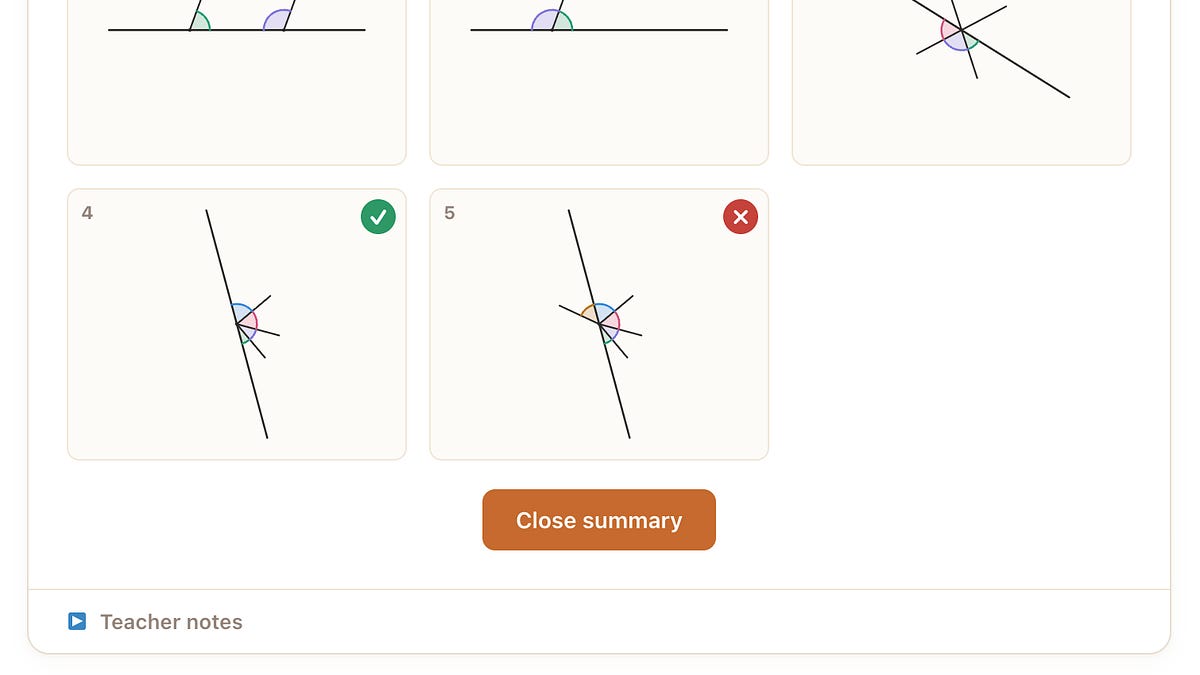
The bulk of the post consists of five detailed exchanges from Barton's recent work with Claude on building teaching sequences for categorical concepts — resources that use carefully sequenced positive and negative examples to help students induce mathematical rules. In one exchange, Claude pushed back on Barton's five-example sequence for "What is an integer?", arguing that a sixth example with a negative decimal was needed because students wouldn't generalize across fractions and decimals. In another, Claude rejected a visually elegant animation idea because it risked planting the misconception that -1/3 equals -1.3. Barton also pushed back on Claude when animations failed to hold invariant features in fixed positions on screen.
The exchanges illustrate a genuinely collaborative dynamic where both human expertise and AI reasoning improve the final output. Barton emphasizes that the value lies not in the AI producing correct resources on the first try, but in the pedagogical reasoning surfaced through back-and-forth dialogue — reasoning he might have missed when bogged down in formatting and typing. He also advocates using voice dictation (via Wispr Flow) to free up working memory for deeper thinking, and shares links to the resulting interactive resources on topics like integers, standard form, and angles on a straight line.
This guide from Prompt Engineering Guide outlines foundational tips for designing effective prompts for large language models. It emphasizes starting simple and iterating incrementally, treating prompt design as an experimental process where complexity is added gradually. The guide recommends using clear command verbs like "Write," "Classify," or "Summarize" and separating instructions from context with delimiters like "###" for clarity.
A central theme is the importance of specificity over vagueness — rather than asking for "a short explanation," a well-crafted prompt specifies the exact length, audience, and format desired. The guide also addresses the common pitfall of telling models what not to do, demonstrating through a movie recommendation chatbot example that positive instructions (stating what the model should do) produce far better results than negative constraints. Each tip is illustrated with concrete before-and-after prompt examples, making the advice immediately actionable for practitioners at any level.
Jason Wei addresses the common question of whether prompt engineering will become obsolete over time. His short answer is a definitive "no," but he offers a more nuanced perspective: the goal of prompt engineering has evolved significantly. In the early days (2020/2021), it was primarily about coaxing a finnicky language model into performing relatively simple tasks. Over time, the focus has shifted toward figuring out how to unlock more complex capabilities from increasingly powerful models.
The post, though truncated, highlights an important insight about the maturing role of prompt engineering in AI development — it's not disappearing but rather transforming in scope and ambition as language models improve.
The Prompt Engineering Guide is a comprehensive resource dedicated to the emerging discipline of prompt engineering — the practice of designing and optimizing prompts to effectively leverage large language models (LLMs). It highlights how researchers use prompt engineering to enhance LLM performance on tasks like question answering and arithmetic reasoning, while developers use it to build robust prompting techniques that interface with LLMs and external tools.
Beyond just crafting prompts, the guide emphasizes that prompt engineering encompasses a broad set of skills for interacting with and understanding LLMs, including improving model safety, integrating domain knowledge, and augmenting models with external tools. The resource compiles the latest research papers, advanced techniques, model-specific guides, lectures, and tools. It also offers structured courses ranging from beginner-level prompt engineering fundamentals to intermediate courses on building effective AI agents with function calling and tool integration.