Mike Kentz argues that the popular framing of AI as a "thinking partner" is intellectually dangerous, making users weaker rather than stronger. He points out that unlike a trusted human collaborator who brings genuine experience and judgment, generative AI is a pattern-matching system prone to hallucination and sycophancy — it agrees with users rather than challenging them. Even OpenAI CEO Sam Altman has warned that ChatGPT shouldn't be trusted as much as people trust it, yet users increasingly rely on it for collaborative problem-solving across disciplines.
Kentz proposes reframing AI interaction as a "sparring partner" rather than a thinking partner. A sparring partner isn't there to be liked — it pushes back, tests assumptions, and forces users to defend their positions. This approach treats AI interaction as a test of skill, subject matter expertise, and metacognition rather than a comfortable brainstorming session. He cites his creative writing mentor Ken Liu's insight: "You've got to force AI to force YOU to be more human."
The article draws on Kentz's classroom experience, where the sparring model proved highly effective. Examples include students conducting adversarial interviews with an AI-generated Holden Caulfield, catching deliberate hallucinations, and being graded down for passively accepting AI-generated ideas. He has developed nine sparring prompts designed to push users into productive intellectual conflict, and is now partnering with universities and K-12 districts to pilot research programs based on this approach.
Craig Barton, a veteran maths teacher and resource creator, shares his evolving framework for using AI as a thought partner rather than as a passive content generator or mere formatting tool. He identifies two traps educators commonly fall into: cognitive outsourcing (letting AI do all the thinking) and ego-driven underuse (doing all the thinking yourself and only using AI for layout). His five-step framework includes ending prompts with "Before you build, ask me some clarifying questions," explicitly inviting the AI to challenge your ideas with reasons, scrutinizing outputs like a colleague's draft, iterating through multiple versions, and asking the AI to reflect on what it learned for future sessions.
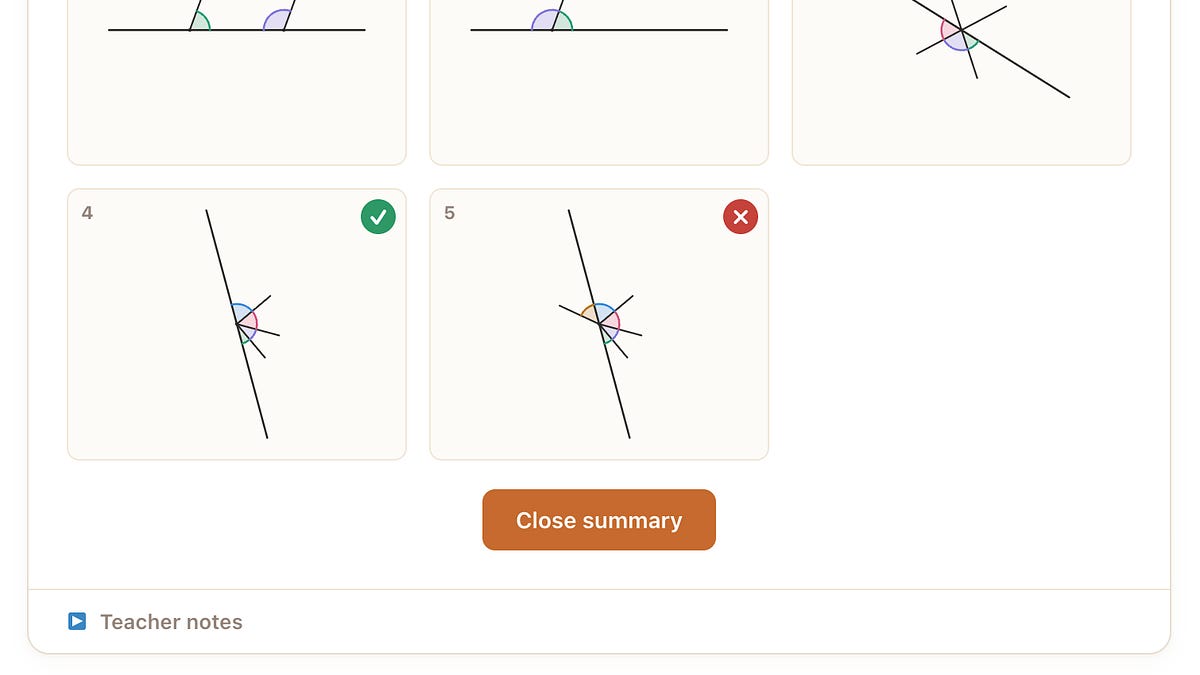
The bulk of the post consists of five detailed exchanges from Barton's recent work with Claude on building teaching sequences for categorical concepts — resources that use carefully sequenced positive and negative examples to help students induce mathematical rules. In one exchange, Claude pushed back on Barton's five-example sequence for "What is an integer?", arguing that a sixth example with a negative decimal was needed because students wouldn't generalize across fractions and decimals. In another, Claude rejected a visually elegant animation idea because it risked planting the misconception that -1/3 equals -1.3. Barton also pushed back on Claude when animations failed to hold invariant features in fixed positions on screen.
The exchanges illustrate a genuinely collaborative dynamic where both human expertise and AI reasoning improve the final output. Barton emphasizes that the value lies not in the AI producing correct resources on the first try, but in the pedagogical reasoning surfaced through back-and-forth dialogue — reasoning he might have missed when bogged down in formatting and typing. He also advocates using voice dictation (via Wispr Flow) to free up working memory for deeper thinking, and shares links to the resulting interactive resources on topics like integers, standard form, and angles on a straight line.