
Daria Cupareanu describes how she built a personal AI assistant that operates 24/7 through Telegram, handling tasks like calendar management, email drafting, web searches, idea capture, and document organization — all from a single message. The system is powered by n8n (a workflow automation platform), the OpenAI API, and integrations with Google Cloud services, Notion, and SerpAPI. Two n8n workflows drive the architecture: one for real-time request handling and another for processing and organizing ideas in Notion. A custom "mega-prompt" gives the AI agent the context to interpret requests and route them to the appropriate service.
The author breaks down the cost at roughly $23/month — $20 for n8n's cloud subscription plus approximately $2.64 in OpenAI credits for around 300 tasks — and contrasts this with hiring a human assistant. She reports saving approximately 4 hours of admin time per week, capturing 24 ideas that would have otherwise been lost, and significantly reducing mental overhead from context-switching between apps. The post is structured as a step-by-step tutorial, though the full implementation guide (including workflow JSON files, connection guides, and the AI agent prompt) is gated behind a paid Substack subscription.

Small teams are increasingly bypassing the traditional developer hiring bottleneck by using no-code AI automation platforms to build workflows tailored to their specific needs. The article illustrates this through a five-person specialty food distributor team that eliminated a two-hour weekly manual reconciliation process by building their own automation over two afternoons, without writing any code. Tools like Airtable serve as flexible database foundations, allowing non-technical users to model their actual workflows and layer automation on top.
The piece identifies a critical pattern in successful small-team automation: automating the "noticing" rather than the "deciding." Rule-based, repetitive tasks like flagging order discrepancies are ideal candidates for automation, while genuinely ambiguous judgment calls should remain with humans. The article also pushes back against marketing claims of instant setup, noting that building something that fits a team's real, messy workflow requires meaningful iteration — but that investment pays off. Ironically, small teams often end up with better-fitting solutions than larger companies because the people building the tool are the same ones living with the problem daily, catching nuances that would be lost in a formal requirements document.

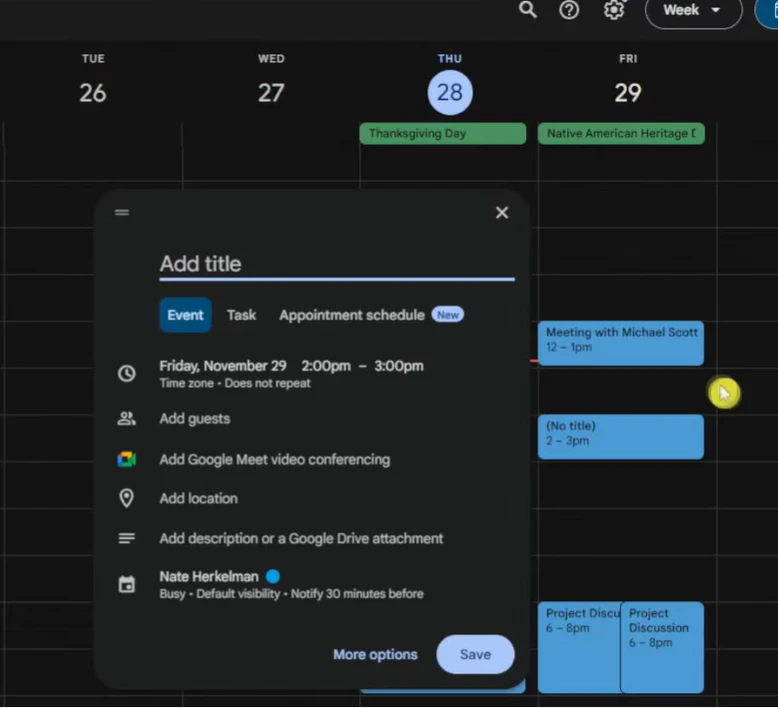
This AIMultiple article provides a comprehensive guide to building and using personal AI agents across three main approaches. The first is no-code automation tools like n8n and Zapier, which allow users to create AI workflows through drag-and-drop interfaces — demonstrated through an n8n agent that creates calendar events and sends emails via Telegram. However, the authors note these tools lack true autonomy since they follow predefined sequences rather than dynamically adapting.
The second approach uses Anthropic's Model Context Protocol (MCP) to build self-reflective agents that can dynamically access tools, evaluate their own outputs, and involve humans for high-stakes decisions. This method offers greater autonomy but requires backend development knowledge. The article then catalogs 18 agent platforms and tools for non-builders, organized into categories: scheduling assistants (Motion, Reclaim.ai, Lindy), model provider assistants (Manus, ChatGPT Operator, Claude Cowork), workspace/knowledge tools (Notion AI, ClickUp AI, Saner AI), communication and meeting tools (Superhuman Platform, Fyxer, Otter.ai), and domain-specific assistants for finance and personal coaching.
A fourth section covers local-first open-source agents like OpenClaw, Hermes Agent, and security-focused options like IronClaw, which run on personal hardware and maintain persistent memory across sessions. The article highlights important tradeoffs including security risks (OpenClaw's CVE history and malicious skill registry entries), running costs from uncapped token usage, and the setup complexity inherent in self-hosted solutions. The piece effectively maps the current landscape from fully managed to fully self-hosted personal AI agent options.
This guide presents a comprehensive agentic AI tool stack for solo founders in 2025, covering every stage from ideation to operations. It distinguishes agentic AI — autonomous, multi-step AI systems that can chain tasks, call APIs, and adapt over time — from simpler one-off assistants. The recommended stack centers on GPT-4o for general-purpose ideation and strategy, Devin (Cognition.ai) as an autonomous AI software engineer claiming 8-12x coding speedups, Lindy for no-code marketing and sales automation, and Claude 3 for customer support with its 200K token context window.
The article walks through specific use cases at each startup stage: using Claude or GPT-4o for market research and competitor analysis, deploying Devin or Cursor for product development, setting up Lindy or Cognosys workflows for automated email drip campaigns and sales outreach, and leveraging Retell AI for voice-based customer support with claimed 80% cost reductions. For operations, it highlights Basis (which raised $34M) as an AI accounting agent that integrates with QuickBooks and Xero. The guide includes detailed comparison tables with pricing, pros, and limitations for each tool category, and emphasizes that while these agents deliver 30-80% efficiency gains, they function best as "very smart interns" requiring human oversight rather than fully autonomous replacements.
This article surveys 20 AI workflow tools that enterprises can use to inject large language model (LLM) intelligence into their business processes. Author Peter Wayner explains how these tools build on decades of business intelligence, business process management, and robotic process automation by adding modern AI capabilities — from LLM-driven decision-making to no-code workflow creation where users can prompt an AI to build the workflow itself. The tools range from open-source frameworks like Apache Airflow, LangChain/LangGraph, and n8n to commercial platforms like Zapier, Microsoft Power Automate, Workato, and Make.
The roundup covers a diverse spectrum of approaches: CrewAI for multi-agent orchestration with natural language instructions, StackAI and Vellum AI for retrieval-augmented generation with document collections, Dagster and Prefect for data pipeline orchestration, and Flowise AI for human-in-the-loop designs. Wayner notes that while experimentation with these tools is fast — since moving data between systems is now relatively easy — success ultimately depends on prompt quality and how well the LLM can absorb the context of larger workflows. The article serves as a practical reference for IT leaders evaluating which tool best fits their enterprise's integration needs, technical skill level, and governance requirements.
