
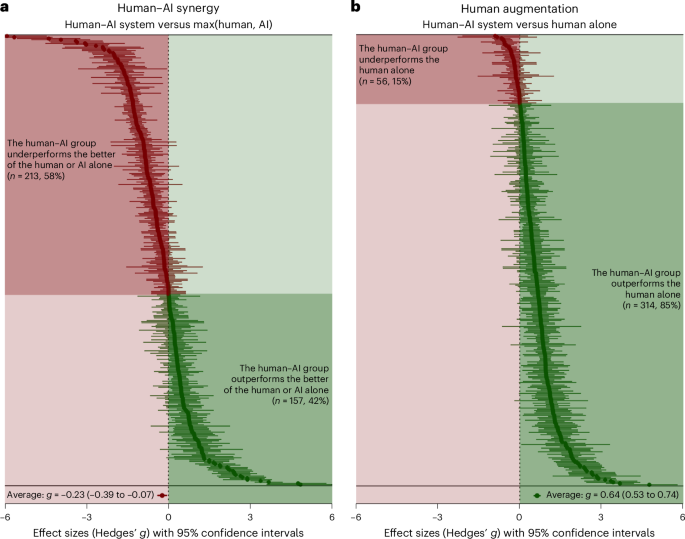
A systematic review and meta-analysis published in Nature Human Behaviour examines whether combining humans and AI yields better performance than either alone. Researchers analyzed 106 experimental studies with 370 effect sizes published between January 2020 and June 2023, finding that on average, human–AI systems performed significantly worse than the best of humans or AI alone (Hedges' g = −0.23). However, these combinations did outperform humans working alone, demonstrating what the authors call human augmentation (g = 0.64). The findings challenge the widespread assumption that pairing humans with AI automatically produces superior results.
The study identifies critical moderating factors. Task type matters significantly: decision tasks (choosing among finite options) showed performance losses, while creation tasks (generating open-response content) showed performance gains from human–AI collaboration. The relative performance gap between human and AI also proved crucial — when humans outperformed AI alone, the combination achieved genuine synergy (g = 0.46), but when AI outperformed humans, the combination suffered losses (g = −0.54). The authors hypothesize that when humans are more skilled at a task, they are also better at judging when to trust their own judgment versus the AI's suggestions.
Notably, factors that have received significant research attention — such as providing AI explanations or confidence scores — did not significantly affect human–AI system performance. The authors suggest researchers should shift focus toward less-studied but more impactful factors like task type, baseline performance differences, and division of labor between humans and AI. They also note that only 3 of 100+ experiments explored predetermined delegation of subtasks to humans and AI, pointing to a largely unexplored but promising design approach for achieving genuine human–AI complementarity.
This California Management Review article by Dritjon Gruda and Brad Aeon systematically debunks seven common myths about AI and productivity using evidence from recent meta-analyses and systematic reviews rather than individual studies or vendor claims. The authors challenge the assumption that AI is a universal productivity enhancer, showing that gains are highly context-dependent — benefiting junior workers far more than experts, and often introducing quality regressions that offset speed improvements. Perhaps most strikingly, a meta-analysis of 106 experiments found that human-AI collaboration frequently underperforms either agent working independently, except in open-ended creative tasks like brainstorming.
The article also addresses AI's impact on creativity, finding that while AI-augmented humans achieve modestly higher novelty scores, this comes at the cost of dramatic declines in idea diversity — a homogenization effect that undermines innovation. At the macroeconomic level, a meta-analysis of 371 estimates found no robust relationship between AI adoption and aggregate productivity gains once methodological factors are controlled, echoing a modern version of the Solow paradox. Additional myths around automation bias, where high-reliability AI systems actually increase certain types of human error by 12%, and the stress paradox, where AI creates new forms of technostress rather than reducing workplace burden, round out the analysis.
The authors conclude with practical guidance: organizations should conduct evidence audits with task-specific metrics, implement a "creation versus evaluation" matrix for task triage, deploy adaptive governance structures with confidence disclosures, and maintain an equity lens to track distributional impacts across skill levels. The core message is that AI's productivity dividend is real but narrow — it materializes only for specific users, specific tasks, and specific workflow designs, demanding far more analytical rigor than most organizations currently apply.

Valerio Capraro shares findings from a meta-analysis of 106 studies published in Nature Human Behaviour examining the effectiveness of human-AI collaboration. The key finding is striking: on average, there was no synergy between humans and AI working together. Human–AI combinations did not outperform both humans and AI working independently.
Particularly notable is the implication that when AI alone performed well on a task, adding a human to the loop did not improve outcomes. This challenges the widely held assumption that combining human judgment with AI capabilities automatically produces superior results, and raises important questions about how organizations should design their human-AI workflows.