A Reddit user in r/AI_Agents asks the community for real-world examples of AI agents in use, noting that most content online consists of tutorials rather than practical, lived experiences. The thread generates a rich set of responses from practitioners who share their actual implementations, ranging from personal assistant agents handling calendar management, email summarization, and meeting prep, to more specialized workflows like automated job application filtering, SEO content pipelines, and school email monitoring.
Several standout examples emerge: one user built a voice-driven AI assistant for a CEO that handles messaging, email drafting, meeting context retrieval, and automated booking. Another describes a multi-workflow system using Telegram that plans trips, searches LinkedIn jobs with automated cover letter generation, drafts SEO-optimized articles using Perplexity, Claude, and ChatGPT in sequence, and monitors school communications. A developer details an automated code review orchestrator using Gemini models that fetches pull requests, builds context via AST trees, and identifies logical and security bugs.
The thread also surfaces practical realities: one commenter notes that building agents is easy but monetizing them is hard, with 98% of agent businesses struggling to find paying customers. Another points out that government contracts largely prohibit these tools on state IT networks. Most implementations described run on platforms like N8N and integrate with tools like Google Docs, Sheets, Telegram, and Zapier, emphasizing that the most valuable agents aren't flashy multi-agent systems but quiet productivity tools that eliminate repetitive admin work.
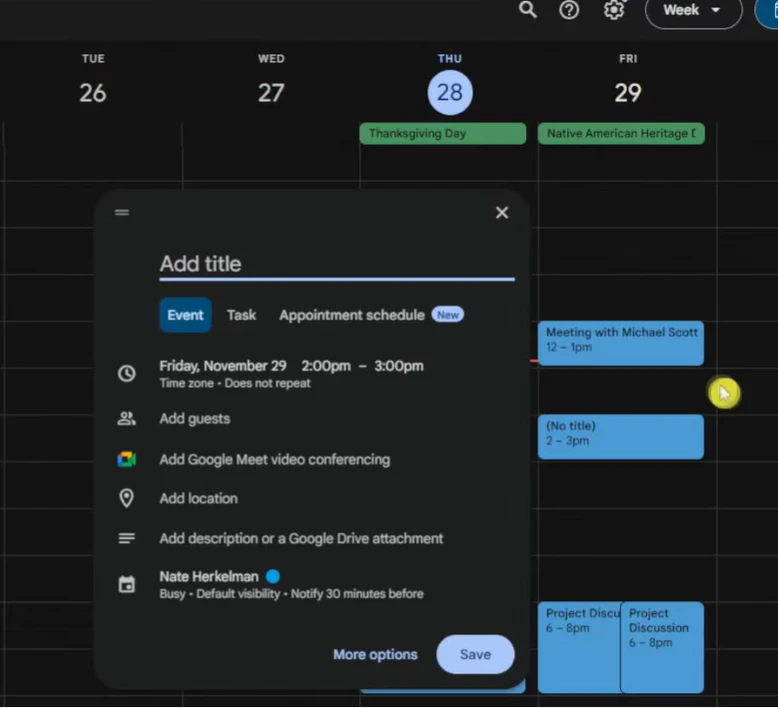
This AIMultiple article provides a comprehensive guide to building and using personal AI agents across three main approaches. The first is no-code automation tools like n8n and Zapier, which allow users to create AI workflows through drag-and-drop interfaces — demonstrated through an n8n agent that creates calendar events and sends emails via Telegram. However, the authors note these tools lack true autonomy since they follow predefined sequences rather than dynamically adapting.
The second approach uses Anthropic's Model Context Protocol (MCP) to build self-reflective agents that can dynamically access tools, evaluate their own outputs, and involve humans for high-stakes decisions. This method offers greater autonomy but requires backend development knowledge. The article then catalogs 18 agent platforms and tools for non-builders, organized into categories: scheduling assistants (Motion, Reclaim.ai, Lindy), model provider assistants (Manus, ChatGPT Operator, Claude Cowork), workspace/knowledge tools (Notion AI, ClickUp AI, Saner AI), communication and meeting tools (Superhuman Platform, Fyxer, Otter.ai), and domain-specific assistants for finance and personal coaching.
A fourth section covers local-first open-source agents like OpenClaw, Hermes Agent, and security-focused options like IronClaw, which run on personal hardware and maintain persistent memory across sessions. The article highlights important tradeoffs including security risks (OpenClaw's CVE history and malicious skill registry entries), running costs from uncapped token usage, and the setup complexity inherent in self-hosted solutions. The piece effectively maps the current landscape from fully managed to fully self-hosted personal AI agent options.
n8n positions itself as an advanced AI workflow automation platform designed for technical teams, emphasizing debuggability, explainability, and maintainability over hype. The platform offers modular AI system building with key features including human-in-the-loop controls at any workflow stage, guardrails that combine AI with rule-based automation to constrain inputs and validate outputs, and detailed execution monitoring that logs every prompt, model response, and subsequent action for debugging, audits, and compliance.
The platform supports a wide range of use cases across departments — from IT routing employee requests to the best model, to sales discovering leads via MCP-connected services, to finance automating operations with specialized agent teams. Notable capabilities include MCP integration that makes n8n workflows callable by external AI platforms like Claude and Lovable, a natural language workflow builder that generates working automations from plain English descriptions, and a unified chat interface for organization-wide access to multiple AI models and agentic workflows.
A case study with SanctifAI highlights the platform's practical value: the company spun up its first workflow in just 2 hours using n8n's visual builder — 3X faster than writing Python controls for LangChain — and now trains product managers to build and test directly, reducing dependence on scarce engineering talent. The platform is self-hostable, SOC2 compliant, and boasts over 185k GitHub stars.