An ML engineer at a large tech company shares a no-hype, practical review of 10 AI tools that have earned a permanent place in their daily workflow. Each tool is evaluated with specific strengths, weaknesses, pricing, and honest assessments of when to use — and when not to use — each one. The lineup includes Claude for high-quality reasoning and code review, Cursor for LLM-integrated coding (with a realistic note that the "3x productivity" claim only holds for greenfield work), Perplexity for citation-backed research, ElevenLabs for text-to-speech and voice cloning, and n8n as an open-source workflow automation alternative to Zapier.
The list also covers more specialized tools: Granola for local, bot-free meeting transcription, Gamma for quick AI-generated presentations, v0 by Vercel for generating React/Tailwind UI components, NotebookLM for grounded RAG over uploaded documents (highlighted as underrated), and Claude Code as a CLI-based coding agent that the author calls the "most genuine productivity gain" on the list. The post closes with a practical decision framework: don't subscribe to any tool unless you can name the specific task it solves, use free tiers for a week first, and expect that 2–3 well-chosen tools matter more than adopting all 10. Total cost if subscribing to everything is roughly $130/month.

Microsoft's Azure Foundry documentation provides a comprehensive guide to prompt engineering techniques for GPT models, covering foundational concepts through advanced strategies. The article breaks down prompts into key components — instructions, primary content, examples, cues, and supporting content — explaining how each element shapes model behavior. It emphasizes that GPT models fundamentally predict the most likely next words based on training data, making prompt design more art than science. Notably, these techniques are not recommended for reasoning models like GPT-5 and o-series models.
The guide dives into practical strategies including few-shot learning, chain-of-thought prompting, output structure specification, and the use of affordances like search to ground model responses in factual data. It demonstrates how breaking complex tasks into smaller steps, repeating instructions, and using clear syntax (such as Markdown or XML separators) can significantly improve output quality. The article also covers temperature and Top_p parameters for controlling randomness, and provides grounding context techniques to reduce hallucinations.
A set of best practices rounds out the guide: be specific, be descriptive, leverage recency bias by placing instructions strategically, and give models an "out" to avoid fabricated responses. The article also addresses space efficiency, noting that tabular data formats are more token-efficient than JSON, and that careful whitespace management can help maximize the limited context window available in GPT models.

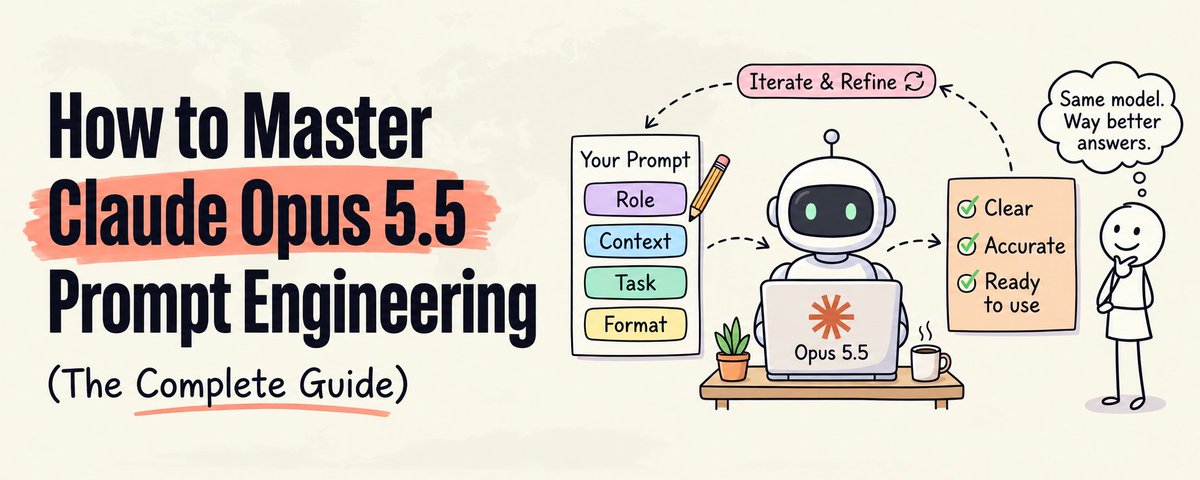
This comprehensive guide by Khairallah AL-Awady breaks down prompt engineering for Claude Opus 5.5, arguing that the model represents a fundamental shift where established prompting habits now actively work against users. The core thesis is that techniques like "think step by step," manual thinking budgets, forced tool calls, and requests to show reasoning — all best practices eighteen months ago — should be deleted from prompts. Anthropic's own documentation confirms that Opus 5.5 decides autonomously how much to think, always has thinking enabled, and can refuse prompts that push it to reproduce internal reasoning under a new reasoning_extraction refusal category.
The guide identifies twelve specific changes, with effort level (low, medium, high, xhigh, max) replacing prompt-based instructions as the primary lever for controlling intelligence, latency, and cost. Key recommendations include replacing abstract quality words like "professional" or "engaging" with concrete, named patterns to follow or avoid, front-loading all instructions and tool declarations from the first request, and explicitly naming failure modes the model should prevent. For agents, this means describing exact early-stop patterns — like announcing next steps without executing them — rather than vague instructions to "be thorough."
The article provides three detailed before-and-after prompt rewrites covering data analysis, LinkedIn copywriting, and autonomous agent tasks, demonstrating how specificity and structure outperform generic directives. It closes with an engineering-oriented testing methodology: building evaluation sets of 10–20 real inputs, running effort sweeps across multiple levels, changing one variable at a time, and studying failures rather than successes. The overarching message is that prompt engineering hasn't died — it has shifted from memorizing incantations to the harder, more durable skill of communicating with precision and measuring outcomes.
This article by Cankun Wang maps 50+ years of cybernetics theory directly onto modern AI agent system design, arguing that multi-agent architectures are unknowingly reinventing principles established decades ago. Starting with Wiener's feedback loops and Ashby's Law of Requisite Variety, the piece shows how foundational cybernetic concepts explain why single orchestrators fail at complex tasks and why multi-agent systems with proper variety engineering succeed. Stafford Beer's Viable System Model (VSM) is presented as a near-exact blueprint for current orchestrator-worker architectures, with its five subsystems (operations, coordination, internal management, intelligence, identity) mapping cleanly onto components like worker agents, conflict resolution layers, and quality audits.
The article moves through Perceptual Control Theory (defining what agents should perceive rather than output), second-order cybernetics (recognizing designers are part of the system they build), autopoiesis (systems that maintain their own operating conditions), and Pask's Conversation Theory (multi-level dialogue between agents operating at execution, description, and explanation layers). Donella Meadows' leverage points framework provides a practical hierarchy for system intervention, showing that tweaking parameters like temperature is far weaker than changing system goals or paradigms.
The most forward-looking section covers Karl Friston's Free Energy Principle and Active Inference, positioning it as the 21st-century continuation of cybernetics. The fusion of Active Inference with LLMs — where Active Inference serves as a cognitive control layer deciding what the LLM should attend to while LLMs provide the language interface — is highlighted as the key frontier for 2024–2026. The piece also introduces stigmergy as the critical scaling mechanism for moving from small agent teams to thousands, using shared environments instead of centralized communication. A comprehensive mapping table and prioritized reading list make this a practical reference for agent system designers.

Noah MacCallum shares his enthusiasm for GPT-4.1, declaring it his new daily driver. He notes that his team has spent hundreds of hours experimenting to optimize the model's performance and offers to share key learnings to help others get the most out of it from day one.
A primary takeaway highlighted in the post is GPT-4.1's strength in agentic workflows, suggesting the model excels when used in autonomous, multi-step task execution scenarios. The post appears to be part of a longer thread with an accompanying image, likely containing more detailed tips and best practices for working with the model.
Daniel Ch provides a comprehensive guide to GPT-6.1 Sol, OpenAI's newly released model positioned between the flagship GPT-6 Astra and the lightweight GPT-6 Luna. Sol delivers near-Astra performance on complex coding, computer use, and professional document work at roughly one-fifth of Astra's token prices, making it the practical default for serious everyday work rather than a cheaper fallback. The guide covers benchmark results across DeepSWE, GDP.pdf, AutomationBench, OSWorld 2.0, and Terminal-Bench Science, while emphasizing that teams should validate performance against their own workflows rather than relying on public scores.
The core framework centers on seven principles: start with Sol as the default for complex work, route tasks by successful outcomes rather than token price, match reasoning effort (low through max) to task difficulty, describe the finished state rather than a topic, use the Responses API for tool-based workflows, reuse context efficiently with prompt caching, and escalate to Astra only when Sol measurably falls short. Specific advice covers structuring prompts with explicit goals, deliverables, and approval boundaries, managing the 1,050,000-token context window, and building confidence gates around outputs. The article identifies five high-value workflows — repository-level coding, professional document intelligence, multi-step business operations, computer-use automation, and decision-oriented research — where Sol's cost structure can deliver significant savings. Pricing sits at $2.00 per million input tokens and $10.00 per million output tokens, with cached input at just $0.10 per million tokens.

Andrew Ng discusses tool use as a key design pattern in AI agentic workflows. He explains that tool use involves giving an LLM access to functions it can request to call for purposes such as gathering information, taking actions, or manipulating data. Common examples include LLM-based systems that can perform web searches or execute code. The post is part of Ng's broader series on agentic AI design patterns, highlighting how tool use enables AI agents to extend their capabilities beyond pure text generation by interacting with external systems and APIs.
Anthropic's guide to prompt engineering best practices for 2026 walks through a progression of techniques for getting better results from AI models like Claude. The article starts with core techniques — being explicit and clear, providing context and motivation, adding specificity, using examples (few-shot prompting), and giving the model permission to express uncertainty. These foundational habits are positioned as the starting point before moving to more sophisticated methods.
The guide then covers advanced techniques including response prefilling to enforce output formats like JSON, chain of thought prompting (with basic, guided, and structured variants), output format control, and prompt chaining — breaking complex tasks into sequential steps across multiple prompts. Notably, the article acknowledges that some once-popular techniques like XML tags and heavy role prompting are now less necessary with modern models like Claude 4.x, which can interpret structure and intent more naturally.
A practical decision framework helps readers choose the right technique for their situation, while a troubleshooting section addresses common problems like generic responses, hallucinations, and inconsistent formatting. The article emphasizes that prompt engineering is converging with context engineering for newer Claude models, where the focus shifts from scaffolding prompts to curating the right context. The overarching advice: start simple, add complexity only when needed, and remember that the best prompt is the one that achieves goals reliably with minimum structure.
Garry Tan, CEO of Y Combinator, describes the compounding personal AI system he's built over the past five months, arguing that AI should be treated not as a chat window but as an operating system. His open-source stack — GBrain for knowledge infrastructure, OpenClaw/Hermes Agent as thin routing harnesses, and GStack for coding — maintains a structured knowledge base of roughly 100,000 pages covering every person, meeting, book, and idea he engages with. The system runs 100+ cron jobs daily, automatically ingesting meeting transcripts, triaging email, and propagating updates across entity pages to create what he calls a "nervous system" rather than a filing cabinet.
The centerpiece concept is skillification: a meta-skill called Skillify that observes a manual workflow, extracts the repeatable pattern, and writes a tested skill file with triggers and edge cases. Tan illustrates this with his book-mirror pipeline, which takes a book like Pema Chödrön's When Things Fall Apart, runs sub-agents to summarize each chapter, and maps every idea to his specific life context — family history, founder conversations, therapy notes — producing a 30,000-word personalized analysis in 40 minutes. He's done this with 20+ books, each mirror enriching the next because the brain's context grows.
Tan advocates a "fat skills, fat code, thin harness" architecture where the routing layer is minimal, the skills encode deep operational knowledge (100+ markdown skill files), and multiple models — Opus 4.7, GPT-5.5, DeepSeek V4-Pro, Groq/Llama — are dispatched by the skill based on the task. Cross-modal evaluation catches errors by having models score each other's output. He open-sources everything at github.com/garrytan/gbrain and urges builders to start by doing something they care about, iterating until it's good, then skillifying the pattern into reusable infrastructure that compounds over time.

Andrew Ng highlights a significant shift in how large language models (LLMs) are being developed. While LLMs have traditionally been optimized to answer users' questions — a paradigm popularized by ChatGPT — there is now a growing trend toward optimizing models to integrate into agentic workflows. Ng argues that this evolution will deliver a substantial boost to agentic AI performance.
This observation points to a broader industry movement where AI models are not just reactive question-answering tools but proactive agents capable of executing multi-step tasks, making decisions, and collaborating within larger automated systems. The shift from conversational AI to agentic AI represents a key inflection point in how these models are designed, trained, and deployed.
Rohan Paul shares a research paper titled "Large Language Models For Text Classification: Case Study And Comprehensive Review" and highlights that he generated a podcast episode about the paper using Google's Illuminate, a tool that converts research papers into audio discussions. The post includes a media attachment (likely the podcast audio or a visual summary) showcasing the output from Illuminate.
This is a brief social media post that points to the intersection of LLMs for text classification and AI-powered research summarization tools. It serves as a useful reference for those interested in both the academic survey of LLM-based text classification approaches and the practical use of Google's Illuminate for digesting academic content.
This Forbes Technology Council roundup presents 20 real-world use cases for large language models (LLMs) across diverse industries, contributed by technology executives and leaders. The examples span healthcare, cybersecurity, customer service, software development, pharmaceuticals, marketing, and more. Notable cases include OpenAI's collaboration with a healthcare provider that reduced diagnostic errors by 20%, GitHub Copilot enhancing developer productivity with real-time coding suggestions, Ricoh cutting technician onboarding from 10 weeks to two using a specialized LLM, and a pharmaceutical company saving days to weeks of manual work by automating scientific literature curation.
A recurring theme across the contributions is that success with LLMs depends not just on choosing the right model, but on rigorous data management, domain-specific fine-tuning, and thoughtful workflow integration. Several contributors emphasize that LLMs work best when they augment human capabilities rather than replace them — freeing teams to focus on higher-impact, strategic work. The article also highlights that organizations of all sizes can benefit, as many of these use cases leverage publicly available models rather than requiring massive proprietary training datasets. From automating claims processing to generating test data, the examples collectively illustrate that LLMs deliver the most value when applied to well-defined, labor-intensive processes where language understanding and data synthesis are key bottlenecks.

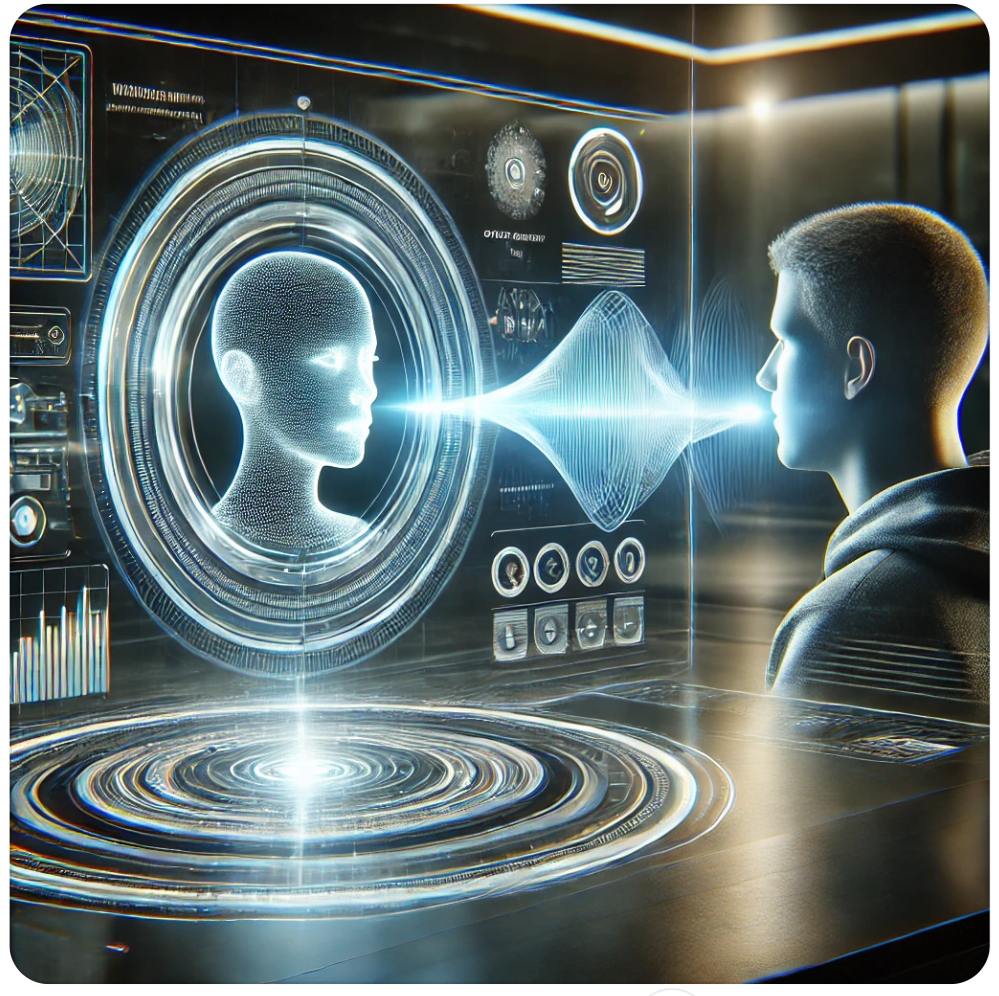
The author, a researcher working on augmented and virtual reality tools for molecular graphics, makes the case that Voice User Interfaces (VUIs) are rapidly approaching the level of sophistication needed for mainstream adoption. Drawing on a debate with a skeptical colleague and Daley Wilhelm's analysis of Star Trek's predictions for UX, the article examines why speech-based interaction has historically fallen short of science fiction's seamless vision — but argues that recent AI breakthroughs are closing the gap faster than most realize.
The piece identifies four technological pillars required for truly fluid VUIs: speech recognition, understanding, text processing, and speech synthesis. The author rates each on a 10-point scale, giving text processing a 9/10 (largely thanks to large language models like GPT-4), understanding an 8/10, speech recognition a 7/10 (citing models like OpenAI's Whisper V3), and speech synthesis a modest 5/10 as the weakest link still sounding somewhat robotic. The emergence of multimodal AI models that natively process sound, text, and other inputs within a single architecture is presented as a potential breakthrough that could unify these capabilities.
Despite the technical progress, the author acknowledges significant remaining barriers: lack of deep cross-system integration, privacy concerns around always-listening devices, and the challenge of diverse accents and noisy environments. Nevertheless, the conclusion is that computers are now more ready than humans for routine speech-based interaction, and that VUIs will become essential in contexts like AR/VR, accessibility, vehicles, and industrial settings where hands-free operation is critical.
A Twitter user summarizes a recent insight from Andrej Karpathy about a shift in how he uses AI. Rather than primarily using AI for code generation, Karpathy is now spending more time leveraging LLMs to build personal knowledge bases. His workflow involves dumping raw sources — articles, papers, repos, datasets, and images — into a folder, then having an LLM organize and structure the material.
This reflects a broader trend where AI power users are moving beyond code assistance toward using LLMs as knowledge management and curation tools. The approach treats AI not just as a productivity shortcut for development, but as a way to synthesize and make sense of large volumes of information across diverse formats.
Snowflake's guide explores the evolution from task-oriented AI systems to autonomous AI agents — systems capable of interpreting goals, constructing plans, executing actions, and iterating with limited human supervision. The article distinguishes between traditional AI agents, which respond to discrete prompts, and autonomous agents that assume workflow ownership, maintaining persistent context, accessing enterprise tools, and adapting through continuous feedback loops. Key architectural capabilities include persistent memory, goal-based reasoning powered by LLMs, tool integration with enterprise systems, and built-in guardrails and governance.
The piece outlines a spectrum of autonomy ranging from simple reflex agents to complex multi-agent systems where specialized agents collaborate on tasks. Real-world applications span customer support operations, software development and DevOps, revenue operations, market intelligence, and finance/compliance — all scenarios characterized by data-intensive, multi-step workflows requiring sustained intervention. The article balances its discussion of benefits like scalable digital capacity and faster feedback loops with candid treatment of challenges including control and reliability risks, state management complexity, security exposure from tool integrations, cost and latency concerns, and the difficulty of debugging probabilistic decision-making. The overarching argument is that organizations benefiting most from agentic AI will treat autonomy as infrastructure, combining intelligent reasoning with disciplined data architecture and continuous oversight.

Andrej Karpathy shares his experience with Claude coding over the past few weeks, noting a dramatic shift in his development workflow. He describes moving from roughly 80% manual coding with autocomplete and 20% agent-assisted coding in November to an inverted ratio of 80% agent coding with only 20% manual edits and touchups by January 2026.
The post reflects a broader trend among developers rapidly adopting LLM-powered coding agents as their capabilities have improved significantly. Karpathy's firsthand account underscores how quickly AI-assisted development is becoming the dominant workflow for experienced programmers, signaling a major shift in software engineering practices.
Matt Shumer shares his impressions after a week of testing GPT-5.4, declaring it the best model in the world "by far." He argues it is so capable that it effectively ends the debate over which AI model to use for various tasks. Perhaps most notably, Shumer reveals that he barely uses Pro mode anymore, which he frames as a surprising shift given his known usage patterns. The post signals a significant leap in model quality from OpenAI, suggesting GPT-5.4 may represent a consolidation point where one model suffices for most use cases.
A Reddit user on r/LocalLLaMA asks the community for best practices on integrating multiple AI models — including Claude, GPT, and Gemini — into a unified daily workflow. Their main pain points include context switching between platforms, managing multiple subscriptions, and lacking seamless integration with productivity tools like email, calendar, and task management.
Community responses suggest several approaches. OpenRouter emerges as a popular option for accessing multiple models through a single interface. Poe is mentioned for its clean UI but noted for lacking deep workflow integration. One commenter recommends Atlascloud.ai for aggregated access to LLM and image/video models with competitive pricing. For context persistence across different AI interactions — a key concern of the original poster — respondents acknowledge that no aggregator handles this well, suggesting instead the use of memory tools or building custom agents. The thread also touches on the cost implications of querying multiple models for the same task and the value of comparing outputs from different models, especially for content writing.
A product manager with 3–4 years of experience in AI products shares a candid critique of the "AI Product Manager" role as it exists today, particularly in the Indian startup ecosystem. The author argues that many positions marketed as AI PM roles are actually implementation and customer success roles disguised with an AI label. In these roles, the core AI platform is already built by engineering teams, and the PM's job reduces to configuring prompts, designing conversation flows, and deploying the system for enterprise clients — not shaping the product's roadmap or working on core AI capabilities.
The post highlights a frustrating career trap: after spending one or two years in such a role, professionals find themselves stuck. They lack the ML engineering background that companies building serious AI infrastructure demand, yet their experience is too AI-focused for generic PM roles. The author also challenges the prevailing hype, estimating that AI improves enterprise workflow efficiency by roughly 20–25 percent — far from the transformational claims commonly made. Many startups, the author notes, are essentially API wrappers built on top of OpenAI or Anthropic, yet hiring expectations still reflect an older era when AI products required deep ML research expertise.
Commenters largely validate the observations, with several noting that the implementation-vs-core-product distinction is a longstanding pattern in PM hiring that AI has merely amplified. Others draw parallels to previous hype cycles around mobile, blockchain, and growth PM titles, predicting that "AI PM" will eventually dissolve into standard product management as the technology matures. The consensus advice: before accepting an AI PM role, carefully evaluate whether the position involves building and evolving the core product or merely deploying it for clients.
GPT-4o, OpenAI's third major iteration of GPT-4, introduces a unified multimodal architecture that handles text, vision, and audio within a single model rather than routing between separate specialized models. Released in May 2024, it is twice as fast, 50% cheaper, and offers 5x the rate limit compared to GPT-4 Turbo, with a 128K context window. The "omni" model enables near-zero latency voice interactions and native understanding across all supported modalities, including video input via frame extraction.
Roboflow's evaluation of GPT-4o across key computer vision tasks reveals meaningful improvements in some areas but persistent weaknesses in others. For OCR, GPT-4o achieves 94.12% average accuracy, a 10.8% improvement over GPT-4V, with a 58.47% speed increase making it the leader in speed efficiency. Document understanding also improved, successfully extracting tax information from receipts where GPT-4V had failed. However, object detection remains a significant weakness — GPT-4o fails to generate accurate bounding boxes, consistent with failures seen in Gemini, GPT-4V, and Claude 3 Opus. Visual question answering showed inconsistent counting ability, sometimes returning incorrect answers that change on retry.
The authors position GPT-4o as most valuable for rapid prototyping and scenarios where custom-trained or fine-tuned models aren't yet available. Its speed improvements finally open the door to real-time computer vision use cases, and its on-device multimodal capabilities reduce the friction of switching between screens and models. However, for specialized production applications, cost constraints and the lack of fine-tuning support mean that open-source and custom models remain preferable for many enterprise workflows.