Anthropic announces its research paper titled "Measuring Progress on Scalable Oversight for Large Language Models," which explores how humans could leverage AI systems to better oversee other AI systems. The post highlights proof-of-concept results demonstrating that a language model can actually improve human performance at a given task, pointing toward a future where AI assists in supervising increasingly capable AI systems.
This work addresses a critical challenge in AI safety: as language models grow more powerful, direct human oversight becomes harder. Scalable oversight — using AI to help humans maintain control and understanding — is a key research direction for ensuring that advanced AI systems remain aligned with human intentions.
Allie K. Miller shares a summary of six prompting tips derived from a comprehensive review of over 1,500 research papers on prompt engineering. The tips she highlights include using more examples in prompts whenever reasonable and randomly ordering those examples rather than clustering similar ones together. The post references what AI experts consider a foundational paper on prompt engineering, positioning it as essential reading for anyone working with large language models.
While the full thread appears truncated, the visible tips emphasize the importance of few-shot prompting best practices — specifically that quantity and ordering of examples significantly impact AI model performance. This kind of research-backed guidance is valuable for practitioners looking to move beyond intuition-based prompting toward more systematic, evidence-driven approaches.
Jean de Nyandwi shares a tweet highlighting the research paper "Lost in the Middle: How Language Models Use Long Contexts", which investigates a critical open question in language modeling: how models actually utilize long input contexts. The post emphasizes that the paper approaches this problem with significant rigor, making it a noteworthy contribution to understanding one of the biggest unknowns in language modeling — namely, whether models effectively leverage information throughout an entire long context or tend to lose track of content in the middle.
D2Cell is a novel pipeline that combines large language models (LLMs) with genome-scale metabolic models (GEMs) to extract and predict metabolic engineering strategies from scientific literature. The approach leverages the text-understanding capabilities of LLMs to mine published research for relevant metabolic engineering designs, then integrates these insights with computational metabolic models.
This work represents a promising intersection of AI-driven text mining and systems biology, potentially accelerating the design of engineered microorganisms for biotechnology applications. By automating the extraction of metabolic engineering knowledge from vast bodies of scientific literature, D2Cell could significantly reduce the time researchers spend on manual literature review and strategy formulation.
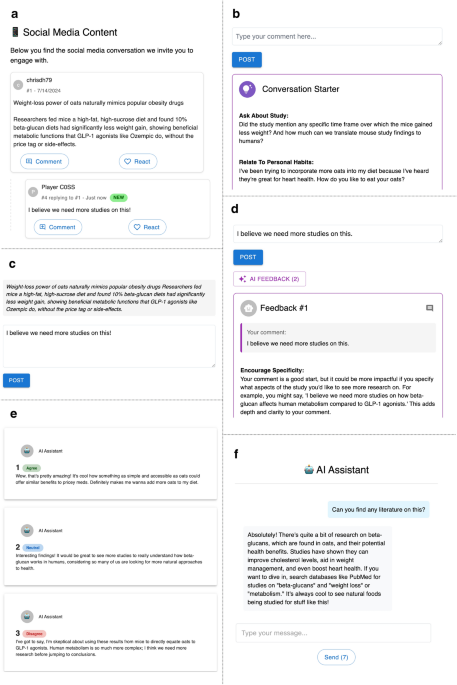
A controlled experiment involving 680 U.S. participants investigates how four distinct generative AI tools—Chat assistance, Conversation Starters, Feedback on drafts, and reply Suggestions—affect both content producers and consumers in a realistic social media environment. Participants were organized into groups of five and discussed three topics (dogs vs. cats, health benefits of oats, and universal basic income) across different experimental conditions. The study reveals a critical duality: while AI tools increase user engagement, content volume, and participation equality, they simultaneously decrease perceived quality and authenticity of discussions. Consumers rated AI-assisted content as more "robotic" and "generic," and all AI treatments significantly increased dislike reactions compared to the control group.
The research uncovers nuanced usage patterns across tools and topics. Chat was widely adopted (94.4%) with users adapting their prompts to context—casual queries for lighter topics, fact-checking for scientific discussions, and political engagement for divisive subjects. Conversation Starters improved participation equality but were often misaligned with user intent, with 27.5% of users diverging entirely from AI suggestions. Feedback was most valued in high-stakes discussions requiring argumentation and credibility, while Suggestions showed a notable bias toward agreeing stances in controversial topics. Critically, no single AI tool improved both producer and consumer experiences simultaneously.
Based on these findings, the authors propose four design principles for integrating AI into social media: transparent disclosure of AI-generated content, user-focused personalization, context-sensitivity accounting for topic and intent, and intuitive user interfaces. The study represents one of the first direct experimental tests of whether generative AI can genuinely elevate online discussions, with evidence suggesting it more likely amplifies low-quality interaction and creates negative spillover effects on conversations—even affecting users who don't use the AI tools themselves.
This paper presents a large-scale dynamic experiment with over 800 participants across 40+ countries investigating how exposure to AI-generated ideas from ChatGPT affects human creativity, idea diversity, and the evolution of collective thought. Using a variant of the Alternate Uses Task (AUT), a standard divergent thinking measure, participants brainstormed creative uses for everyday objects after viewing example ideas that were either human-generated (from prior participants) or AI-generated. The researchers manipulated two key factors: AI exposure level (none, low, or high) and AI disclosure (whether AI-generated ideas were labeled as such). The experiment's dynamic design, inspired by the "multiple-worlds" paradigm, allowed ideas from earlier participants to feed forward as stimuli for later ones, simulating how AI content compounds through a cultural feedback loop.
The key finding is that high AI exposure increased collective idea diversity but did not improve individual creativity — in short, AI made ideas different, not better. High AI exposure also accelerated the rate of change in idea diversity over time, a compounding effect with potentially significant long-term implications. There were no main effects of disclosure (labeling ideas as AI-generated), though interesting moderating effects emerged: self-identified creative individuals were less influenced by AI disclosure, while participants appeared more likely to knowingly adopt AI ideas when the task was difficult. The study contributes a novel experimental framework for studying passive AI exposure — the increasingly common scenario where people encounter AI-generated content without actively soliciting it — and suggests that while AI integration may enrich the diversity of a collective idea pool, it does not necessarily elevate the quality of individual contributions.
Jason Wei addresses the common question of whether prompt engineering will become obsolete over time. His short answer is a definitive "no," but he offers a more nuanced perspective: the goal of prompt engineering has evolved significantly. In the early days (2020/2021), it was primarily about coaxing a finnicky language model into performing relatively simple tasks. Over time, the focus has shifted toward figuring out how to unlock more complex capabilities from increasingly powerful models.
The post, though truncated, highlights an important insight about the maturing role of prompt engineering in AI development — it's not disappearing but rather transforming in scope and ambition as language models improve.
MIT Sloan School of Management shares a concise three-step framework for identifying practical use cases for large language models (LLMs) in organizations. The recommended approach involves breaking down existing workflows into discrete tasks, carefully evaluating all costs associated with automation (not just implementation but ongoing expenses), and launching pilot programs to test and validate before scaling.
This guidance reflects a growing emphasis on structured, cost-conscious adoption of AI rather than rushing to deploy LLMs broadly. By focusing on task-level analysis and pilots, organizations can better match LLM capabilities to genuine business needs and avoid costly missteps.
Ethan Mollick highlights an ongoing academic debate about AI-assisted idea generation. The discussion centers on three interconnected papers: first, an experimental study showing that even the older GPT-3.5 model helped people generate higher-quality ideas; second, a response paper arguing that the AI-generated ideas tend to be highly similar to one another, raising concerns about diversity of thought; and third, a counter-response suggesting that this lack of variety may not matter since the outcomes are still demonstrably good.
The thread captures a nuanced tension in AI research — whether the quality of individual outputs outweighs concerns about homogeneity and originality. This is a key question for anyone using large language models as brainstorming tools, as it speaks to the tradeoff between reliably strong results and the risk of converging on a narrow set of ideas.
AI-enabled scientific discovery is rapidly evolving from hype to reality, though significant limitations remain. The article traces the journey from Adam, a robot that made the first fully automated scientific discoveries in the 2000s, to today's powerful AI agents like ChatGPT running on GPT-5 pro, which helped physicist Alex Lupsasca independently rediscover black hole symmetries and mathematician Ernest Ryu prove a new optimization theorem. Both researchers have since joined OpenAI's new Science team. Meanwhile, specialized tools like AlphaFold (which earned a 2024 Nobel Prize) are enabling drug discovery breakthroughs, and companies like Insilico Medicine have used AI to identify both a disease-causing protein and a blocking drug for idiopathic pulmonary fibrosis, now in clinical trials.
Skeptics like NYU cognitive scientist Gary Marcus warn that large language models are fundamentally limited — they excel at searching within defined boundaries but lack the causal understanding and creativity needed for paradigm-shifting discoveries like relativity or continental drift. LLMs have also fueled a rise in junk science and paper mills. The most promising approaches appear to combine general-purpose AI agents with specialized, verifiable tools like knowledge graphs and domain-specific models, rather than relying on any single system.
Looking ahead, researchers are building systems that can construct their own experimental frameworks — like AutoRA for social science and Code Scientist for computer science — though these still lack true creativity and sometimes fabricate results. Google DeepMind's Demis Hassabis estimates genuine AI creativity is five to ten years away. A key bottleneck remains the physical world: AI-generated hypotheses must still be validated in real laboratories, and bridging that gap with robotic labs and tools like XR glasses for human-AI collaboration represents the next frontier.

Machine Learning Street Talk (MLST) identifies three key weaknesses of leading AI models: long-term planning, idea generation, and taste. The post appears to reference Marc Andreessen (or another prominent "Marc" figure), arguing that his proficiency in these three areas explains why AI tools seem impressive to him — essentially reflecting his own capabilities back at him in a phenomenon described as "Marc in, Marc out!"
The post suggests that the quality of AI output is heavily shaped by the quality of input and direction provided by the user. MLST implies that those who excel at planning, ideation, and taste will naturally get better results from AI, while the models themselves still fundamentally lack these higher-order cognitive abilities. The truncated message hints at a recommendation for the referenced individual to observe how others with less aptitude in these areas fare with the same tools.
OpenAI has released a first-of-its-kind research paper through the National Bureau of Economic Research, offering an unprecedented look at how people actually use ChatGPT, based on internal user data rather than self-reported surveys. The numbers are striking: ChatGPT now has over 700 million weekly active users (nearly 10% of the world's adult population), processing over 2.6 billion messages daily as of June 2025. However, usage growth among long-term users has plateaued, with recent gains driven almost entirely by new user acquisition. The user base skews heavily young, with 46% between ages 18–25, and has shifted from 80% male at launch to a slight female majority today.
The most surprising finding may be that 72% of ChatGPT usage is non-work related, a figure that has grown significantly over the past year. Among all conversations sampled, writing assistance dominates at 28%, rising to 42% for work-related tasks — though much of this involves editing and critiquing rather than generating text from scratch. Information seeking has surged to 24.4% of conversations, positioning ChatGPT increasingly as a search engine alternative despite ongoing confabulation concerns. Meanwhile, 14.9% of work-related conversations involve making decisions and solving problems, suggesting people are treating ChatGPT as an advisor rather than just a task executor. Notably, some hyped use cases remain relatively niche: computer programming accounts for just 4.2% of conversations, creative ideation 3.9%, and game/roleplay a mere 0.4%.