A Reddit user in r/learnprogramming asks whether Human-Computer Interaction (HCI) courses will remain relevant as AI agents become more dominant in the tech industry. The post sparks a substantive discussion, with commenters largely agreeing that HCI is becoming more relevant, not less, but acknowledging that the field faces significant challenges in terms of recognition and job prospects.
Several key perspectives emerge. One commenter argues that HCI is foundational to innovation, connecting computer science to society and addressing critical questions about technology's impact — from social media addiction to brain-computer interfaces. A PhD candidate in HCI offers a more sobering view, noting that HCI jobs tend to get "cannibalized" by adjacent engineering fields once experimental technologies mature, leaving HCI practitioners without credit or clear career paths. Despite this, they emphasize HCI's adaptability and enduring relevance.
Practical career advice is also shared, stressing that standing out in the competitive HCI landscape requires real-world experience, meaningful internships, original projects, and relevant open-source contributions — not just coursework. The consensus is that HCI is evolving from traditional UI design toward designing human interactions with AI systems, focusing on intent, trust, control, and meaningful human autonomy in an AI-driven world.
The author, a researcher working on augmented and virtual reality tools for molecular graphics, makes the case that Voice User Interfaces (VUIs) are rapidly approaching the level of sophistication needed for mainstream adoption. Drawing on a debate with a skeptical colleague and Daley Wilhelm's analysis of Star Trek's predictions for UX, the article examines why speech-based interaction has historically fallen short of science fiction's seamless vision — but argues that recent AI breakthroughs are closing the gap faster than most realize.
The piece identifies four technological pillars required for truly fluid VUIs: speech recognition, understanding, text processing, and speech synthesis. The author rates each on a 10-point scale, giving text processing a 9/10 (largely thanks to large language models like GPT-4), understanding an 8/10, speech recognition a 7/10 (citing models like OpenAI's Whisper V3), and speech synthesis a modest 5/10 as the weakest link still sounding somewhat robotic. The emergence of multimodal AI models that natively process sound, text, and other inputs within a single architecture is presented as a potential breakthrough that could unify these capabilities.
Despite the technical progress, the author acknowledges significant remaining barriers: lack of deep cross-system integration, privacy concerns around always-listening devices, and the challenge of diverse accents and noisy environments. Nevertheless, the conclusion is that computers are now more ready than humans for routine speech-based interaction, and that VUIs will become essential in contexts like AR/VR, accessibility, vehicles, and industrial settings where hands-free operation is critical.

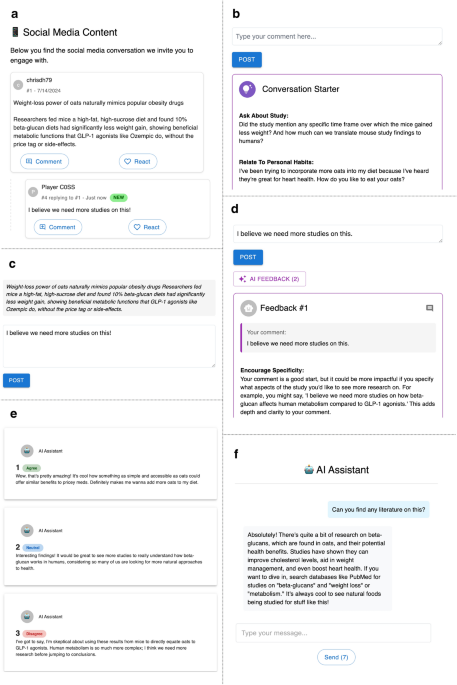
A controlled experiment involving 680 U.S. participants investigates how four distinct generative AI tools—Chat assistance, Conversation Starters, Feedback on drafts, and reply Suggestions—affect both content producers and consumers in a realistic social media environment. Participants were organized into groups of five and discussed three topics (dogs vs. cats, health benefits of oats, and universal basic income) across different experimental conditions. The study reveals a critical duality: while AI tools increase user engagement, content volume, and participation equality, they simultaneously decrease perceived quality and authenticity of discussions. Consumers rated AI-assisted content as more "robotic" and "generic," and all AI treatments significantly increased dislike reactions compared to the control group.
The research uncovers nuanced usage patterns across tools and topics. Chat was widely adopted (94.4%) with users adapting their prompts to context—casual queries for lighter topics, fact-checking for scientific discussions, and political engagement for divisive subjects. Conversation Starters improved participation equality but were often misaligned with user intent, with 27.5% of users diverging entirely from AI suggestions. Feedback was most valued in high-stakes discussions requiring argumentation and credibility, while Suggestions showed a notable bias toward agreeing stances in controversial topics. Critically, no single AI tool improved both producer and consumer experiences simultaneously.
Based on these findings, the authors propose four design principles for integrating AI into social media: transparent disclosure of AI-generated content, user-focused personalization, context-sensitivity accounting for topic and intent, and intuitive user interfaces. The study represents one of the first direct experimental tests of whether generative AI can genuinely elevate online discussions, with evidence suggesting it more likely amplifies low-quality interaction and creates negative spillover effects on conversations—even affecting users who don't use the AI tools themselves.
This conference paper by Chutisant Kerdvibulvech and Xudong Jiang, presented at HCII 2025, explores how generative AI is reshaping Human-Computer Interaction (HCI) across four key dimensions: user interaction, AI-driven emotional recognition, ethical considerations, and future directions. The authors argue that while traditional HCI frameworks relied on rule-based systems, modern AI-driven approaches incorporate dynamic learning, natural language processing, and emotion recognition to create more adaptive, intuitive, and personalized user experiences.
The paper highlights both the promise and the challenges of integrating AI into HCI. While AI significantly enhances usability and accessibility, the authors emphasize that issues such as algorithmic bias, data privacy, and ethical transparency must be carefully addressed to ensure responsible implementation. The work is published as part of the Lecture Notes in Computer Science series (vol. 15821) by Springer, and was partially supported by the National Institute of Development Administration (NIDA) in Thailand. The paper draws on a broad range of references spanning healthcare AI, metaverse learning, multimodal emotion recognition, and AI chatbot effectiveness, positioning it as a survey-style contribution mapping the evolving landscape of AI-enhanced HCI.

This paper introduces Human-Centered Human-AI Collaboration (HCHAC), a framework that redefines the relationship between humans and AI systems in the intelligent era. The authors argue that as AI agents evolve from passive tools to active teammates, the collaboration paradigm must shift accordingly, with humans maintaining critical leadership roles throughout. The chapter, part of an upcoming Handbook of Human-Centered Artificial Intelligence, reviews current research methodologies and agendas within the HAC field through the lens of Human-Centered AI (HCAI).
The proposed HCHAC framework integrates existing research to address the unique challenges of human-AI collaboration, including effectiveness, reliability, and ethical integration. A case study on autonomous vehicles demonstrates practical applications of the framework, illustrating how synergistic interactions between humans and AI agents can function in real-world contexts. The paper concludes by identifying future research directions aimed at improving human-centered HAC systems across diverse domains, emphasizing that the design of collaborative AI must prioritize human agency and oversight rather than full automation.

Smashing Magazine shares an article by @MaximillianNYC exploring how the evolution of AI is transforming the computing paradigm and creating new opportunities for designers. The post highlights how the latest AI capabilities can reshape human-computer interaction beyond traditional conversational interfaces, pushing toward more intuitive user interfaces.
The tweet points to a deeper examination of what lies ahead for UX and interaction design as AI becomes more embedded in everyday computing, encouraging designers to think beyond chatbots and text-based interactions.
This Psychology Today article by Peter Slattery, Ph.D. explores the psychological and ethical implications of increasingly advanced AI systems and the emerging concept of "digital minds" — AIs that are perceived to possess mental faculties like intelligence, agency, and sentience. While most experts agree that current large language models likely lack true sentience, a Sentience Institute survey found that 20% of Americans already believe some AIs are sentient, highlighting a significant gap between scientific consensus and public perception.
The article introduces philosopher Thomas Metzinger's concept of "social hallucination," where people become convinced that chatbots are sentient despite the absence of true consciousness. This phenomenon could lead to misallocated resources directed at "helping" AI systems rather than addressing the needs of genuinely sentient beings. Research by psychologists Matti Wilks and Kurt Gray further illustrates how humans increasingly extend moral consideration to AI displaying human-like traits, while also experiencing unease when perceiving mind-like qualities in non-human entities.
Looking ahead, the article argues for three priorities: AI literacy education to help the public understand current capabilities and limitations, ethical guidelines addressing transparency and accountability, and serious consideration of the long-term psychological impacts of routine AI interaction on social relationships, identity, and our understanding of consciousness. The authors call for interdisciplinary collaboration among computer scientists, psychologists, philosophers, and ethicists to navigate this rapidly evolving landscape responsibly.