This article argues that AI agents for entrepreneurs deliver real value only when they automate specific, recurring workflow bottlenecks — not when they're used as glorified chatbots for one-off tasks. The author warns against what he calls "cruel optimism": the belief that adopting the next shiny tool will fix a broken business system. Instead, he proposes a practical scorecard: automate workflows that repeat weekly, create costly delays when ignored, and improve revenue or decision quality when handled faster.
The piece outlines five workflows to automate first: lead triage, follow-up, research, reporting, and decision preparation. Each is chosen because it directly impacts revenue or execution speed in a one-person business. Notably, the author emphasizes that agents should prepare work rather than make decisions — monitoring triggers, summarizing data, drafting options, and surfacing risks while keeping human judgment at the center. He also highlights a growing gap: U.S. Census data shows firms with 20+ employees are integrating AI into operations while smaller businesses remain stuck experimenting with isolated tools.
The article introduces an "AI Delegation Contract" framework for keeping agents safe — specifying narrow scope, limited tool access, approval gates, and clear reporting loops. The core message is that solopreneurs have a structural advantage in adopting AI workflows quickly, but only if they resist the urge to collect agents and instead build disciplined, sequential automation that frees their attention for strategic decisions.

This article by Erwin Lima explores a subtle but significant shift in how people use AI: the gradual, often unconscious transition from using it as a thinking partner (a "mirror") to treating it as a silent authority (an "oracle"). The author argues that the real risk of AI isn't misinformation or job displacement, but what he calls "authority drift" — the slow delegation of inner decision-making to AI systems. He illustrates this with two examples: an extreme case where someone stops consulting friends and mentors entirely, relying on AI for major life decisions, and a mundane case where AI progressively rewrites a person's professional identity until they can no longer distinguish their own voice from the optimized version.
The piece introduces a practical framework distinguishing Mirror Mode (using AI to surface patterns, contradictions, and blind spots while retaining decision authority) from Oracle Mode (effectively asking AI what to do, what to believe, or who to become). Lima emphasizes that the danger isn't in Oracle Mode existing, but in slipping into it unconsciously. The erosion manifests as less internal debate, faster but shallower decisions, and a gradual loss of authentic voice. His core message isn't anti-AI — it's a call for more conscious engagement, urging readers to use AI to sharpen their thinking while remembering that authorship over one's identity, narrative, and life direction must remain fundamentally human.
Rawad Baroud, CEO of ZeroGPT, argues that AI's greatest value for leaders isn't speed or output — it's serving as a thinking partner that helps reduce mental friction. He observes that leadership often feels overwhelming not because tasks are impossible, but because too many unstructured thoughts compete for attention. Rather than treating AI as a "second brain" that thinks for you, Baroud suggests using it to clarify messy thinking — translating vague concerns into decision memos, mapping stakeholder perspectives before difficult conversations, running project premortems, and pressure-testing initiatives.
The article cautions against over-reliance, emphasizing that a polished AI response is not necessarily a correct or complete one. Leaders must still bring context, values, experience, and accountability to every decision. Baroud also highlights practical risks: sharing sensitive company information without safeguards, AI reflecting bias, and the tendency to flatten complex human situations into something that sounds logical but lacks empathy. He advocates for clear boundaries — using AI to clarify, question, and structure, but never outsourcing responsibility or human judgment. The core takeaway is that AI, used thoughtfully, can function less like a shortcut and more like a stabilizer for leadership thinking.

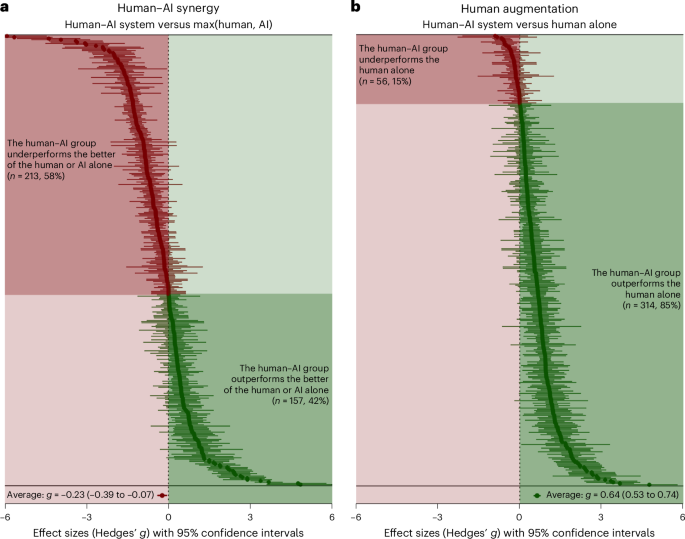
A systematic review and meta-analysis published in Nature Human Behaviour examines whether combining humans and AI yields better performance than either alone. Researchers analyzed 106 experimental studies with 370 effect sizes published between January 2020 and June 2023, finding that on average, human–AI systems performed significantly worse than the best of humans or AI alone (Hedges' g = −0.23). However, these combinations did outperform humans working alone, demonstrating what the authors call human augmentation (g = 0.64). The findings challenge the widespread assumption that pairing humans with AI automatically produces superior results.
The study identifies critical moderating factors. Task type matters significantly: decision tasks (choosing among finite options) showed performance losses, while creation tasks (generating open-response content) showed performance gains from human–AI collaboration. The relative performance gap between human and AI also proved crucial — when humans outperformed AI alone, the combination achieved genuine synergy (g = 0.46), but when AI outperformed humans, the combination suffered losses (g = −0.54). The authors hypothesize that when humans are more skilled at a task, they are also better at judging when to trust their own judgment versus the AI's suggestions.
Notably, factors that have received significant research attention — such as providing AI explanations or confidence scores — did not significantly affect human–AI system performance. The authors suggest researchers should shift focus toward less-studied but more impactful factors like task type, baseline performance differences, and division of labor between humans and AI. They also note that only 3 of 100+ experiments explored predetermined delegation of subtasks to humans and AI, pointing to a largely unexplored but promising design approach for achieving genuine human–AI complementarity.
A study from the MIT Center for Collective Intelligence, published in Nature Human Behaviour, challenges a widely held assumption about AI-human collaboration. After analyzing over 100 studies, researchers found that human-AI combinations on average do not outperform the best human-only or AI-only systems — a finding that surprised even the researchers. The study reveals that combinations work best when each party handles what it does better than the other: humans excel at tasks requiring contextual understanding and emotional intelligence, while AI dominates repetitive, high-volume, or data-driven tasks. Notably, when humans already outperform AI on a given task, adding AI to the mix tends to yield the best collaborative results.
One bright spot for collaboration is generative AI and content creation tasks, where human-AI synergy showed significantly positive effects compared to decision-making tasks. The iterative, interactive nature of generative AI — where humans can draft, edit, and refine outputs in real time — makes it better suited for collaboration than earlier AI systems designed for narrow tasks. Rather than simply dividing subtasks between humans and AI, the researchers recommend redesigning entire workflows and adopting continuous improvement models. MIT Sloan professor Thomas W. Malone emphasized that the findings should not discourage collaboration efforts but instead push organizations toward more sophisticated, evidence-based approaches to deploying human-AI teams.