The Financial Times shares an opinion piece questioning the relevance of consultants in the age of AI. The article appears to explore how artificial intelligence is disrupting the traditional consulting industry, potentially replacing or diminishing the need for human consultants as AI tools become more capable of providing strategic advice, data analysis, and business recommendations that were once the exclusive domain of consulting firms.
A study published by the National Bureau of Economic Research (NBER) surveyed approximately 6,000 CEOs, CFOs, and other executives and found that the vast majority see little impact from AI on their operations. The finding, shared by FORTUNE on X (formerly Twitter) in February 2026, suggests a notable disconnect between the widespread hype surrounding artificial intelligence and the actual perceived effects on day-to-day business operations at the executive level. This raises important questions about the pace of AI adoption and whether the technology is delivering on its promised transformative potential for enterprises.
Daniel Miessler argues that AI will inevitably replace most knowledge work — not because AI is extraordinary, but because the current state of corporate work is deeply dysfunctional. Drawing on 25+ years of consulting across hundreds of Fortune 10,000 companies, he describes a landscape of unclear vision, inconsistent processes, undocumented institutional knowledge, empire-building politics, and blind leadership that can't even see what their organizations are doing. He frames this chaos as what AI is actually competing against, noting that $50+ trillion is spent annually on knowledge workers where only 21% are engaged and the majority are doing the minimum or actively disengaged.
Miessler dismantles the "human reliability myth" by drawing parallels between LLMs and human cognition — arguing that humans don't know where their thoughts come from, can't predict how they'll finish sentences, and have deeply flawed memory systems. He introduces a capability stack (knowledge, understanding, intelligence, creativity) and contends that AI already matches or exceeds humans on the first three layers, which constitute the vast majority of knowledge work. The real gap, he argues, is an "articulation gap" — expertise trapped in human heads that hasn't been documented into AI-executable skills and SOPs. This gap is closing through a one-way "expertise ratchet" where captured knowledge permanently enters the collective AI pool.
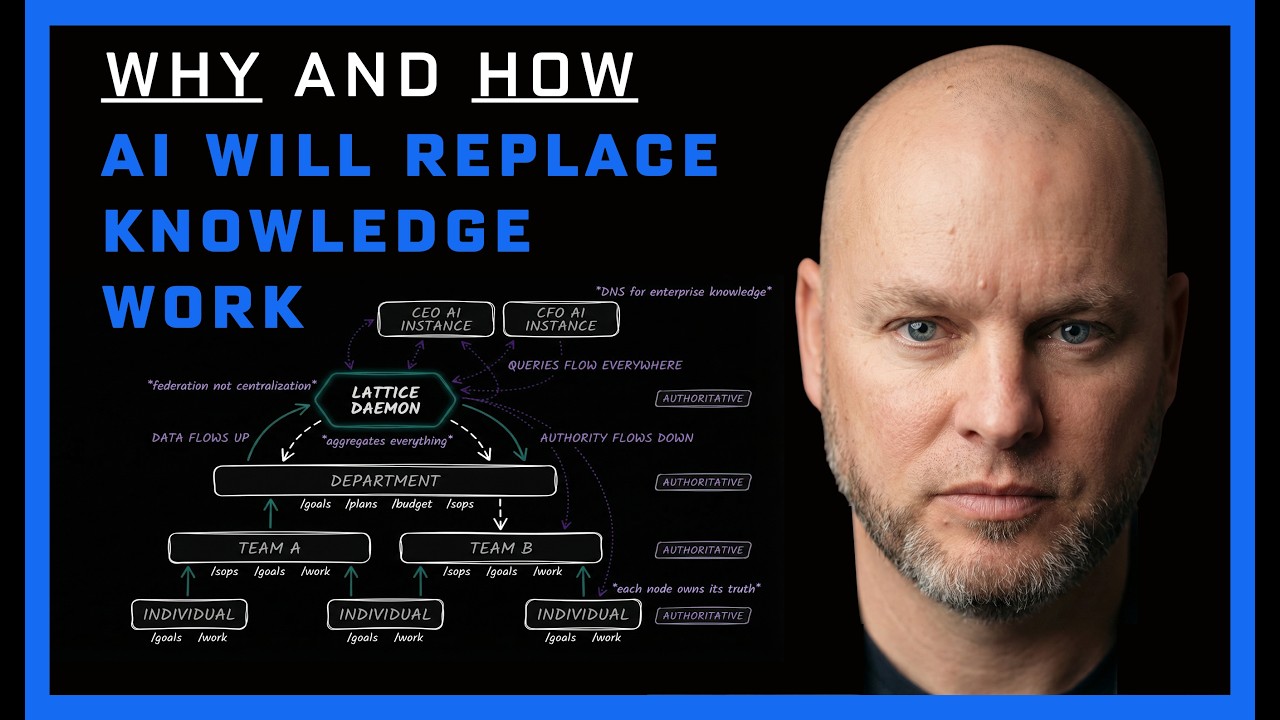
He proposes an architecture called the Lattice — an open-source system where every individual, team, department, and company broadcasts its goals, SOPs, metrics, and work items via APIs, giving leaders real-time visibility into operations. In this model, humans shift from being doers to overseers, leveraging what AI fundamentally lacks: subjective experience and desire. Miessler frames this transition as "Human 3.0" — moving from survival to corporate drudgery to creative self-expression — arguing that the loss of knowledge work jobs is ultimately liberation from a system everyone already knew was broken.