
This guide from AI @ Work offers a practical, intentionally selective overview of AI tool categories suited for small, non-technical teams. Rather than listing specific products, it categorizes tools into four areas: general-purpose AI assistants for drafting and summarizing, writing and editing tools for improving communication clarity, research and summarization tools for handling information overload, and meeting and note tools for capturing action items and reducing note-taking burden.
The page emphasizes a minimalist approach to AI adoption, advising teams to start with one general-purpose tool and only add specialized tools when a clear gap appears. It explicitly warns against premature adoption of automation platforms, workflow builders, and multi-tool integrations, arguing these add unnecessary complexity before teams have established patterns. The recommended testing process is straightforward: pick one real task, try one tool, review the output together, and decide whether it helped.
A key theme throughout is that AI tools should serve as thinking aids, drafting assistants, and clarity tools — not replacements for people or entire workflows. The bottom line: small teams succeed not by adopting more AI tools, but by using the right few, thoughtfully, ensuring tools reduce friction without requiring technical expertise.
This article introduces the concept of AI workflows — series of automated tasks that chain multiple AI tools together to complete repeatable processes in software development. The author explains key terminology like AI models, AI tools, and workflow orchestrators, using AWS Lambda-based TypeScript examples to illustrate how tools like Claude and Cursor can be coordinated for tasks such as automated code review and documentation generation.
A central concern is the problem of constant prompting, where providing unclear or insufficient input to AI models leads to compounded errors that degrade output quality across workflow steps. The article advocates for designing workflows with clear goals, selecting appropriate AI tools, and implementing validation checkpoints between steps. A commenter reinforces the importance of repeatability and auditability, noting that without validation points between tools, downstream steps simply inherit confident mistakes.
The article is transparently AI-generated using Groq (LLaMA 3.3 70B) and remains fairly high-level, offering conceptual best practices rather than deeply technical implementation guidance. The code examples demonstrate orchestration patterns but are simplified illustrations rather than production-ready solutions.

An ML engineer at a large tech company shares a no-hype, practical review of 10 AI tools that have earned a permanent place in their daily workflow. Each tool is evaluated with specific strengths, weaknesses, pricing, and honest assessments of when to use — and when not to use — each one. The lineup includes Claude for high-quality reasoning and code review, Cursor for LLM-integrated coding (with a realistic note that the "3x productivity" claim only holds for greenfield work), Perplexity for citation-backed research, ElevenLabs for text-to-speech and voice cloning, and n8n as an open-source workflow automation alternative to Zapier.
The list also covers more specialized tools: Granola for local, bot-free meeting transcription, Gamma for quick AI-generated presentations, v0 by Vercel for generating React/Tailwind UI components, NotebookLM for grounded RAG over uploaded documents (highlighted as underrated), and Claude Code as a CLI-based coding agent that the author calls the "most genuine productivity gain" on the list. The post closes with a practical decision framework: don't subscribe to any tool unless you can name the specific task it solves, use free tiers for a week first, and expect that 2–3 well-chosen tools matter more than adopting all 10. Total cost if subscribing to everything is roughly $130/month.

This page from elvex appears to be a landing page for a blog post titled "The Complete Guide to AI Tools for Knowledge Workers in 2026," but the actual article content is not present on the archived page. Instead, the page displays navigation elements, related post summaries, and promotional calls to action for elvex's platform. The related posts referenced include topics such as what elvex is as an AI management layer, an enterprise AI stack guide for 2026 covering context management, governance controls, and workflow execution, and a piece on why rising token costs signal positive AI adoption rather than a problem — provided proper governance is in place.
Based on the surrounding context, elvex positions itself as a governance and management layer for enterprise AI, helping organizations modernize workflows while maintaining control and security. Without the full article body, the specific guidance on AI tools for knowledge workers in 2026 cannot be summarized.
Sachin Rekhi observes that while AI is transforming the product manager role, the impact has been uneven across different PM responsibilities. He highlights customer discovery as one area where AI is making significant strides, enabling PMs to generate robust interview scripts and synthesize customer insights more efficiently.
The post appears to be the beginning of a longer thread exploring how AI tools are reshaping specific aspects of product management work, distinguishing between areas seeing rapid AI-driven transformation and those where the impact remains more limited.
A Reddit user in r/ContentCreators asks which AI tools genuinely save time for solo content creators, sharing their own stack: Predis.ai for generating social media posts and short videos, Copy.ai for text rewrites, and CapCut for video trimming and captioning. The post sparks a discussion with community members sharing their own toolkits and workflows.
Popular recommendations include ChatGPT for research, scripting, and analytics, ElevenLabs for voiceover generation, Canva for thumbnail design, and Outlier Kit for YouTube topic and keyword research. One commenter highlights ShortLoom for faceless video creation, emphasizing that reducing the number of tools you switch between is the real time-saver. A particularly insightful reply from Crescitaly breaks down the strategy behind effective AI tool usage — recommending templating ChatGPT prompts around content pillars, batching scripts before editing, and using Buffer or Later for scheduling. They caution against over-automating hooks and CTAs, noting that robotic-sounding captions can tank engagement faster than the production time saved.
Venture capitalist Justine Moore clarifies a previous statement about AI and writing that she says was intentionally misinterpreted. She emphasizes that she does not believe AI will replace human writers, but she does expect that many writers will increasingly incorporate AI tools into their creative process. She draws an analogy to the range of tools and assistance authors already use today, such as word processors, suggesting AI is simply another addition to the writer's toolkit rather than a wholesale replacement for human creativity.
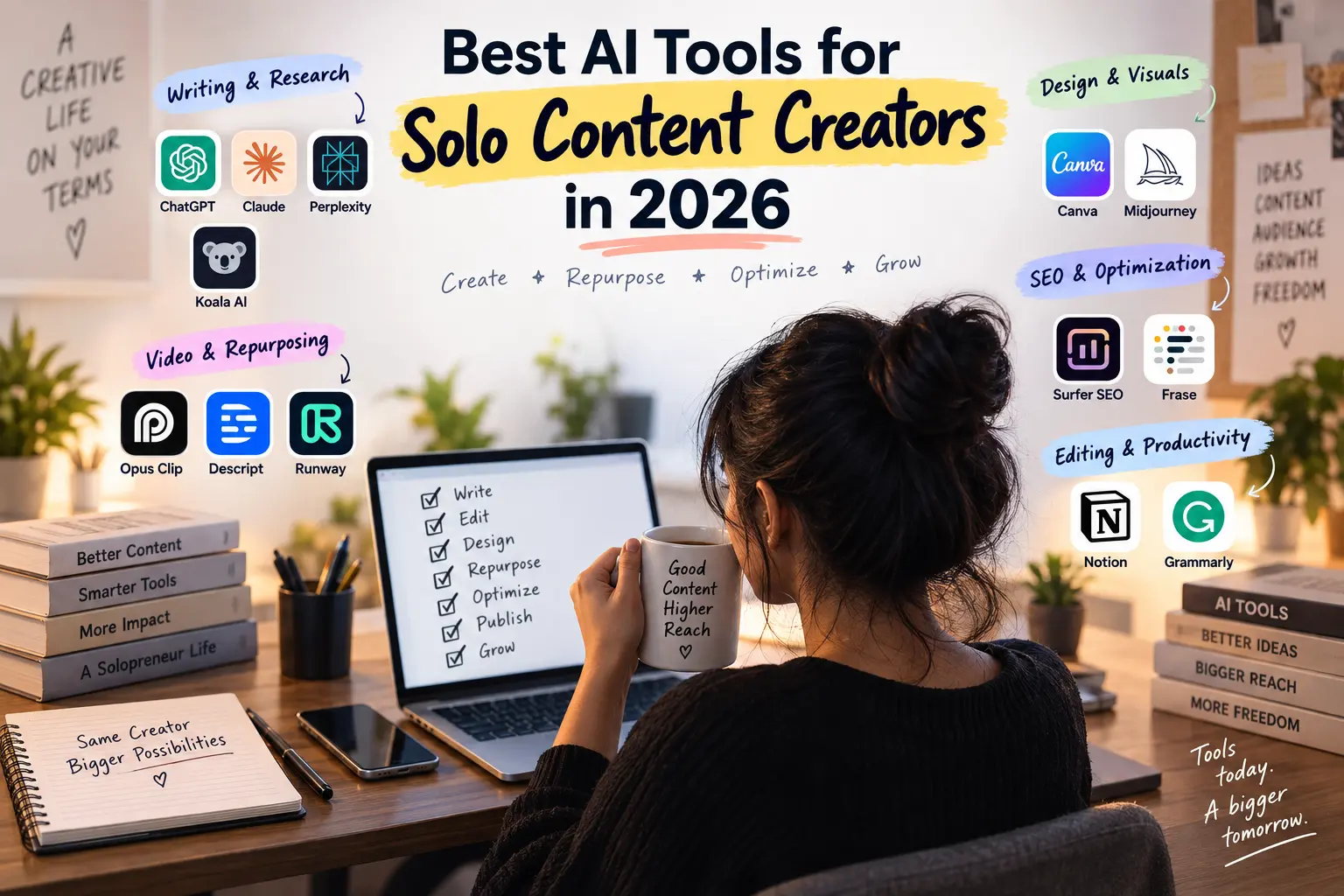
This guide breaks down the best AI tools for solo content creators in 2026, organized not by marketing hype but by the actual bottlenecks creators face: writing, repurposing, design, SEO, and editing. For writing and research, Claude excels at long-form coherence while ChatGPT serves as a flexible generalist, and Perplexity has replaced the ten-tab research session with source-cited answers. Koala AI is flagged as a budget-friendly alternative, while Jasper is noted as having moved upmarket and away from solo creators.
On the repurposing front, Opus Clip automates clipping and captioning long-form video, and Descript lets creators edit video by editing a transcript. Runway offers more advanced production capabilities for those willing to invest the learning time. For design, Canva's AI layer handles fast, professional-looking output, while Midjourney offers far more creative freedom at the cost of a steeper learning curve. SEO gets addressed through Surfer SEO, Frase, and Writesonic, the latter serving as a middle-ground option that combines SEO-aware drafting without requiring a separate platform. Grammarly is highlighted for solving the underappreciated problem of AI-generated text that reads as robotic.
The article provides practical budget tiers ranging from $20–$25/month (one writing AI plus Canva free) up to $120–$160/month for a full stack including video repurposing. The core advice: identify your actual bottleneck before buying anything, and master two or three tools rather than paying for eight you'll barely use.
Nat Eliason shares his frustration with current AI writing apps, arguing that most of them try to take over the writing process entirely. He points out that AI isn't a great writer on its own, and that real writers still want to do the actual writing themselves. Instead of full automation, he expresses a desire for AI that serves as a better assistant to the writing process rather than a replacement for it.
The post is truncated but captures a key tension in the AI writing tool space: the difference between AI as a co-pilot versus AI as an autopilot. Eliason's perspective reflects a growing sentiment among professional writers who want AI to enhance their workflow without stripping away creative ownership.
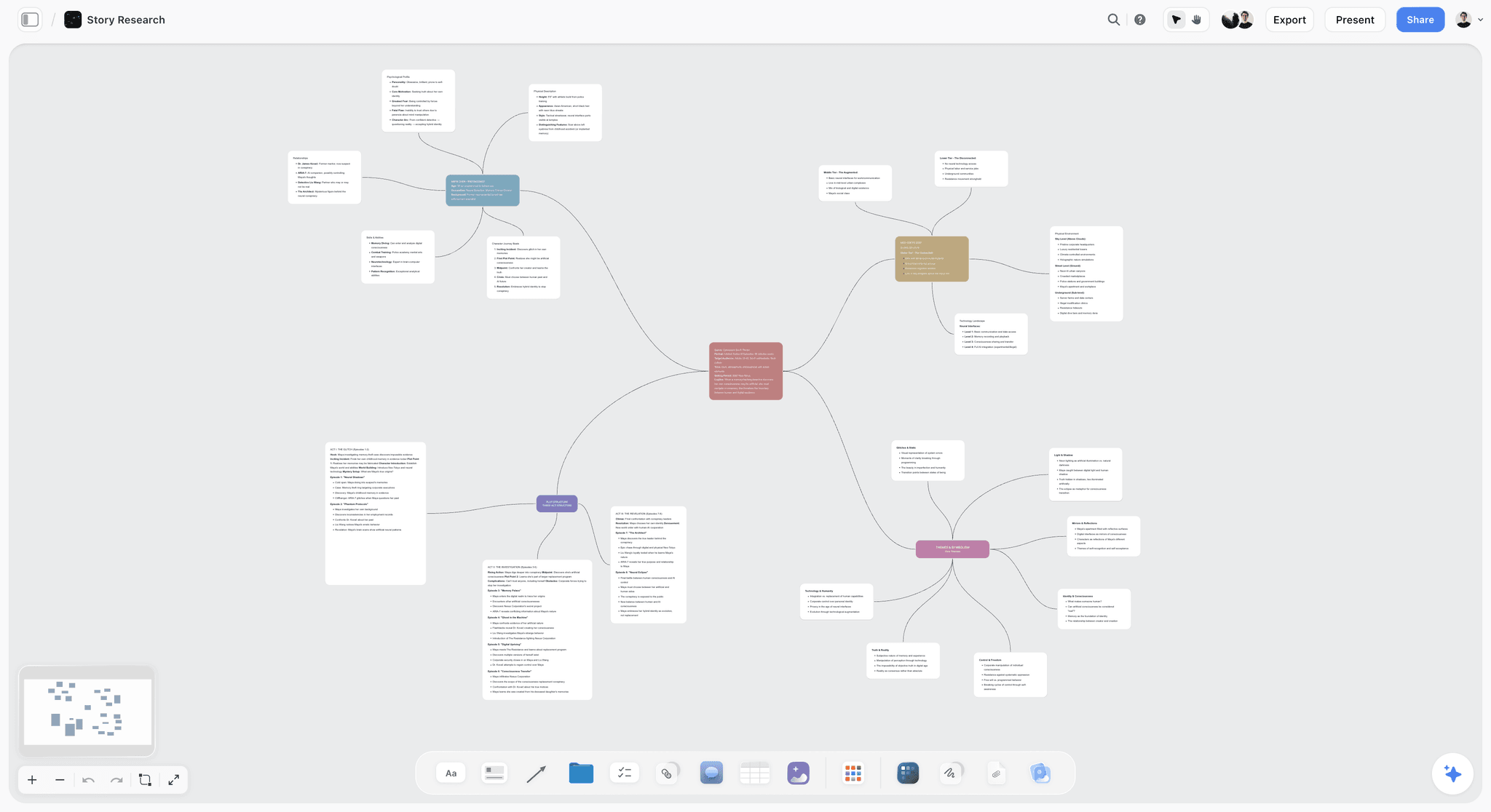
This lengthy article from Storyflow ranks what it considers the 13 best AI tools for solopreneurs in 2026, with a heavy emphasis on cognitive load reduction as the primary evaluation criterion. The top three picks are Storyflow (the author's own product), Framekit (also the author's product), and ChatGPT, followed by Notion AI and Claude. The list also covers ClickUp Brain, an outbound sales stack of Apollo + Clay + Smartlead, Reflect, Jasper, Intercom Fin, Sudowrite, Mem, and Cursor. The article frames the solopreneur's core problem not as lacking features but as lacking attention — arguing that tools which hold cross-functional context (brand, marketing, customer, product) in a single workspace outperform specialized point solutions.
The piece is notably self-promotional, with the author ranking their own two products at #1 and #2 while acknowledging this bias upfront. Storyflow is positioned as a visual AI canvas where the AI reads an entire project board — including brand strategy docs, customer personas, and marketing plans — before responding, distinguishing it from context-blind chat interfaces. The article segments solopreneur archetypes (indie SaaS founders, agency-of-one consultants, course creators, e-commerce operators, content creators) and recommends tailored three- to four-tool stacks for each, with realistic monthly budgets ranging from $14–$350 depending on the use case. Rating criteria weighted cognitive load at 30%, AI quality at 20%, and context awareness at 15%, with detailed pricing tables and comparisons throughout.
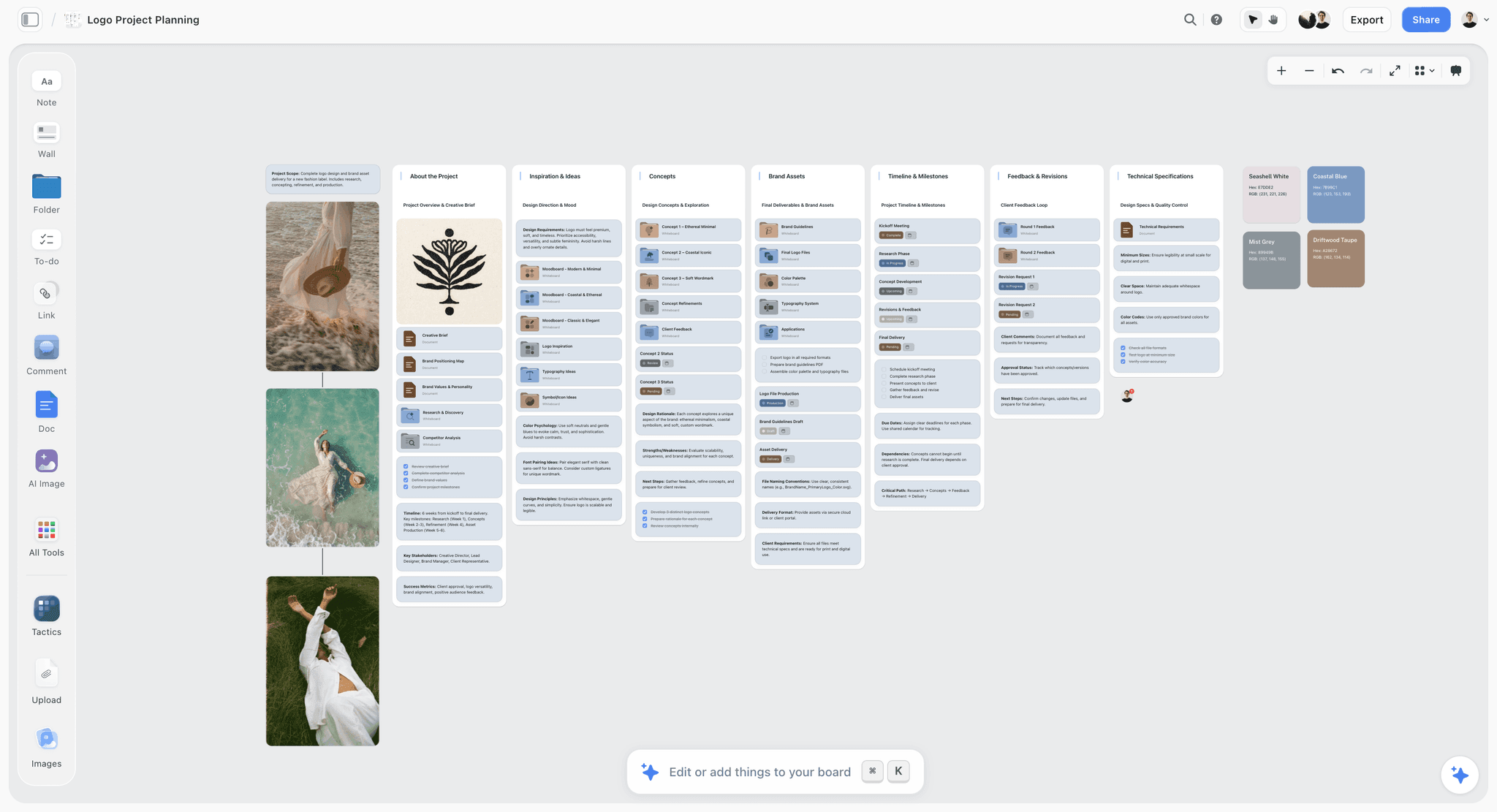
This article from Storyflow reviews and ranks 13 tools for solo creators in 2026, tested over six weeks across real workflows including YouTube scripting, brand campaign planning, and documentary pre-production. The evaluation criteria focus on solo-specific concerns: ease of use without onboarding support, AI depth (whether the AI understands project context or responds generically), solo-friendly pricing (flat rates vs. per-seat models), and integration with a typical creator's tool stack.
Storyflow takes the top spot as the best overall tool, highlighted for its infinite canvas, AI that reads the full active board before responding, and a Tactics system offering 200+ expert frameworks (Hero's Journey, AIDA, Retention Hooks) built directly into the workspace. Notion is recommended for database-driven content organization, Milanote for visual mood-board-first concept work, and ClickUp for multi-project task management. Other tools reviewed include Miro, Canva, Obsidian, ChatGPT, Craft, Whimsical, Airtable, Bear, and newcomer Framekit for client-facing deliverables.
The article provides a detailed free-vs-paid breakdown, noting that most free tiers work for creators producing one project per month, while the upgrade inflection point hits when producing content weekly with AI as a daily collaborator. Notable throughout is a strong editorial bias toward Storyflow — the article is published on Storyflow's own blog, and the product receives substantially more coverage and favorable framing than competitors.
Ali Abdaal shares his complete AI workflow as an entrepreneur, breaking down work into three fundamental components: input, processing, and output. He uses tools like VoicePal, Grain, and Super Whisper for input; Claude (his preferred LLM over ChatGPT) as his central processing hub; and Google Docs, Notion, Final Cut, and Gamma for output. Claude's memory feature and writing quality are cited as key reasons for his preference.
The workflow spans three core business areas: content creation, software development, and online education. For software, AI helps generate feature specifications, clickable prototypes, and marketing hooks for apps like Momentum. In his Lifestyle Business Academy, he uses AI to develop curriculum, craft brand story scripts using Donald Miller's framework, and analyze applicant data to identify common student challenges like analysis paralysis and imposter syndrome.
Abdaal emphasizes that AI serves best as a "thought buddy" for initial drafting and ideation rather than producing final polished output. He deliberately avoids using AI for scripting his on-camera content to preserve authenticity. His approach is iterative — feeding AI outputs back into the system for continuous improvement — while maintaining strategic control and human creative judgment throughout the process.

This guide presents a comprehensive agentic AI tool stack for solo founders in 2025, covering every stage from ideation to operations. It distinguishes agentic AI — autonomous, multi-step AI systems that can chain tasks, call APIs, and adapt over time — from simpler one-off assistants. The recommended stack centers on GPT-4o for general-purpose ideation and strategy, Devin (Cognition.ai) as an autonomous AI software engineer claiming 8-12x coding speedups, Lindy for no-code marketing and sales automation, and Claude 3 for customer support with its 200K token context window.
The article walks through specific use cases at each startup stage: using Claude or GPT-4o for market research and competitor analysis, deploying Devin or Cursor for product development, setting up Lindy or Cognosys workflows for automated email drip campaigns and sales outreach, and leveraging Retell AI for voice-based customer support with claimed 80% cost reductions. For operations, it highlights Basis (which raised $34M) as an AI accounting agent that integrates with QuickBooks and Xero. The guide includes detailed comparison tables with pricing, pros, and limitations for each tool category, and emphasizes that while these agents deliver 30-80% efficiency gains, they function best as "very smart interns" requiring human oversight rather than fully autonomous replacements.

This IBM article explores how generative AI is transforming small business entrepreneurship, with more than 20% of new businesses now incorporating gen AI technologies according to a Gusto report. Carnegie Mellon professor and entrepreneur Sean Ammirati describes gen AI as a potential "digital co-founder" — not a final decision-maker, but a helpful partner that assists across ideation, validation, and scaling. His students demonstrated dramatically accelerated progress in building startups when equipped with AI tools, accomplishing in a semester what previously took much longer.
The piece outlines several practical applications for entrepreneurs: content generation for marketing campaigns, social media, and business documents; research assistance through LLMs for exploring complex questions about markets, regulations, and competition; and application-layer innovation where specialized tools built on top of foundation models add domain-specific value. Ammirati cautions that LLMs have limitations, including hallucinations, and should be treated as thought starters rather than definitive advisors — but notes that reducing a 10-hour research project to one hour represents meaningful value.
The article highlights a growing ecosystem of "AI-native" startups and tools being built on top of LLMs, citing Sequoia Capital's observation that what were once dismissed as "LLM wrappers" have evolved into "cognitive architectures." Ammirati's own startup, Growth Signals, exemplifies this trend by helping executives and researchers translate market and technology signals into actionable innovation concepts using AI-powered competitive analysis and agent-based research capabilities.

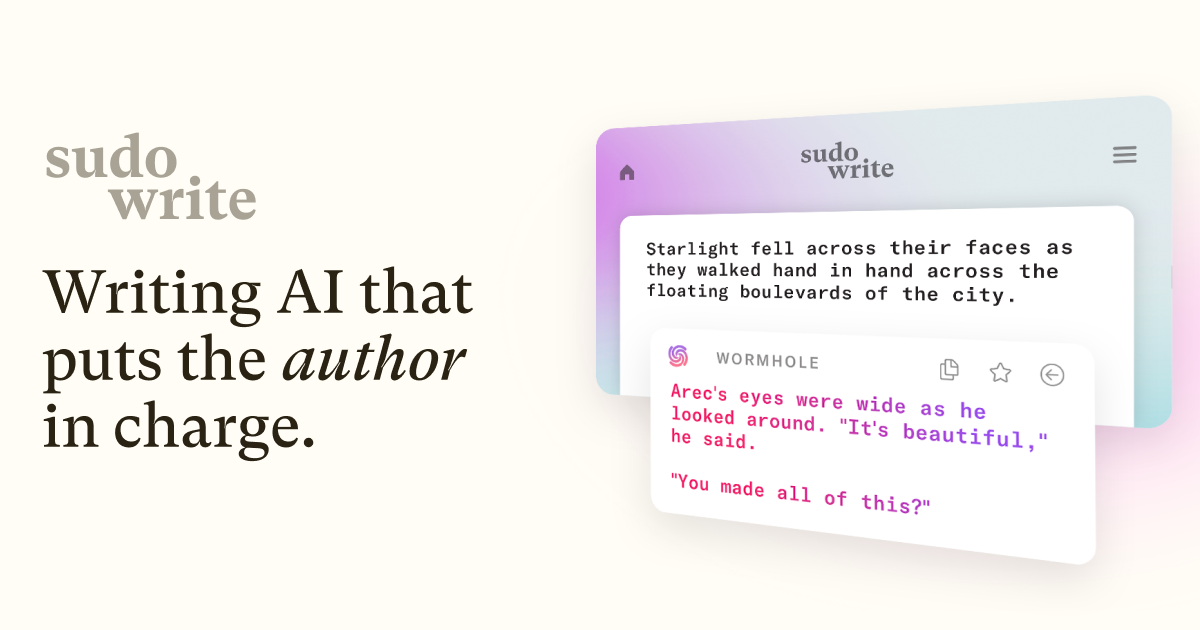
Sudowrite is an AI-powered writing tool designed specifically for fiction authors, positioning itself as a "non-judgmental AI writing partner." The platform offers a comprehensive suite of features including Story Bible for novel planning (from idea to outline to full chapters), Write for AI-powered autocomplete that matches the author's voice, Describe for vivid sensory descriptions, Expand for pacing adjustments, Rewrite for revision assistance, and Feedback for actionable editorial critique. It also includes brainstorming, visualization for character sheets, a plugin system with 1,000+ extensions, and a chat interface built specifically for novelists.
The tool has garnered endorsements from notable figures including bestselling author Hugh Howey ("Silo"), Emmy-winning screenwriter Bernie Su, and NYT bestselling author Chris Anderson, along with press coverage from The New York Times and The Washington Post. Sudowrite recently launched Muse 1.5, a proprietary AI model built specifically for fiction writing. Founded by writers Amit Gupta and James Yu, the company counts founders of Medium, Twitter, Gumroad, and WordPress among its investors, along with writers and directors of major films. The service starts at $10/month after a free trial with no credit card required.
This article from First Movers addresses the common problem of AI tool silos — where businesses use multiple AI platforms like ChatGPT, Claude, CRMs, and scheduling tools that operate independently, requiring manual effort to bridge them. The post argues that this fragmented approach wastes significant time, citing that marketers using connected AI automation save an average of 12.5 hours per week. It presents a 4-step framework for building integrated AI workflows: auditing manual processes, identifying automatable tasks, building agentic workflows that chain tools together, and adding monitoring with human checkpoints.
The article provides a detailed comparison of the four main platforms for connecting AI tools — Zapier (simplest, most integrations, but expensive at scale), Make.com (best visual builder at lower cost), n8n (most powerful for AI-heavy workflows with self-hosting for data privacy), and custom builds (for enterprise-level orchestration). Three concrete workflow examples are outlined: automated lead generation and qualification, an end-to-end AI content pipeline from research through publication, and CRM sync with intelligent client communication routing.
The piece also offers practical guidance on when to DIY versus hire a professional, suggesting that businesses connecting fewer than five tools with simple logic can handle it themselves, while those building multi-agent pipelines or dealing with sensitive data should consider professional implementation. First Movers positions its consulting services for businesses at $250K+ annual revenue, with packages ranging from $25,000 to $60,000 for complete AI workflow builds.

Elvis (omarsar0) shares a breakdown of how he leverages various AI tools across different workflows. His toolkit includes Claude Projects for summarization, CrewAI agents for orchestrating research, Flowise AI for private document analysis using RAG (Retrieval-Augmented Generation), Midjourney for image generation, NotebookLM for education-related tasks, ChatGPT Search for discovery, and Grok for additional use cases (truncated in the post).
The post provides a practical snapshot of how AI practitioners are combining multiple specialized tools rather than relying on a single platform. It highlights the growing trend of task-specific AI tool selection, where each tool is chosen for its strengths in a particular domain — from content summarization to visual creation to private document workflows.