
Greg Isenberg argues that marketing engineers — hybrid marketers who can also build and wire AI agents — are the most valuable new role in business. He traces the evolution from Mad Men-era gut-feel campaigns through digital marketing, growth hacking, and AI-assisted copywriting to this new paradigm where one person can run dozens of experiments per day by connecting AI agents to real customer data. The core thesis: the cost of marketing experiments has collapsed, and whoever runs the most good experiments learns fastest and wins.
The article provides a detailed eight-step playbook for building a marketing engineer's system. It starts with setting up an agent workspace (Claude Code, Cursor, Codex) and writing a "brain" — a structured folder of context files covering customer profiles, brand voice, founder opinions, and past failures. From there, it walks through connecting data sources (CRM, support tickets, call recordings), building a customer language agent that extracts exact phrases from sales calls, and then layering on five more agents: buying trigger detection, search/content, creative ad generation, closed-lost deal recovery, and performance analysis.
Isenberg emphasizes that creative is the new targeting on platforms like Meta, where the Andromeda algorithm reads ad content to determine audience matching, making diverse creative concepts more important than interest targeting. He advocates using AI-generated UGC actors to test scripts cheaply, then paying real creators for winners. The piece also covers organic social as a free testing lab, building decision tools (calculators, migration checkers) as marketing assets, and running a weekly review loop where the marketer's job shifts from production to editing and judgment. The recommended stack spans tools like Clay, HubSpot, Nano Banana, Veo, Arcads, and PostHog, with the prediction that by 2028, one or two marketing engineers with dozens of agents will outship departments ten times their size.

AgentMail is an email inbox API designed specifically for AI agents, functioning as a programmatic equivalent of Gmail but built for non-human users. The platform allows developers to provision dedicated, persistent email inboxes for AI agents with a single API call, enabling two-way email conversations with threading, attachments, real-time webhooks, and semantic search. The company recently raised $6M in seed funding backed by Y Combinator and positions itself distinctly from transactional email services like SendGrid or Mailgun by treating the inbox — not just sending — as its core primitive.
Key use cases include enabling browser automation agents to extract 2FA verification codes, building executive assistant agents that manage calendars and scheduling via email, parsing document attachments like invoices, and routing customer service emails to appropriate AI handlers. The platform supports multi-tenancy at scale, with one customer (CarEdge) running over 25,000 inboxes handling millions of messages. AgentMail also offers a companion product called AgentID, described as a "sign-in button for AI agents."
The service provides SDKs for Python, TypeScript, and CLI access, along with MCP integration and compatibility with popular AI agent tools including Claude Code, Cursor, Codex, and Grok. A free tier offers 3 inboxes and 3,000 emails per month. The company emphasizes that giving agents their own email identity creates a stable, verifiable address for signing up for services, receiving verifications, and maintaining audit trails separate from human accounts.

A Reddit user in r/AI_Agents asks the community for real-world examples of AI agents in use, noting that most content online consists of tutorials rather than practical, lived experiences. The thread generates a rich set of responses from practitioners who share their actual implementations, ranging from personal assistant agents handling calendar management, email summarization, and meeting prep, to more specialized workflows like automated job application filtering, SEO content pipelines, and school email monitoring.
Several standout examples emerge: one user built a voice-driven AI assistant for a CEO that handles messaging, email drafting, meeting context retrieval, and automated booking. Another describes a multi-workflow system using Telegram that plans trips, searches LinkedIn jobs with automated cover letter generation, drafts SEO-optimized articles using Perplexity, Claude, and ChatGPT in sequence, and monitors school communications. A developer details an automated code review orchestrator using Gemini models that fetches pull requests, builds context via AST trees, and identifies logical and security bugs.
The thread also surfaces practical realities: one commenter notes that building agents is easy but monetizing them is hard, with 98% of agent businesses struggling to find paying customers. Another points out that government contracts largely prohibit these tools on state IT networks. Most implementations described run on platforms like N8N and integrate with tools like Google Docs, Sheets, Telegram, and Zapier, emphasizing that the most valuable agents aren't flashy multi-agent systems but quiet productivity tools that eliminate repetitive admin work.
Harvard Business Review highlights how agentic AI is fundamentally reshaping the entrepreneurship landscape, giving startups a distinct competitive advantage. Startups are now deploying coordinated systems of AI agents capable of planning, acting, and adapting autonomously, which dramatically compresses the time and capital traditionally required to scale a company.
This shift represents a move beyond simple AI tool usage toward orchestrated, multi-agent systems that operate with significant autonomy. According to HBR, this AI-driven agility allows smaller companies to punch above their weight, potentially disrupting established players by accelerating key business processes that once demanded large teams and substantial funding.
Tom Dörr shares a project involving simulating one million AI agents on social media. The post links to an external resource and includes a media attachment, suggesting a large-scale experiment or research effort exploring how AI-generated agents behave and interact within social media environments. This type of simulation could provide insights into emergent behavior, information propagation, and the dynamics of AI-driven online communities at massive scale.
Meta announces the Muse Wonder series, a new family of AI models that achieves state-of-the-art results across key benchmarks for personal and professional agents, memory, and coding. The series includes Muse Wonder and Muse Wonder Full, which are designed to apply specialized knowledge to problems people encounter both at work and in daily life. The post highlights the models' broad capabilities, ranging from understanding complex scenarios to practical problem-solving, positioning them as versatile tools for a wide range of use cases.
Aaron Levie, CEO of Box, identifies the context problem as the #1 challenge for AI agents in the enterprise. He draws a distinction between agentic coding — where much of the needed context already exists within the code base and users are technical enough to supply the rest — and the broader world of knowledge work agents, where the context problem becomes significantly harder.
Levie's observation highlights a critical barrier to enterprise AI adoption: while AI coding assistants benefit from structured, accessible context, general-purpose knowledge work agents must navigate fragmented, unstructured, and often siloed enterprise information. This framing underscores why companies building enterprise AI infrastructure need to solve the context delivery problem before agents can be truly effective across business functions.
This article by Cankun Wang maps 50+ years of cybernetics theory directly onto modern AI agent system design, arguing that multi-agent architectures are unknowingly reinventing principles established decades ago. Starting with Wiener's feedback loops and Ashby's Law of Requisite Variety, the piece shows how foundational cybernetic concepts explain why single orchestrators fail at complex tasks and why multi-agent systems with proper variety engineering succeed. Stafford Beer's Viable System Model (VSM) is presented as a near-exact blueprint for current orchestrator-worker architectures, with its five subsystems (operations, coordination, internal management, intelligence, identity) mapping cleanly onto components like worker agents, conflict resolution layers, and quality audits.
The article moves through Perceptual Control Theory (defining what agents should perceive rather than output), second-order cybernetics (recognizing designers are part of the system they build), autopoiesis (systems that maintain their own operating conditions), and Pask's Conversation Theory (multi-level dialogue between agents operating at execution, description, and explanation layers). Donella Meadows' leverage points framework provides a practical hierarchy for system intervention, showing that tweaking parameters like temperature is far weaker than changing system goals or paradigms.
The most forward-looking section covers Karl Friston's Free Energy Principle and Active Inference, positioning it as the 21st-century continuation of cybernetics. The fusion of Active Inference with LLMs — where Active Inference serves as a cognitive control layer deciding what the LLM should attend to while LLMs provide the language interface — is highlighted as the key frontier for 2024–2026. The piece also introduces stigmergy as the critical scaling mechanism for moving from small agent teams to thousands, using shared environments instead of centralized communication. A comprehensive mapping table and prioritized reading list make this a practical reference for agent system designers.

This sponsored report from MIT Technology Review, produced in partnership with Neo4j, examines why enterprise AI agents frequently fail to move from pilot to production — with only about 34% of agentic AI projects reaching production on average. The core problem identified is not a lack of data, but a lack of knowledge: the contextual understanding of what data means within an organization. Without this, agents make flawed and unreliable decisions. The report, based on a survey of 300 technology executives, finds that legacy data systems, security concerns, and data fragmentation (cited by 55% of respondents) are the primary obstacles.
A small group of "production leaders" — organizations where 61% of agentic projects advance beyond pilot — demonstrate notably stronger knowledge capabilities, particularly in semantics. To close the gap, executives expect the biggest impact to come from strengthening the structural foundation between organizational data and AI agents through a dedicated knowledge layer. Investment priorities include retrieval-augmented generation (RAG), ingestion pipelines, AI-ready APIs, AI evaluation agents, and knowledge graphs to expand agent access to contextual knowledge.

Aaron Levie, CEO of Box, argues that context is king for AI agents, emphasizing that the ability to design systems providing agents with optimal context will become a critical competitive advantage. He highlights that individuals, teams, and companies who excel at structuring and delivering relevant context to AI agents will command a huge premium in the market.
Levie notes that knowledge work has always been a relatively messy space, implying that the challenge of organizing information and context for AI agents represents both a significant hurdle and a major opportunity. The post is truncated, but the core insight points to a future where the value shifts from simply having AI capabilities to effectively curating and structuring the information that powers them.
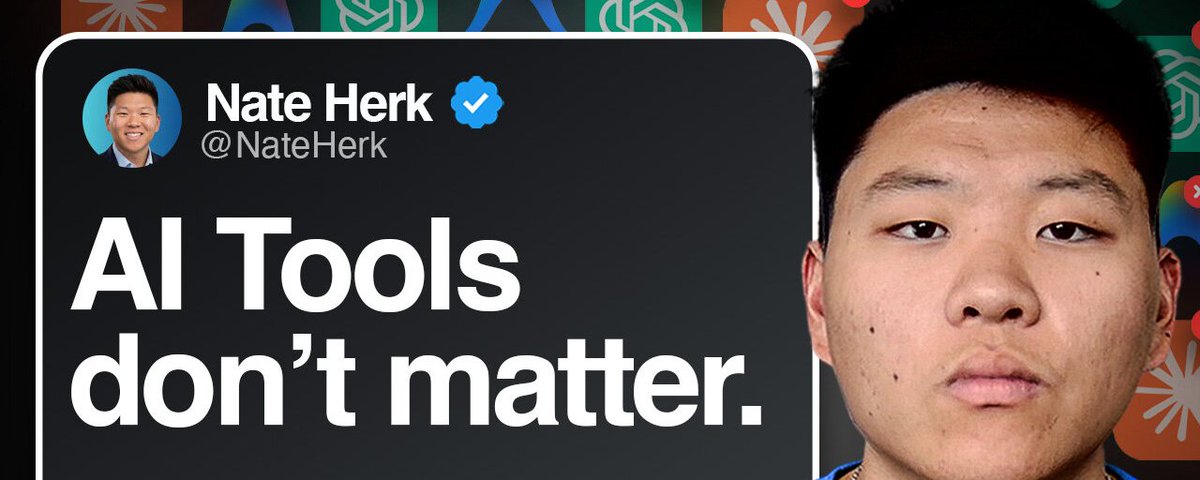
Nate Herk distills 5,000 hours of building with AI into 12 practical lessons, arguing that the real edge isn't about memorizing prompts or mastering a specific tool — it's about turning experience into context, managing AI like an employee, and tying every project to a measurable business outcome. He emphasizes collecting "receipts" (documented before-and-after results) over demo builds, staying tool-agnostic by focusing on transferable skills like problem decomposition and clear communication, and making AI your default starting point even when it only handles 25% of the work.
Several lessons focus on operational discipline for AI agents: building verification loops so agents prove their own work, restricting tool access rather than relying on prompt-level instructions (citing a real incident where an agent emailed 150,000 people unsolicited), and running evals against golden datasets before deploying agents to real customers. On the business strategy side, Herk advises finding the actual constraint — the "clog or leak" in the business pipeline — before building anything, assigning each project a single North Star metric, and routing tasks to the cheapest model capable of handling them to control token costs. The final lesson encourages practitioners to do the work before waiting for a title or permission, automating real tasks and documenting results to build credibility organically.
This article argues that AI agents for entrepreneurs deliver real value only when they automate specific, recurring workflow bottlenecks — not when they're used as glorified chatbots for one-off tasks. The author warns against what he calls "cruel optimism": the belief that adopting the next shiny tool will fix a broken business system. Instead, he proposes a practical scorecard: automate workflows that repeat weekly, create costly delays when ignored, and improve revenue or decision quality when handled faster.
The piece outlines five workflows to automate first: lead triage, follow-up, research, reporting, and decision preparation. Each is chosen because it directly impacts revenue or execution speed in a one-person business. Notably, the author emphasizes that agents should prepare work rather than make decisions — monitoring triggers, summarizing data, drafting options, and surfacing risks while keeping human judgment at the center. He also highlights a growing gap: U.S. Census data shows firms with 20+ employees are integrating AI into operations while smaller businesses remain stuck experimenting with isolated tools.
The article introduces an "AI Delegation Contract" framework for keeping agents safe — specifying narrow scope, limited tool access, approval gates, and clear reporting loops. The core message is that solopreneurs have a structural advantage in adopting AI workflows quickly, but only if they resist the urge to collect agents and instead build disciplined, sequential automation that frees their attention for strategic decisions.

Santiago (@svpino) highlights how knowledge graphs are proving to be a significant advantage for AI Agents, sharing benchmark results that demonstrate their superiority over state-of-the-art methods. The post cites specific accuracy comparisons, including 94.8% versus 93.4% on the Deep Memory Retrieval (DMR) benchmark, along with additional benchmarks showing a notable accuracy gap (71.2% versus an unspecified comparison figure, with the post truncated).
The key takeaway is that integrating knowledge graphs into AI agent architectures can yield measurable performance improvements over conventional retrieval approaches. This is relevant for practitioners working on retrieval-augmented generation (RAG) systems and AI agent design, suggesting that structured knowledge representations may outperform purely vector-based or memory-driven retrieval methods.
Iason Gabriel announces a new piece published in Nature titled "We Need a New Ethics for a World of AI Agents." The paper argues that AI systems are undergoing an "agentic turn," fundamentally shifting from passive tools to active participants in the world. Gabriel contends that this transformation demands a new ethical framework to address the implications of increasingly autonomous AI agents operating in society.
Vercel shares results from integrating AI Agents into their customer support workflow, reporting a 31% reduction in support tickets. The company outlines three key pillars of their approach: an iterative, customer-centric methodology, thorough internal testing, and safe, incremental rollouts.
The post links to a deeper resource detailing how they achieved these results, positioning their experience as a practical case study for organizations looking to deploy AI in customer-facing support roles. The emphasis on gradual, tested deployment reflects a measured approach to AI adoption rather than a wholesale replacement of existing systems.
Atai Barkai announces the launch of Open Bot, an open source Grok Bot designed for real companies and compatible with any agent harness. The project aims to provide a comprehensive AI agent framework with notable features including AI Coworkers, Generative UI, computer use (both remote and local), agent-human handoffs, and full data recording owned by the user.
The emphasis on openness and data ownership sets Open Bot apart, targeting enterprises that want control over their AI agent infrastructure rather than relying on closed, proprietary solutions. The repository is shared publicly, signaling a commitment to community-driven development and transparency in the AI agent tooling space.
Varick Agents founder Vas outlines why most AI implementations in enterprise finance fail and presents a specific methodology for doing it right. He identifies two common but flawed approaches: horizontal assistants like Microsoft Copilot or Claude Cowork, which lead to runaway token spend and agent graveyards, and point solutions from vendors like Ramp, BlackLine, or HighRadius, which don't account for each company's unique exception-handling logic and merely add more software licenses to manage. He cites stark industry numbers — only 7% of finance leaders report high impact from AI (Gartner), and 95% of enterprise Gen-AI pilots deliver no measurable P&L return (MIT NANDA).
The recommended approach is a unified agent layer that sits on top of existing systems like NetSuite, SAP, and Workday, performing work in the background without requiring employees to learn new interfaces. Key implementation principles include embedding engineers with teams to map real workflows (not just documented SOPs), building agents that do work rather than produce dashboards, escalating only when genuine human judgment is needed, and designing for the whole department from day one to avoid siloed agent sprawl. Critically, effective agents are roughly 85% deterministic code and only 15% model calls, which controls token costs and keeps accuracy high.
Vas shares concrete results from client engagements: a month-end close reduced from 12 days to 5, exception handling dropping from 130 hours to 20 per month, and invoice processing times falling from 20 minutes to under 1 minute. He emphasizes that all value should be measured across three buckets — time/cost savings, revenue uplift, and risk reduction — and provides a practical starting framework for CFOs: map real processes deeply, quantify value capture against investment, and prioritize accordingly rather than buying platforms or building internal data science teams.

Gambit Security has uncovered a large-scale financially motivated campaign leveraging autonomous AI agents to attack online retailers. The operation, detailed by Dark Web Intelligence, involves the recovery of a staging server that revealed the use of open-source AI agent harnesses — specifically Hermes, Strix, and Cairn — to deploy credit card skimmers across more than 100 compromised sites, resulting in the theft of over 600,000 payment cards.
This campaign represents a significant escalation in the use of AI-powered tools for cybercrime, as autonomous agents are now being weaponized to automate the deployment and management of web skimming infrastructure at scale. The discovery highlights growing concerns about the misuse of open-source AI frameworks for malicious purposes and underscores the evolving threat landscape facing e-commerce platforms.
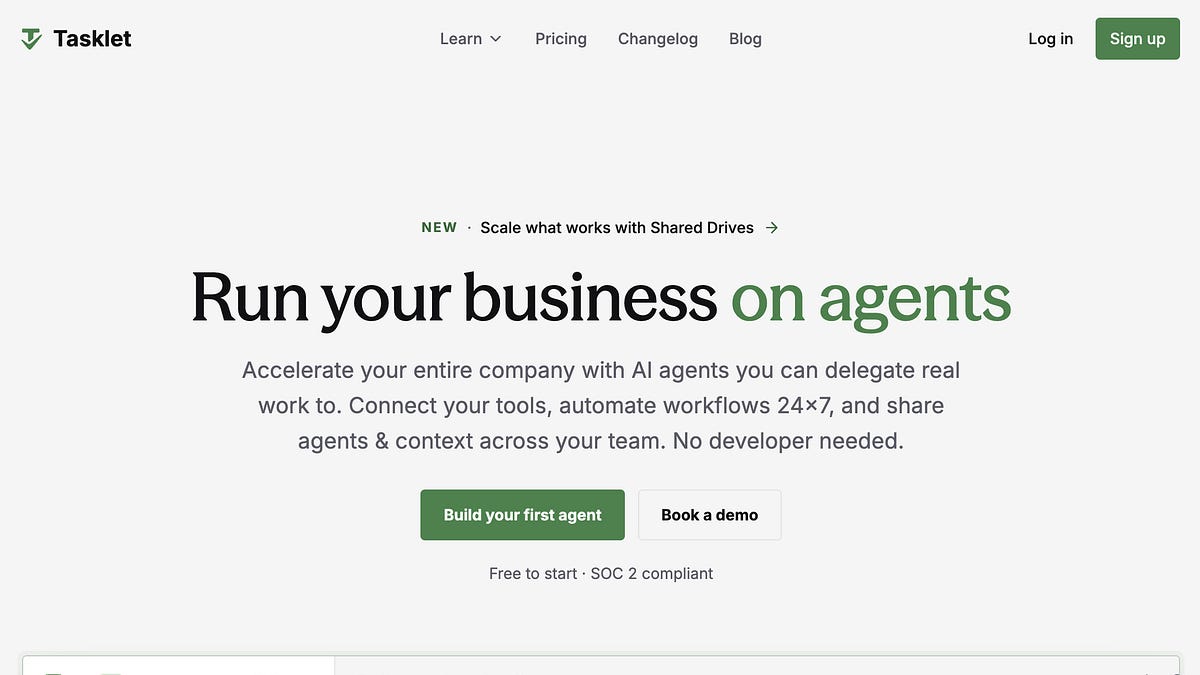
David Sherry explores a question that has puzzled him: how do small, resource-constrained teams actually use AI collaboratively rather than in individual silos? He found his answer through a USV article about Tasklet, a tool whose tagline — "Put agents to work across your company" — resonated with his thinking. He sees small startups and independent teams adopting a mix of tools like Tasklet alongside custom internal tooling to build shared company-level intelligence.
Key takeaways from the article include practical advice on team-wide AI adoption: name agents with human-like names to encourage integration into workflows, add agents to regular communication channels so teams grow comfortable with them, and start with narrow, focused agents that broaden over time. Sherry also mentions Skydive as another interesting app in this space and emphasizes the importance of having an AI Champion — someone who owns and drives AI transformation within the team — to avoid stalling out on adoption.
Aaron Levie, CEO of Box, shares observations from a week of meetings with IT and AI leaders across major enterprise sectors including banking, media, retail, healthcare, consulting, tech, and sports. The focus of these conversations was on agents in the enterprise — the next phase of AI adoption.
Levie signals a key industry shift: enterprises are moving from the chat era of AI to an agentic model, though the full thread of takeaways is truncated in the archived content. The post reflects growing momentum around AI agents as the central topic among large enterprise decision-makers, suggesting this transition is becoming a strategic priority across industries.