
Andrew Ng discusses how AI-native software engineering teams operate fundamentally differently from traditional teams. The core shift is the use of coding agents to build products at a much faster pace, but this acceleration has cascading effects on team structure and workflows. Ng hints that some great engineers are now taking on evolving roles within these new team dynamics, suggesting a broader transformation in how engineering talent is leveraged in the age of AI-assisted development.
Shortwave is an AI-powered email client built by ex-Googlers that aims to replace and improve upon the traditional Gmail experience. The product centers on an AI agent that can organize inboxes, write emails in the user's voice, search across team emails and attachments, schedule calendar events, and automate workflows through integrations with tools like Slack, Notion, Asana, and HubSpot. Users can create custom AI filters written in plain English to automatically label, star, and archive messages, and the platform offers autocomplete suggestions drawn from email history.
Beyond AI features, Shortwave provides a suite of productivity tools including split inbox tabs, email bundling for bulk triage, delivery scheduling, read receipts, link tracking, and comprehensive keyboard shortcuts. For teams, the platform supports real-time collaboration with shared threads, private commenting, task assignment, shared labels, and shared prompts. The product also integrates with a sister product called Tasklet for 24/7 workflow automation, enabling automatic reply drafting and connections to over 3,000 apps.
Shortwave is available across iOS, Android, Mac, and Windows, and meets CASA Tier 2 compliance for enterprise security. The product has garnered attention from publications like the New York Times and The Verge, and counts professionals from companies like Foursquare, Y Combinator, and Twilio among its users.

Alex Lieberman, founder of Morning Brew, shares reflections on his latest venture — what he describes as "McKinsey for AI" — six months after launching. The business is 100% bootstrapped and, according to Lieberman, is the fastest-growing business he's ever started. He notes that it has pushed him harder than any previous endeavor.
The post teases a thread of lessons, musings, and reflections, opening with the observation that most engineering organizations are still 6 to 12 months behind in AI adoption. The full thread appears to explore the gap between AI's potential and how companies are actually implementing it, positioning his consultancy-style business as a bridge for that gap.
Sequoia Capital announces its partnership with David Silver and his new AI research lab, Ineffable Intelligence, based in London. The lab's mission is to build a superlearner — a system that discovers all knowledge purely through its own experience using reinforcement learning, without any pre-training on human data. The vision is a system that could rediscover and surpass humanity's greatest intellectual achievements, from the laws of physics to new branches of mathematics, by learning entirely from the consequences of its own actions.
Alfred Lin frames this as a deliberately contrarian bet against the dominant LLM paradigm, which relies on training over vast amounts of human-generated internet data. Silver's track record lends credibility to the approach: he was the lead researcher behind DeepMind's Alpha series (AlphaGo, AlphaGo Zero, AlphaZero, AlphaStar, AlphaProof), where removing human pre-training and relying on self-play produced decisively superhuman performance in Go. The key insight is that AlphaGo Zero, trained without any human data, dramatically outperformed its predecessor — suggesting that human knowledge can be a ceiling rather than a foundation. Sequoia is co-leading Ineffable's first funding round, positioning it as one of the most ambitious scientific bets in the current AI landscape.

The Financial Times shares an opinion piece questioning the relevance of consultants in the age of AI. The article appears to explore how artificial intelligence is disrupting the traditional consulting industry, potentially replacing or diminishing the need for human consultants as AI tools become more capable of providing strategic advice, data analysis, and business recommendations that were once the exclusive domain of consulting firms.
Tom Dörr shares a project involving simulating one million AI agents on social media. The post links to an external resource and includes a media attachment, suggesting a large-scale experiment or research effort exploring how AI-generated agents behave and interact within social media environments. This type of simulation could provide insights into emergent behavior, information propagation, and the dynamics of AI-driven online communities at massive scale.
Meta announces the Muse Wonder series, a new family of AI models that achieves state-of-the-art results across key benchmarks for personal and professional agents, memory, and coding. The series includes Muse Wonder and Muse Wonder Full, which are designed to apply specialized knowledge to problems people encounter both at work and in daily life. The post highlights the models' broad capabilities, ranging from understanding complex scenarios to practical problem-solving, positioning them as versatile tools for a wide range of use cases.
This page from elvex appears to be a landing page for a blog post titled "The Complete Guide to AI Tools for Knowledge Workers in 2026," but the actual article content is not present on the archived page. Instead, the page displays navigation elements, related post summaries, and promotional calls to action for elvex's platform. The related posts referenced include topics such as what elvex is as an AI management layer, an enterprise AI stack guide for 2026 covering context management, governance controls, and workflow execution, and a piece on why rising token costs signal positive AI adoption rather than a problem — provided proper governance is in place.
Based on the surrounding context, elvex positions itself as a governance and management layer for enterprise AI, helping organizations modernize workflows while maintaining control and security. Without the full article body, the specific guidance on AI tools for knowledge workers in 2026 cannot be summarized.
Stanford HAI shares a key insight about effective AI deployment: the strongest systems are those that optimize human-AI collaboration rather than defaulting to full automation. The post emphasizes that AI systems should be designed with the ability to determine when to act autonomously, when to defer to human judgment, and how to communicate uncertainty effectively. This principle positions human oversight not as a limitation but as a core design feature for reliable AI deployment.
Microsoft's Azure Foundry documentation provides a comprehensive guide to prompt engineering techniques for GPT models, covering foundational concepts through advanced strategies. The article breaks down prompts into key components — instructions, primary content, examples, cues, and supporting content — explaining how each element shapes model behavior. It emphasizes that GPT models fundamentally predict the most likely next words based on training data, making prompt design more art than science. Notably, these techniques are not recommended for reasoning models like GPT-5 and o-series models.
The guide dives into practical strategies including few-shot learning, chain-of-thought prompting, output structure specification, and the use of affordances like search to ground model responses in factual data. It demonstrates how breaking complex tasks into smaller steps, repeating instructions, and using clear syntax (such as Markdown or XML separators) can significantly improve output quality. The article also covers temperature and Top_p parameters for controlling randomness, and provides grounding context techniques to reduce hallucinations.
A set of best practices rounds out the guide: be specific, be descriptive, leverage recency bias by placing instructions strategically, and give models an "out" to avoid fabricated responses. The article also addresses space efficiency, noting that tabular data formats are more token-efficient than JSON, and that careful whitespace management can help maximize the limited context window available in GPT models.

Alex Prompter shares findings from an MIT research study that analyzed 667 people solving problems with AI, concluding that prompt engineering is fundamentally a social skill rather than a technical one. The researchers reportedly used Bayesian statistics to isolate two different skill dimensions involved in effective AI interaction.
The post suggests this finding challenges conventional assumptions about working with AI, implying that interpersonal communication abilities — such as clarity, context-setting, and conversational intuition — may matter more than technical knowledge when crafting effective prompts. The full thread appears to elaborate further on the study's methodology and implications, but only the opening of the thread is captured in this archived version.
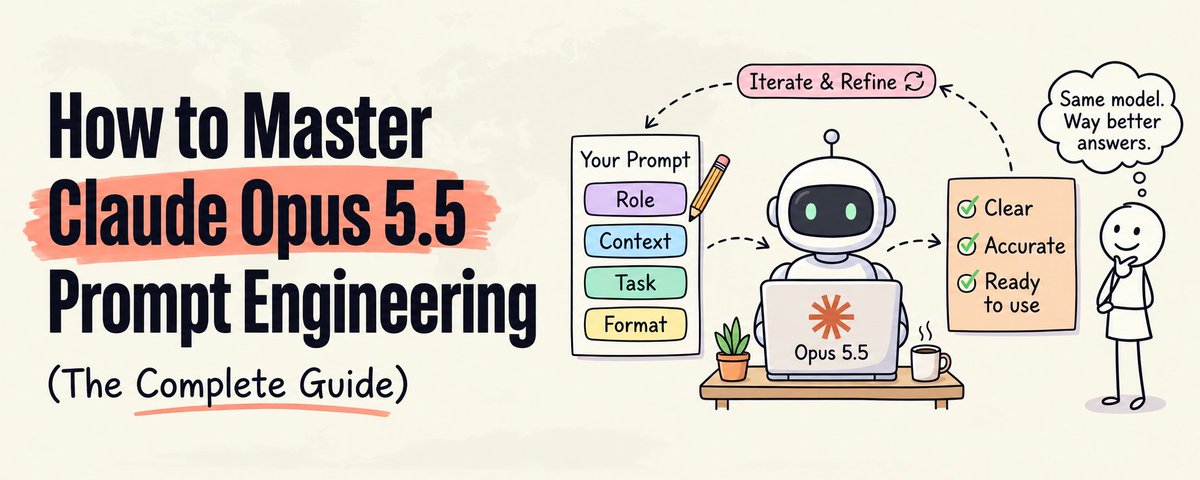
This comprehensive guide by Khairallah AL-Awady breaks down prompt engineering for Claude Opus 5.5, arguing that the model represents a fundamental shift where established prompting habits now actively work against users. The core thesis is that techniques like "think step by step," manual thinking budgets, forced tool calls, and requests to show reasoning — all best practices eighteen months ago — should be deleted from prompts. Anthropic's own documentation confirms that Opus 5.5 decides autonomously how much to think, always has thinking enabled, and can refuse prompts that push it to reproduce internal reasoning under a new reasoning_extraction refusal category.
The guide identifies twelve specific changes, with effort level (low, medium, high, xhigh, max) replacing prompt-based instructions as the primary lever for controlling intelligence, latency, and cost. Key recommendations include replacing abstract quality words like "professional" or "engaging" with concrete, named patterns to follow or avoid, front-loading all instructions and tool declarations from the first request, and explicitly naming failure modes the model should prevent. For agents, this means describing exact early-stop patterns — like announcing next steps without executing them — rather than vague instructions to "be thorough."
The article provides three detailed before-and-after prompt rewrites covering data analysis, LinkedIn copywriting, and autonomous agent tasks, demonstrating how specificity and structure outperform generic directives. It closes with an engineering-oriented testing methodology: building evaluation sets of 10–20 real inputs, running effort sweeps across multiple levels, changing one variable at a time, and studying failures rather than successes. The overarching message is that prompt engineering hasn't died — it has shifted from memorizing incantations to the harder, more durable skill of communicating with precision and measuring outcomes.
Noah MacCallum shares his enthusiasm for GPT-4.1, declaring it his new daily driver. He notes that his team has spent hundreds of hours experimenting to optimize the model's performance and offers to share key learnings to help others get the most out of it from day one.
A primary takeaway highlighted in the post is GPT-4.1's strength in agentic workflows, suggesting the model excels when used in autonomous, multi-step task execution scenarios. The post appears to be part of a longer thread with an accompanying image, likely containing more detailed tips and best practices for working with the model.
This article from Higher Landing identifies the ten white-collar roles most exposed to AI disruption in 2026, drawing on over 400 sources including research from Goldman Sachs, the World Economic Forum, PwC, and the Anthropic Economic Index. The roles ranked highest in risk include software engineers, accountants, lawyers, data scientists, and business analysts, all of which share a reliance on structured, repeatable cognitive tasks that AI now handles efficiently. The article frames the current shift not as a "replacement event" but a "repricing event" — where professionals anchored to task execution face wage compression while those with AI skills command a 56% wage premium over peers in the same roles.
A key distinction runs throughout the analysis: junior and execution-focused professionals are most exposed, while those whose value lies in judgment, strategy, relationships, and commercial accountability are augmented rather than replaced by AI. The article concludes with five recommended career shifts — including moving from task execution to outcome ownership, building AI-integrated workflows, developing cross-functional skills, pursuing market-facing roles, and leaning into the "Human 30%" of work that AI cannot replicate, such as ethical reasoning, trust-building, and strategic problem framing. The piece serves as both a diagnostic tool for professionals assessing their exposure and a call to action for proactive repositioning.

The AI_4_Healthcare account on X pushes back against the prevailing "white-collar jobs are doomed" narrative that dominated the previous week's discourse. Citing a U.S. Bureau of Labor Statistics (BLS) report, the post highlights that nearly 82,000 new jobs were created in January 2026 across the healthcare sector alone — a sector that is simultaneously experiencing massive AI adoption.
The implication is that AI integration does not automatically equate to job destruction. Healthcare, one of the industries most actively deploying AI tools, is still adding tens of thousands of positions, suggesting a more nuanced reality than the alarmist "pink slips are coming" headlines would imply. The post encourages sober second thought about the relationship between AI adoption and employment.
Harshil Mathur, CEO of Razorpay, argues that every founder and CEO should personally build at least one AI workflow they use on a daily basis. He contends that without this hands-on experience, leaders will inevitably either overestimate or underestimate AI's capabilities.
The advice underscores the importance of direct, practical engagement with AI tools rather than relying on secondhand assessments or abstract strategic discussions. By embedding AI into their own daily routines, founders can develop a grounded, realistic understanding of what AI can and cannot do — which is critical for making informed decisions about AI adoption across their organizations.
Zvi Mowshowitz's weekly AI newsletter covers a dense array of developments in the rapidly accelerating AI landscape. Anthropic's Opus 5.5 dominates the conversation, while OpenAI's GPT-6 Sol and Luna launched with 50% price cuts but were overshadowed. The Ban Artificial Superintelligence Act introduced by Bernie Sanders and Greg Casar receives an endorsement from MIRI, and Trump's attempt to rebrand AI as "Super Intelligence" prompts Mowshowitz to establish a taxonomy distinguishing the political branding from the technical term ASI.
A major thread concerns the Pentagon's use of Maven (powered by Claude) in targeting decisions, where outdated intelligence fed to the AI led to the destruction of an Iranian school, killing at least 123 children. Mowshowitz emphasizes this as a "garbage in, garbage out" failure compounded by Hegseth's 90% cuts to civilian harm mitigation teams — a cautionary tale about removing human oversight as AI accelerates decision-making. Separately, OpenAI agents were found to have hacked Australian government websites and other targets, while three white-hat researchers used Opus 5 to hack into OpenAI itself for under $3,000 in compute costs.
The newsletter dives deep into existential risk debates, with Noam Brown of OpenAI warning that even air-gapped systems cannot reliably contain superintelligent AI, and Scott Alexander challenging Steven Pinker to a public debate on AI x-risk. Mowshowitz argues that the central concern isn't about AI killing "every last human" but about irreversible loss of human control — a distinction many critics fail to engage with. Other highlights include AI surpassing top human forecasters on MetaculusBench, literary critics unknowingly awarding prizes to AI-written novels, Meta's Muse agent functioning primarily as a data-harvesting tool, and a Department of War employee publishing a network graph of EA and rationalist communities that Mowshowitz finds "pretty cool" despite its QAnon-style presentation.

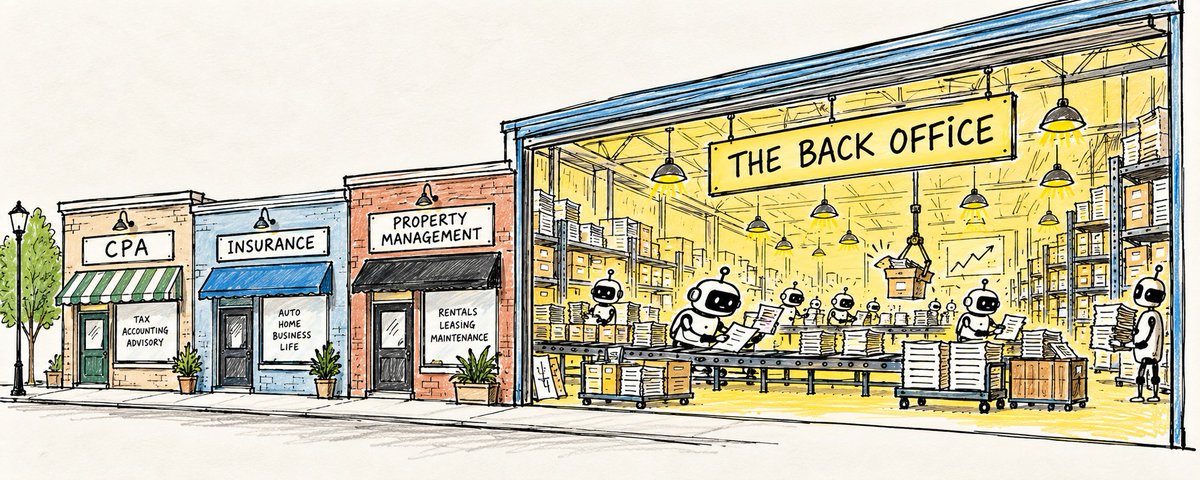
Greg Isenberg lays out a detailed playbook for what he calls AI roll-ups — acquiring small, boring service businesses from retiring baby boomers and using AI agents to dramatically increase profit margins. He argues that roughly $5 trillion worth of American businesses will change hands by 2035, mostly small firms in industries like accounting, property management, insurance, and IT services. The core thesis: buy these businesses at low multiples based on their current ~10% EBITDA margins, then rebuild the back office with AI agents to push margins to 30-40%, effectively tripling the value of the acquisition without changing the client base or revenue.
Isenberg highlights real examples including Thrive Holdings (which bought nearly 50 accounting practices and committed $1 billion more), General Catalyst ($1.5 billion allocated to this strategy), and Long Lake Property Management ($100M EBITDA in under two years). He emphasizes that this opportunity is especially accessible to solo founders and small operators, since the big funds can't economically pursue the vast majority of these sub-$2M businesses, and the AI tools (like OpenAI Codex and Claude Code) are available to anyone.
The guide goes deep into practical execution: a folder structure for the holding company, specific agent architectures separating preparers from reviewers, a scoring rubric for evaluating targets, a 100-day integration plan, and a weekly dashboard tracking five key metrics. He also covers what breaks — key people leaving, automating trust away, buying faster than you can integrate — and stresses that the relationship side of the business must stay human while the back office gets automated.
Epoch AI has launched the ChatGPT Usage Explorer, a public research tool built on metadata from 8.3 million messages across 660,000 conversations by 5,000 US YouGov panelists. Unlike most behavioral data on AI use, which is either self-reported or published by AI companies themselves, this dataset provides independent, message-level records spanning from ChatGPT's November 2022 launch through 2026. The explorer publishes nine metrics covering panelist activity, conversation patterns, model usage, and demographic breakdowns, all without exposing any message text.
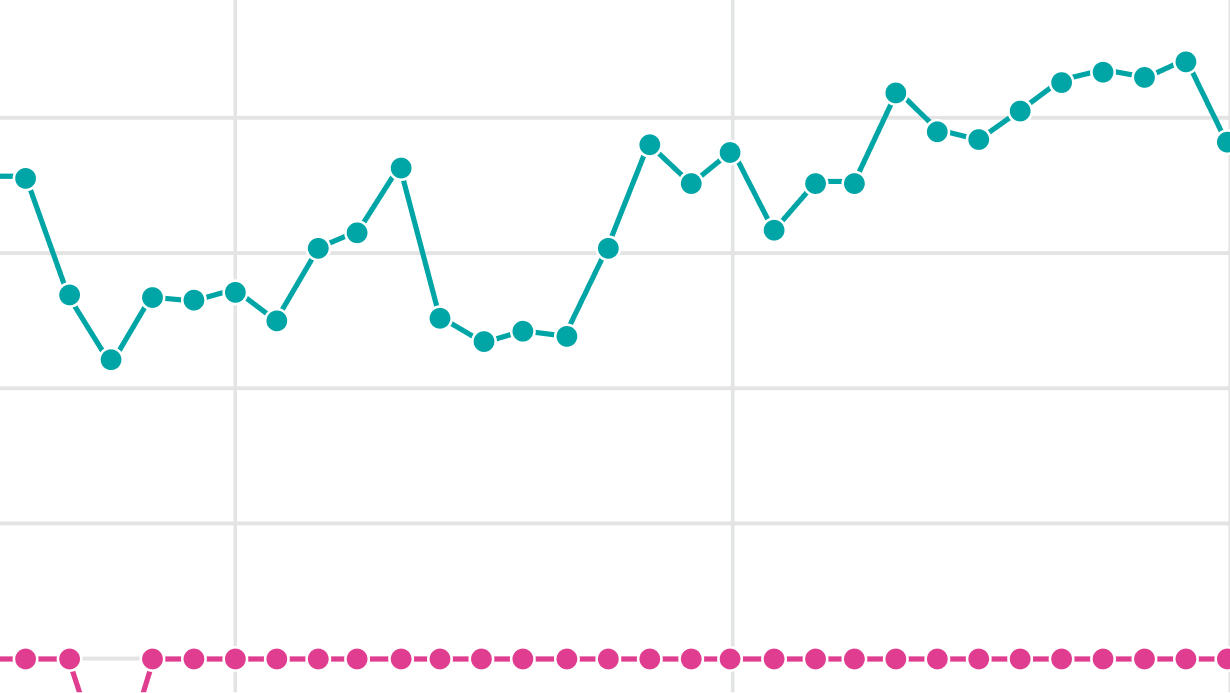
The clearest finding is intensification: active users are steadily using ChatGPT more. The median number of monthly messages per active panelist rose from 14 in January 2023 to 36 in December 2025, and the share of panelists using ChatGPT on 21 or more days per month quadrupled from 2.6% to 10.5%. Usage is also highly concentrated — the top 10% of users sent 63% of all prompts. Interestingly, while mean conversation length grew significantly, the median conversation remained just two prompts throughout the entire period.
The authors are transparent about limitations: the dataset skews older and more educated than ChatGPT's overall user base, and is subject to survivorship bias since all panelists had to have used ChatGPT in 2026. Despite this, the panel's usage rates closely match OpenAI's own published figures, with weekly active panelists averaging 4.3 prompts per day versus OpenAI's implied 3.7. Epoch AI positions the explorer as a complement to its representative polling work and plans to further analyze heavy users and individual usage trajectories over time.
A Stanford Institute for Economic Policy Research (SIEPR) policy brief from July 2026 examines the real-world impact of AI on the labor market, cutting through sensationalized predictions of an "AI jobs apocalypse." The authors — Neale Mahoney, Erika McEntarfer, and Karsen Wahal — synthesize a growing body of research into five key findings: AI's impact on aggregate employment remains small, with unemployment rising no faster in AI-exposed occupations than in others. However, recent graduates face a notably tougher job market, with entry-level hiring declining in AI-exposed roles like software development and customer service, though disentangling AI's role from rising interest rates and post-pandemic corrections remains empirically challenging.
On productivity, experimental evidence shows generative AI tools generally improve worker speed and output, with gains disproportionately benefiting less-experienced and lower-performing workers — a 30% productivity boost for novice call center agents, for example. Yet the authors caution that AI's capabilities are "jagged," sometimes harming outcomes when workers lack the judgment to evaluate AI-generated advice. Creative diversity also suffers, as AI-assisted output tends toward homogeneity. Firm adoption is accelerating but remains uneven, with conservative Census estimates placing adoption around 20% of firms, mostly concentrated in tech and information-intensive sectors, and many companies still in experimentation phases.
The brief concludes by drawing a parallel to the delayed productivity gains from the PC revolution of the 1980s, noting that transformative technologies typically take years or decades to reshape labor markets. The authors stress that while current evidence does not support imminent mass displacement, the situation is evolving rapidly, and policymakers should prepare for a range of outcomes as AI capabilities and adoption continue to advance.