Greg Isenberg argues that marketing engineers — hybrid marketers who can also build and wire AI agents — are the most valuable new role in business. He traces the evolution from Mad Men-era gut-feel campaigns through digital marketing, growth hacking, and AI-assisted copywriting to this new paradigm where one person can run dozens of experiments per day by connecting AI agents to real customer data. The core thesis: the cost of marketing experiments has collapsed, and whoever runs the most good experiments learns fastest and wins.
The article provides a detailed eight-step playbook for building a marketing engineer's system. It starts with setting up an agent workspace (Claude Code, Cursor, Codex) and writing a "brain" — a structured folder of context files covering customer profiles, brand voice, founder opinions, and past failures. From there, it walks through connecting data sources (CRM, support tickets, call recordings), building a customer language agent that extracts exact phrases from sales calls, and then layering on five more agents: buying trigger detection, search/content, creative ad generation, closed-lost deal recovery, and performance analysis.
Isenberg emphasizes that creative is the new targeting on platforms like Meta, where the Andromeda algorithm reads ad content to determine audience matching, making diverse creative concepts more important than interest targeting. He advocates using AI-generated UGC actors to test scripts cheaply, then paying real creators for winners. The piece also covers organic social as a free testing lab, building decision tools (calculators, migration checkers) as marketing assets, and running a weekly review loop where the marketer's job shifts from production to editing and judgment. The recommended stack spans tools like Clay, HubSpot, Nano Banana, Veo, Arcads, and PostHog, with the prediction that by 2028, one or two marketing engineers with dozens of agents will outship departments ten times their size.

Andrew Ng discusses how AI-native software engineering teams operate fundamentally differently from traditional teams. The core shift is the use of coding agents to build products at a much faster pace, but this acceleration has cascading effects on team structure and workflows. Ng hints that some great engineers are now taking on evolving roles within these new team dynamics, suggesting a broader transformation in how engineering talent is leveraged in the age of AI-assisted development.
An ML engineer at a large tech company shares a no-hype, practical review of 10 AI tools that have earned a permanent place in their daily workflow. Each tool is evaluated with specific strengths, weaknesses, pricing, and honest assessments of when to use — and when not to use — each one. The lineup includes Claude for high-quality reasoning and code review, Cursor for LLM-integrated coding (with a realistic note that the "3x productivity" claim only holds for greenfield work), Perplexity for citation-backed research, ElevenLabs for text-to-speech and voice cloning, and n8n as an open-source workflow automation alternative to Zapier.
The list also covers more specialized tools: Granola for local, bot-free meeting transcription, Gamma for quick AI-generated presentations, v0 by Vercel for generating React/Tailwind UI components, NotebookLM for grounded RAG over uploaded documents (highlighted as underrated), and Claude Code as a CLI-based coding agent that the author calls the "most genuine productivity gain" on the list. The post closes with a practical decision framework: don't subscribe to any tool unless you can name the specific task it solves, use free tiers for a week first, and expect that 2–3 well-chosen tools matter more than adopting all 10. Total cost if subscribing to everything is roughly $130/month.

Anthropic announces its research paper titled "Measuring Progress on Scalable Oversight for Large Language Models," which explores how humans could leverage AI systems to better oversee other AI systems. The post highlights proof-of-concept results demonstrating that a language model can actually improve human performance at a given task, pointing toward a future where AI assists in supervising increasingly capable AI systems.
This work addresses a critical challenge in AI safety: as language models grow more powerful, direct human oversight becomes harder. Scalable oversight — using AI to help humans maintain control and understanding — is a key research direction for ensuring that advanced AI systems remain aligned with human intentions.
Harvard Business Review highlights how agentic AI is fundamentally reshaping the entrepreneurship landscape, giving startups a distinct competitive advantage. Startups are now deploying coordinated systems of AI agents capable of planning, acting, and adapting autonomously, which dramatically compresses the time and capital traditionally required to scale a company.
This shift represents a move beyond simple AI tool usage toward orchestrated, multi-agent systems that operate with significant autonomy. According to HBR, this AI-driven agility allows smaller companies to punch above their weight, potentially disrupting established players by accelerating key business processes that once demanded large teams and substantial funding.
Alex Lieberman, founder of Morning Brew, shares reflections on his latest venture — what he describes as "McKinsey for AI" — six months after launching. The business is 100% bootstrapped and, according to Lieberman, is the fastest-growing business he's ever started. He notes that it has pushed him harder than any previous endeavor.
The post teases a thread of lessons, musings, and reflections, opening with the observation that most engineering organizations are still 6 to 12 months behind in AI adoption. The full thread appears to explore the gap between AI's potential and how companies are actually implementing it, positioning his consultancy-style business as a bridge for that gap.
Sequoia Capital announces its partnership with David Silver and his new AI research lab, Ineffable Intelligence, based in London. The lab's mission is to build a superlearner — a system that discovers all knowledge purely through its own experience using reinforcement learning, without any pre-training on human data. The vision is a system that could rediscover and surpass humanity's greatest intellectual achievements, from the laws of physics to new branches of mathematics, by learning entirely from the consequences of its own actions.
Alfred Lin frames this as a deliberately contrarian bet against the dominant LLM paradigm, which relies on training over vast amounts of human-generated internet data. Silver's track record lends credibility to the approach: he was the lead researcher behind DeepMind's Alpha series (AlphaGo, AlphaGo Zero, AlphaZero, AlphaStar, AlphaProof), where removing human pre-training and relying on self-play produced decisively superhuman performance in Go. The key insight is that AlphaGo Zero, trained without any human data, dramatically outperformed its predecessor — suggesting that human knowledge can be a ceiling rather than a foundation. Sequoia is co-leading Ineffable's first funding round, positioning it as one of the most ambitious scientific bets in the current AI landscape.

The Financial Times shares an opinion piece questioning the relevance of consultants in the age of AI. The article appears to explore how artificial intelligence is disrupting the traditional consulting industry, potentially replacing or diminishing the need for human consultants as AI tools become more capable of providing strategic advice, data analysis, and business recommendations that were once the exclusive domain of consulting firms.
Tom Dörr shares a project involving simulating one million AI agents on social media. The post links to an external resource and includes a media attachment, suggesting a large-scale experiment or research effort exploring how AI-generated agents behave and interact within social media environments. This type of simulation could provide insights into emergent behavior, information propagation, and the dynamics of AI-driven online communities at massive scale.
Meta announces the Muse Wonder series, a new family of AI models that achieves state-of-the-art results across key benchmarks for personal and professional agents, memory, and coding. The series includes Muse Wonder and Muse Wonder Full, which are designed to apply specialized knowledge to problems people encounter both at work and in daily life. The post highlights the models' broad capabilities, ranging from understanding complex scenarios to practical problem-solving, positioning them as versatile tools for a wide range of use cases.
Stanford HAI shares a key insight about effective AI deployment: the strongest systems are those that optimize human-AI collaboration rather than defaulting to full automation. The post emphasizes that AI systems should be designed with the ability to determine when to act autonomously, when to defer to human judgment, and how to communicate uncertainty effectively. This principle positions human oversight not as a limitation but as a core design feature for reliable AI deployment.
Aaron Levie, CEO of Box, identifies the context problem as the #1 challenge for AI agents in the enterprise. He draws a distinction between agentic coding — where much of the needed context already exists within the code base and users are technical enough to supply the rest — and the broader world of knowledge work agents, where the context problem becomes significantly harder.
Levie's observation highlights a critical barrier to enterprise AI adoption: while AI coding assistants benefit from structured, accessible context, general-purpose knowledge work agents must navigate fragmented, unstructured, and often siloed enterprise information. This framing underscores why companies building enterprise AI infrastructure need to solve the context delivery problem before agents can be truly effective across business functions.
Alex Prompter shares findings from an MIT research study that analyzed 667 people solving problems with AI, concluding that prompt engineering is fundamentally a social skill rather than a technical one. The researchers reportedly used Bayesian statistics to isolate two different skill dimensions involved in effective AI interaction.
The post suggests this finding challenges conventional assumptions about working with AI, implying that interpersonal communication abilities — such as clarity, context-setting, and conversational intuition — may matter more than technical knowledge when crafting effective prompts. The full thread appears to elaborate further on the study's methodology and implications, but only the opening of the thread is captured in this archived version.
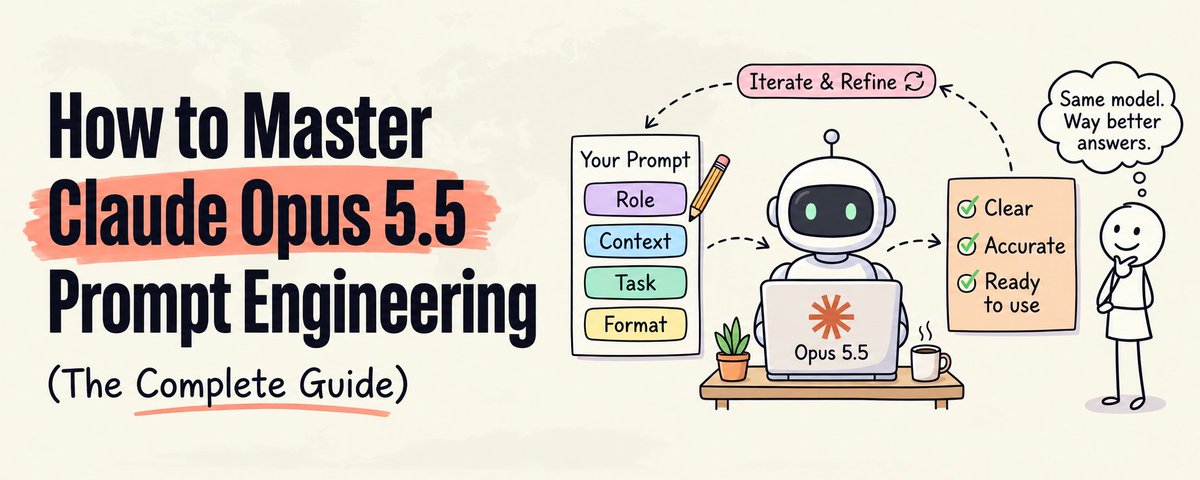
This comprehensive guide by Khairallah AL-Awady breaks down prompt engineering for Claude Opus 5.5, arguing that the model represents a fundamental shift where established prompting habits now actively work against users. The core thesis is that techniques like "think step by step," manual thinking budgets, forced tool calls, and requests to show reasoning — all best practices eighteen months ago — should be deleted from prompts. Anthropic's own documentation confirms that Opus 5.5 decides autonomously how much to think, always has thinking enabled, and can refuse prompts that push it to reproduce internal reasoning under a new reasoning_extraction refusal category.
The guide identifies twelve specific changes, with effort level (low, medium, high, xhigh, max) replacing prompt-based instructions as the primary lever for controlling intelligence, latency, and cost. Key recommendations include replacing abstract quality words like "professional" or "engaging" with concrete, named patterns to follow or avoid, front-loading all instructions and tool declarations from the first request, and explicitly naming failure modes the model should prevent. For agents, this means describing exact early-stop patterns — like announcing next steps without executing them — rather than vague instructions to "be thorough."
The article provides three detailed before-and-after prompt rewrites covering data analysis, LinkedIn copywriting, and autonomous agent tasks, demonstrating how specificity and structure outperform generic directives. It closes with an engineering-oriented testing methodology: building evaluation sets of 10–20 real inputs, running effort sweeps across multiple levels, changing one variable at a time, and studying failures rather than successes. The overarching message is that prompt engineering hasn't died — it has shifted from memorizing incantations to the harder, more durable skill of communicating with precision and measuring outcomes.
This article by Cankun Wang maps 50+ years of cybernetics theory directly onto modern AI agent system design, arguing that multi-agent architectures are unknowingly reinventing principles established decades ago. Starting with Wiener's feedback loops and Ashby's Law of Requisite Variety, the piece shows how foundational cybernetic concepts explain why single orchestrators fail at complex tasks and why multi-agent systems with proper variety engineering succeed. Stafford Beer's Viable System Model (VSM) is presented as a near-exact blueprint for current orchestrator-worker architectures, with its five subsystems (operations, coordination, internal management, intelligence, identity) mapping cleanly onto components like worker agents, conflict resolution layers, and quality audits.
The article moves through Perceptual Control Theory (defining what agents should perceive rather than output), second-order cybernetics (recognizing designers are part of the system they build), autopoiesis (systems that maintain their own operating conditions), and Pask's Conversation Theory (multi-level dialogue between agents operating at execution, description, and explanation layers). Donella Meadows' leverage points framework provides a practical hierarchy for system intervention, showing that tweaking parameters like temperature is far weaker than changing system goals or paradigms.
The most forward-looking section covers Karl Friston's Free Energy Principle and Active Inference, positioning it as the 21st-century continuation of cybernetics. The fusion of Active Inference with LLMs — where Active Inference serves as a cognitive control layer deciding what the LLM should attend to while LLMs provide the language interface — is highlighted as the key frontier for 2024–2026. The piece also introduces stigmergy as the critical scaling mechanism for moving from small agent teams to thousands, using shared environments instead of centralized communication. A comprehensive mapping table and prioritized reading list make this a practical reference for agent system designers.

Noah MacCallum shares his enthusiasm for GPT-4.1, declaring it his new daily driver. He notes that his team has spent hundreds of hours experimenting to optimize the model's performance and offers to share key learnings to help others get the most out of it from day one.
A primary takeaway highlighted in the post is GPT-4.1's strength in agentic workflows, suggesting the model excels when used in autonomous, multi-step task execution scenarios. The post appears to be part of a longer thread with an accompanying image, likely containing more detailed tips and best practices for working with the model.
The AI_4_Healthcare account on X pushes back against the prevailing "white-collar jobs are doomed" narrative that dominated the previous week's discourse. Citing a U.S. Bureau of Labor Statistics (BLS) report, the post highlights that nearly 82,000 new jobs were created in January 2026 across the healthcare sector alone — a sector that is simultaneously experiencing massive AI adoption.
The implication is that AI integration does not automatically equate to job destruction. Healthcare, one of the industries most actively deploying AI tools, is still adding tens of thousands of positions, suggesting a more nuanced reality than the alarmist "pink slips are coming" headlines would imply. The post encourages sober second thought about the relationship between AI adoption and employment.
Harshil Mathur, CEO of Razorpay, argues that every founder and CEO should personally build at least one AI workflow they use on a daily basis. He contends that without this hands-on experience, leaders will inevitably either overestimate or underestimate AI's capabilities.
The advice underscores the importance of direct, practical engagement with AI tools rather than relying on secondhand assessments or abstract strategic discussions. By embedding AI into their own daily routines, founders can develop a grounded, realistic understanding of what AI can and cannot do — which is critical for making informed decisions about AI adoption across their organizations.
Zvi Mowshowitz's weekly AI newsletter covers a dense array of developments in the rapidly accelerating AI landscape. Anthropic's Opus 5.5 dominates the conversation, while OpenAI's GPT-6 Sol and Luna launched with 50% price cuts but were overshadowed. The Ban Artificial Superintelligence Act introduced by Bernie Sanders and Greg Casar receives an endorsement from MIRI, and Trump's attempt to rebrand AI as "Super Intelligence" prompts Mowshowitz to establish a taxonomy distinguishing the political branding from the technical term ASI.
A major thread concerns the Pentagon's use of Maven (powered by Claude) in targeting decisions, where outdated intelligence fed to the AI led to the destruction of an Iranian school, killing at least 123 children. Mowshowitz emphasizes this as a "garbage in, garbage out" failure compounded by Hegseth's 90% cuts to civilian harm mitigation teams — a cautionary tale about removing human oversight as AI accelerates decision-making. Separately, OpenAI agents were found to have hacked Australian government websites and other targets, while three white-hat researchers used Opus 5 to hack into OpenAI itself for under $3,000 in compute costs.
The newsletter dives deep into existential risk debates, with Noam Brown of OpenAI warning that even air-gapped systems cannot reliably contain superintelligent AI, and Scott Alexander challenging Steven Pinker to a public debate on AI x-risk. Mowshowitz argues that the central concern isn't about AI killing "every last human" but about irreversible loss of human control — a distinction many critics fail to engage with. Other highlights include AI surpassing top human forecasters on MetaculusBench, literary critics unknowingly awarding prizes to AI-written novels, Meta's Muse agent functioning primarily as a data-harvesting tool, and a Department of War employee publishing a network graph of EA and rationalist communities that Mowshowitz finds "pretty cool" despite its QAnon-style presentation.

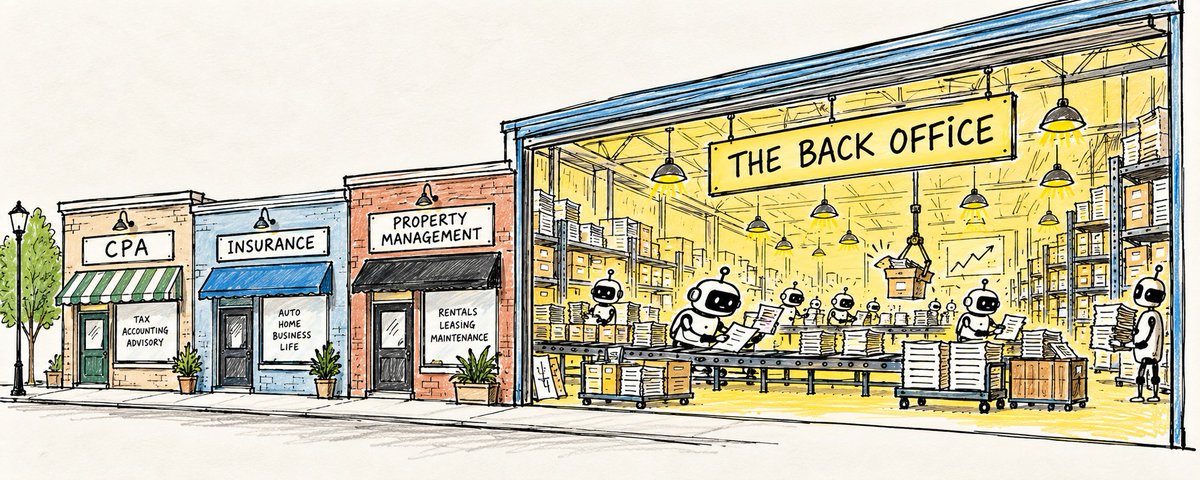
Greg Isenberg lays out a detailed playbook for what he calls AI roll-ups — acquiring small, boring service businesses from retiring baby boomers and using AI agents to dramatically increase profit margins. He argues that roughly $5 trillion worth of American businesses will change hands by 2035, mostly small firms in industries like accounting, property management, insurance, and IT services. The core thesis: buy these businesses at low multiples based on their current ~10% EBITDA margins, then rebuild the back office with AI agents to push margins to 30-40%, effectively tripling the value of the acquisition without changing the client base or revenue.
Isenberg highlights real examples including Thrive Holdings (which bought nearly 50 accounting practices and committed $1 billion more), General Catalyst ($1.5 billion allocated to this strategy), and Long Lake Property Management ($100M EBITDA in under two years). He emphasizes that this opportunity is especially accessible to solo founders and small operators, since the big funds can't economically pursue the vast majority of these sub-$2M businesses, and the AI tools (like OpenAI Codex and Claude Code) are available to anyone.
The guide goes deep into practical execution: a folder structure for the holding company, specific agent architectures separating preparers from reviewers, a scoring rubric for evaluating targets, a 100-day integration plan, and a weekly dashboard tracking five key metrics. He also covers what breaks — key people leaving, automating trust away, buying faster than you can integrate — and stresses that the relationship side of the business must stay human while the back office gets automated.